Hamann Manus · Volume 8
Collecting: Buying, Checking and Sources
The Manus is not rare. Something like 25,000 to 30,000 were made, by my estimate from the serial ranges. It turns up regularly in Germany and the Netherlands, less often elsewhere. The early models are another matter. Blümich’s evidence table of machines seen over the years lists only a handful of A’s and B’s, and the C’s of the first variant, like mine, are the oldest machines most collectors will find. This volume covers where they turn up, what they cost, what to check, and the sources behind this series.
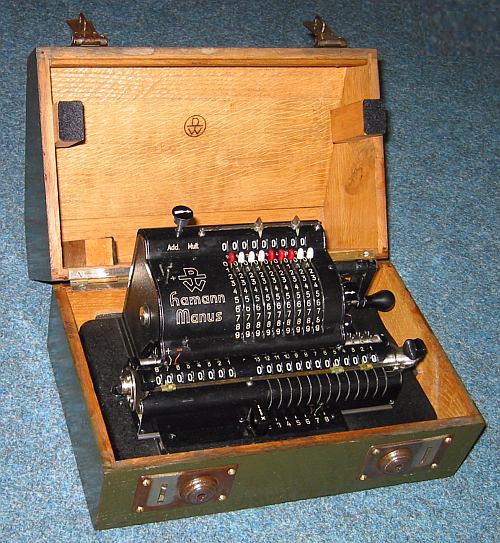
8.1 Where they turn up
- eBay.de and eBay.com. The main market. Most of the serial numbers in Blümich’s evidence table were seen on eBay.
- Kleinanzeigen.de, the German classifieds. A search for “Rechenmaschine Hamann” on 24 October 2026 returned 27 listings.
- Specialist auctions. Auction Team Breker in Cologne holds sales of office antiques, and DAWO and others offer Hamanns from time to time.
- Collectors’ fairs. In Germany, the Berlin-Brandenburg collectors’ meeting is one.
8.2 What they cost
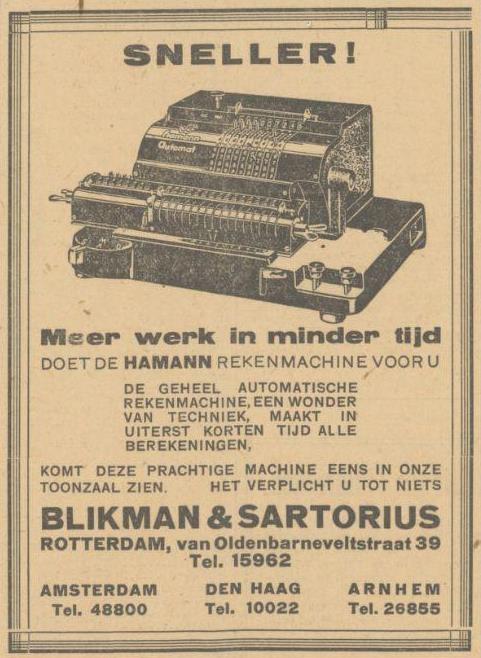
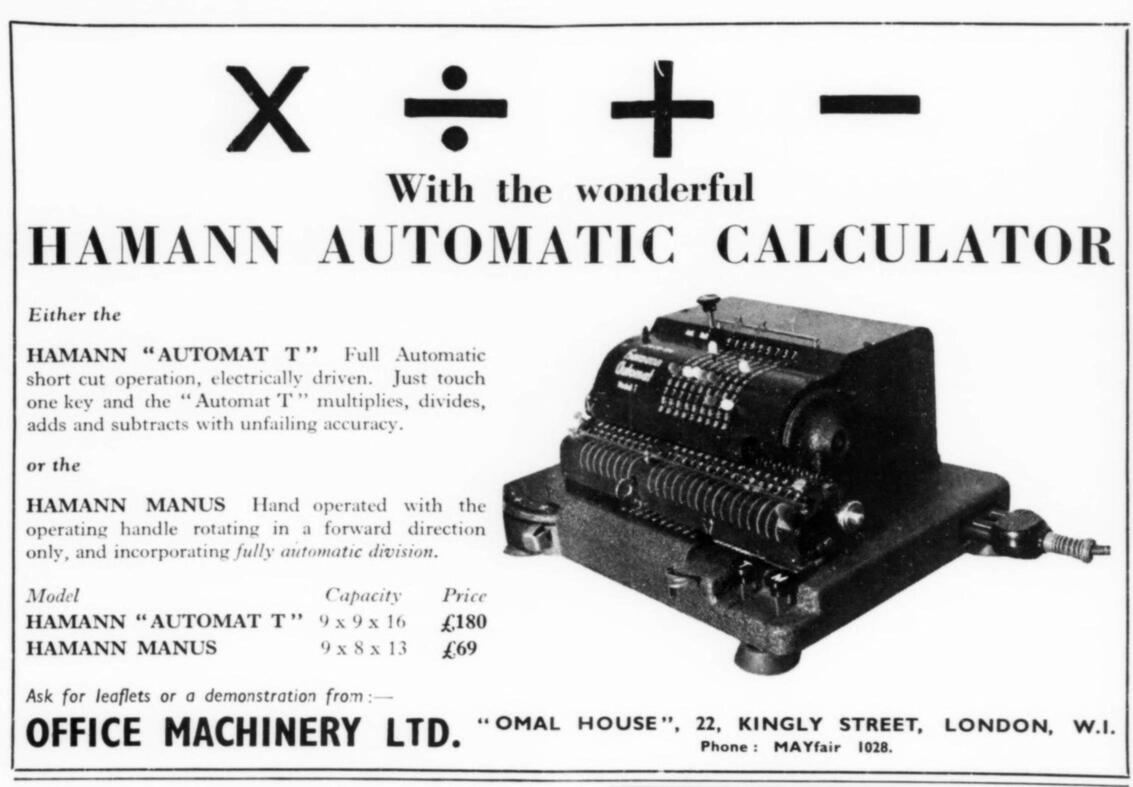
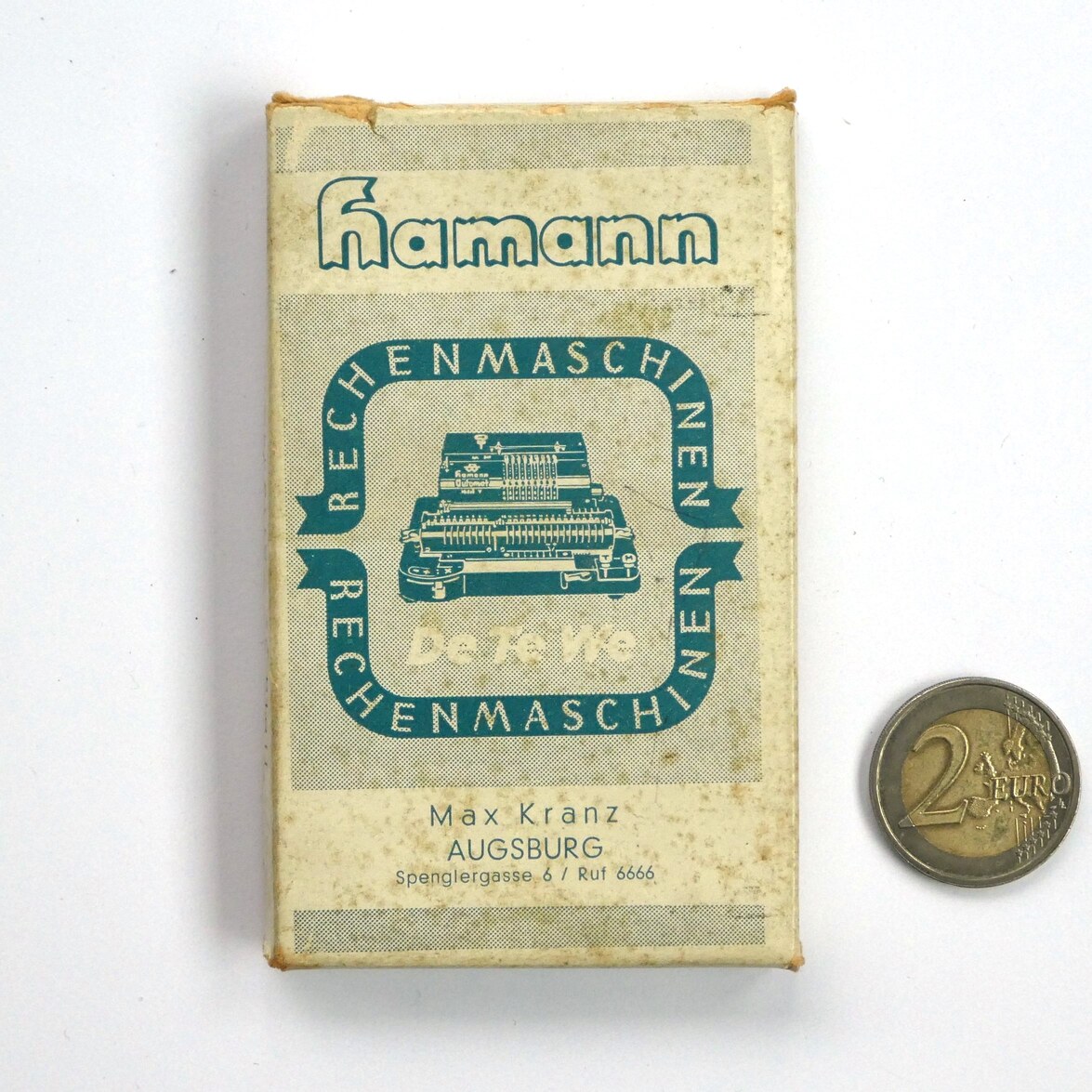
The original prices are documented. Current prices are not well documented: eBay’s sold listings could not be retrieved for this series, so the figures below are asking prices from a single day, not sales.
Table 1 — What they cost
| Price | Status | |
|---|---|---|
| Manus (model D), 1940 | RM 490 net | new, dealer’s advertisement |
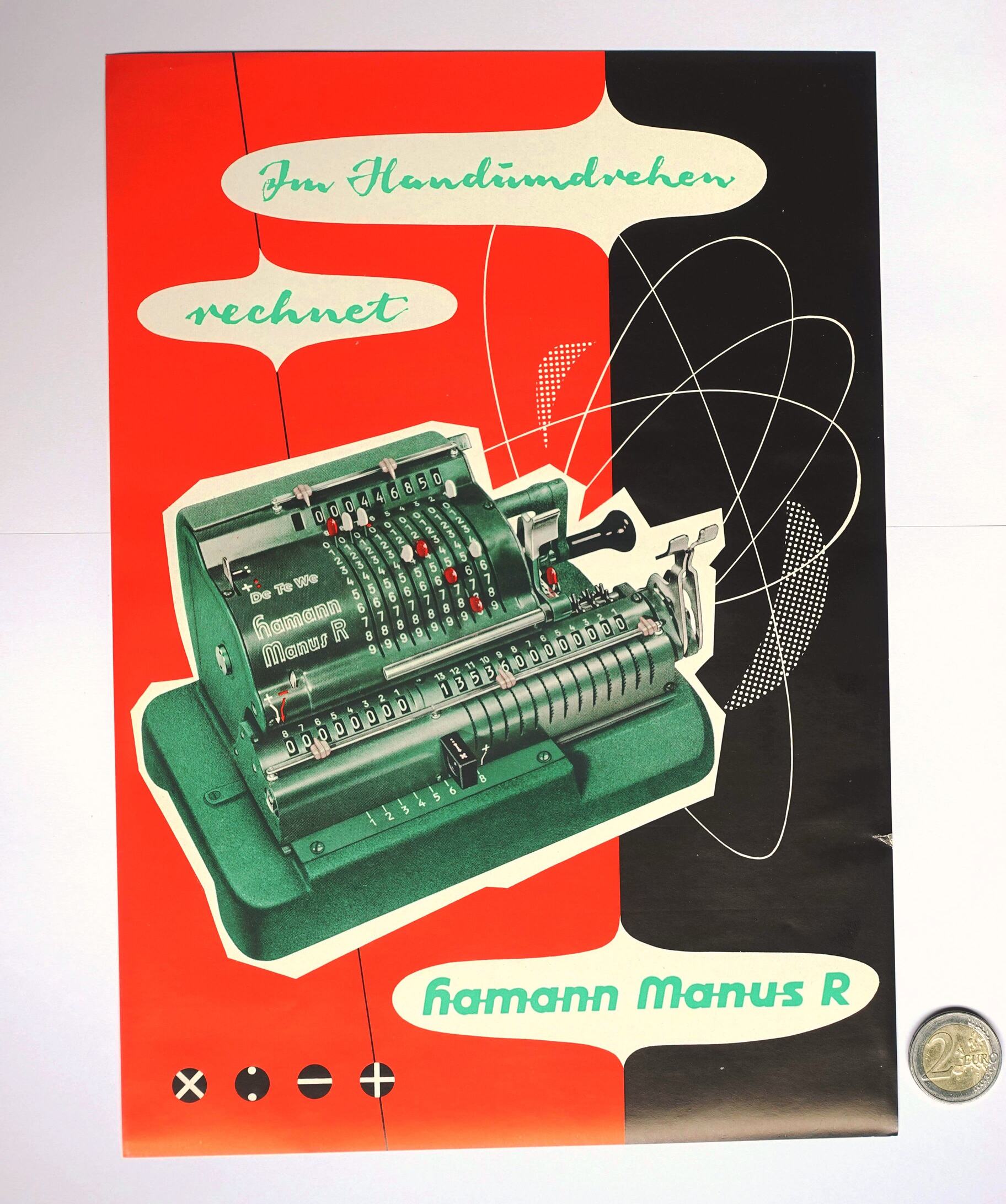
| Manus R, 1956 | DM 665 | new |
| Manus R, 1958 | DM 598 | new |
| Manus R, green | €550 | asking, relisted several times (Kleinanzeigen, Sept–Oct 2026) |
| Manus R | €150 or offer | asking (Kleinanzeigen, Oct 2026) |
| Manus, model unstated | €55–150 | asking (Kleinanzeigen, Oct 2026) |
| Manus “Modell C (1927–1930)“ | €15 or offer | asking (Kleinanzeigen, Sept 2026) |
| Other Hamanns: Elma, 500, 505, Hamann E | €30–170 | asking (Kleinanzeigen, Oct 2026) |
The range says what the market is: a working Manus is a machine of tens to a few hundred euros, not thousands. Completeness, condition and model make the difference. Check sold prices on eBay (“sold items” / Verkaufte Artikel) before buying or selling.
8.2.1 What adds value
- Model. The A (1925–26) and B (1926–27) are scarce. The C is the commonest pre-war model, and its first variant, below serial 6001 with the model letter stamped by the number, is the earliest most collectors will find. Treat any claim of a pre-1937 “model D” with suspicion: the old D was probably a phantom. The R is the most plentiful.
- Completeness: original lever caps (often broken or replaced), the clearing-knob cap, transport-lever caps, the metal dust cover with rear hooks on early C’s, a wooden case, the manual.
- Function, above all automatic division running cleanly all the way to the end.
- Originality. A repainted machine is worth less than an honestly worn one.
8.3 Before buying: a checklist
- The crank pulls out of its holder, turns clockwise smoothly, and snaps back. It does not turn backwards, except with the reverse tab pressed (from model B).
- Every lever, 0 to 9, shows the same figure in its check window and detents firmly. The top knob returns them all to zero.
- Addition and the full carry. Set 111,111,111 and turn once: the result is 111111111 and the counter 1. Then set 999,999,999 plus 1 to test a carry rippling all the way: the result must read 1000000000. Skipped or extra carries point to the drum, as in the repair volume’s fault table.
- Subtraction. Switch to Sub and subtract back to zero, then once more: the register shows 9999999999999 and the bell rings (A, B) or the underflow window shows (C).
- Multiplication. 3,845 × 246 = 945,870 tests the carriage steps and the counter.
- Automatic division. 581,214 ÷ 2,468 = 235.5. The carriage must step unaided all the way and lock the crank at the end. This is the real test.
- Clearing. On a C, at the far left, with both wings and the middle tongue: counter and result must zero cleanly. A sheared clearing axle is a known fault.
- The carriage slides without binding.
- “Crank blocked” (Kurbel blockiert) in a listing. Don’t expect an easy fix unless the price allows for it. A drum stopped off zero also locks the carriage, as the repair volume explains.
- Look for forced or bent levers, missing springs, cracked base castings, and rust on the drum.
8.4 Videos
- The Arithmeum, Bonn: “The ‘Hamann Manus’ calculating machine”, a 3D animation of the mechanism by Xenia Ewert. https://www.youtube.com/watch?v=y1EgDd2aY0E
- Jaap Scherphuis’s demonstrations of the Manus E, Manus F and Delta, on his Hamann page: https://www.jaapsch.net/mechcalc/hamann.htm
Sources
Patents
- C. Hamann / Deutsche Telephonwerke, US 1,788,192, “Computing Machine”, filed 17 Dec 1925, granted 6 Jan 1931. https://patents.google.com/patent/US1788192A/en
- DE 367,726 (filed 1920), DE 384,150 (1923), DE 432,435 (1924), DE 443,479 and DE 468,275 (1926): the switching latch, automatic division and the counter. Via Google Patents and Rechnerlexikon.
- C. Hamann, US 832,666 (the Gauss, 1906); US 1,011,617 and DE 209,817 (the proportional lever, 1909–11).
Manuals
- Handhabung der Hamann Manus Rechenmaschine (DeTeWe, c. 1937–44). https://www.jaapsch.net/mechcalc/pdf/hamannmanus.pdf
- English translation: “Operating the Hamann Manus Calculator”, transl. Knut Faegri Jr. http://www.rechenmaschinen-illustrated.com/Manuals/Hamann%20Manus%20manual_eng.pdf
- Handhabung der Hamann Manus R Rechenmaschine (DeTeWe, 1953). https://www.jaapsch.net/mechcalc/pdf/hammanmanusrmanual.pdf
- Reparaturanleitung Hamann Automat S (Hamann Rechenmaschinen GmbH, c. 1955), the factory repair manual. https://www.jaapsch.net/mechcalc/pdf/hamannautomats.pdf
References
- Ernst Martin, Die Rechenmaschinen und ihre Entwicklungsgeschichte (1925; English edition), the entry “Hamann-Manus (1925)”.
- Wolf-G. Blümich, Entwicklungsstadien der Hamann Manus (2007, rev. 2016). http://www.bluemich.net/rechner/rmhamannmanus.htm
- Rechnerlexikon, “Hamann Manus”, “Hamann Manus R”, “DeTeWe” and related articles. https://www.rechnerlexikon.de/artikel/Hamann_Manus
- Jaap Scherphuis, “Hamann” (models, patents, manuals, photographs). https://www.jaapsch.net/mechcalc/hamann.htm
- Christian Hamann’s pages on the Manus C2, D and R, restorations and “trickies”. https://public.bht-berlin.de/hamann/hamann/manus/index.html
- Peter Haertel, Die Klassifizierung mechanischer Rechenmaschinen, Teil 3: Schaltwerksprinzipien (3rd ed., 2022). https://www.rechnerlexikon.de/upload/0/07/Klassifizierung_Teil_3_09..pdf
- Heinz Nix, “Hamann, Christel”, Neue Deutsche Biographie 7 (1966), p. 573. https://www.deutsche-biographie.de/sfz25675.html
- Detlev Bölter, restoration of a Manus E. http://www.boelter.rechnerlexikon.de/_Hamann/hamann_manus_e.html
- Cris Vande Velde, Manus C2. https://www.crisvandevel.de/hmc.htm
- John Wolff’s Web Museum, “Overhauling mechanical calculators”. https://www.johnwolff.au/calculators/Tech/Overhaul/Overhaul.htm
- vintage-calculators.nl, Manus R and repair notes. https://www.vintage-calculators.nl/page23.html
- The Arithmeum, Bonn. https://www.arithmeum.uni-bonn.de/
Comments (0)