Hamann Manus · Volume 1
My Hamann Manus Model C
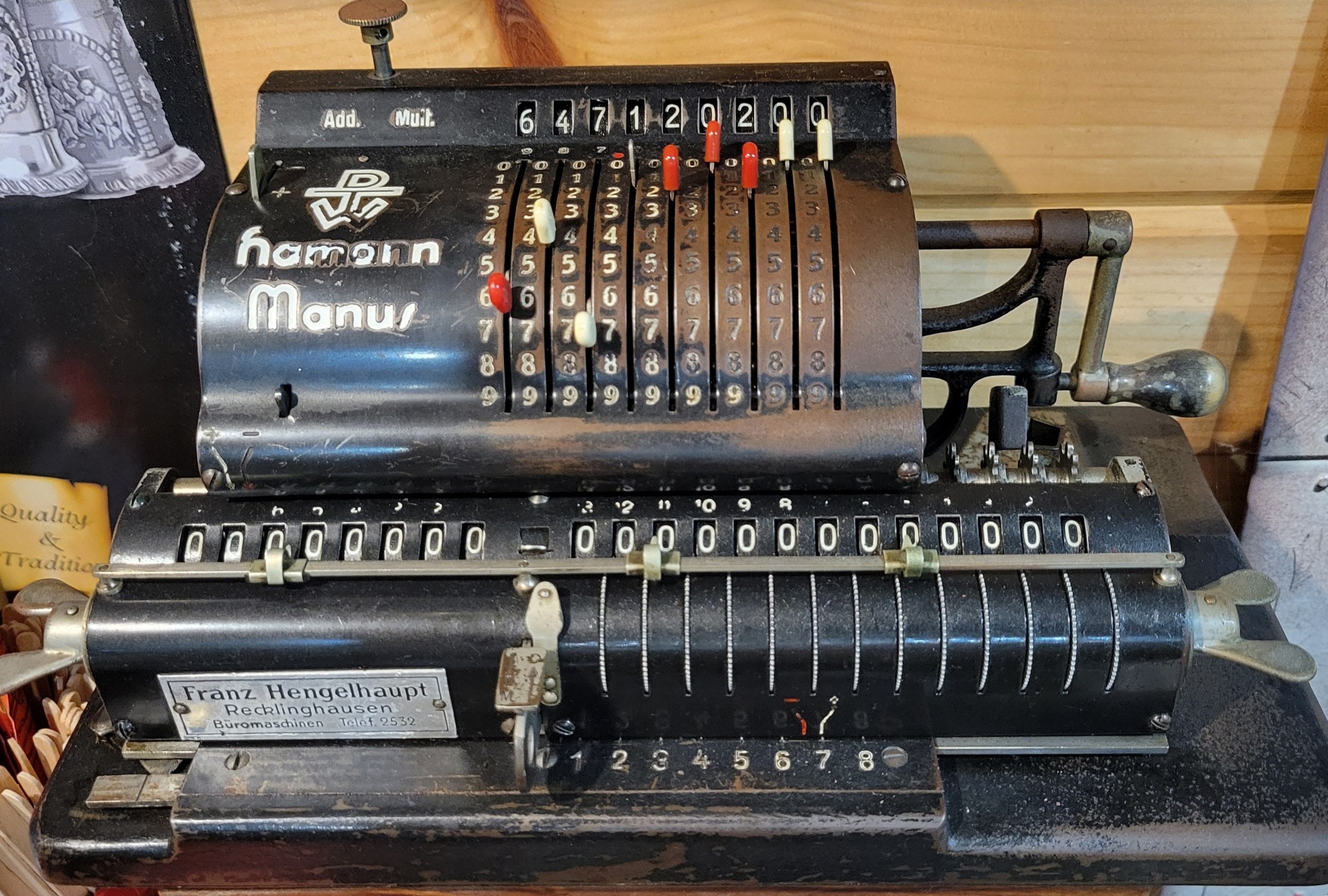
My Hamann Manus is a black, crank-driven calculating machine about the size of a large shoebox, with nine sliding setting levers on a curved front, a crank on the right and a sliding carriage across the bottom. At first sight it looks like any of the pinwheel calculators that filled European offices between the wars, the Brunsvigas, Odhners and Thales machines, and it was meant to. When the Deutsche Telephonwerke of Berlin launched it in 1925, Ernst Martin’s survey of calculating machines noted that its designer had given it “the same exterior design as that of the Odhner machines and also copied its dimensions”, to suit the operators who were used to them. Inside it is something else entirely: Christel Hamann’s own switching-latch mechanism, which no other manufacturer used, and which let a small hand machine do something none of its pinwheel rivals could: divide automatically while the operator simply kept turning the crank.
1.1 What it is, in one paragraph
A Hamann Manus model C, made by the Deutsche Telephonwerke und Kabelindustrie AG (DTW, later DeTeWe) in Berlin, to Christel Hamann’s design, probably between 1927 and 1929. It is a four-function calculating machine: it adds and subtracts directly, multiplies by repeated addition with a shifting carriage, and divides automatically. Numbers are set on nine levers. The result register holds 13 places and the revolutions counter 8, so in the collectors’ notation it is a 9 × 8 × 13 machine. It is driven by a hand crank that always turns the same way, clockwise, for every operation. It weighs about 5.5 kg.
1.2 How I identified it
There is no model plate anywhere on the outside of my machine. The identification comes from three things.
The stamping on the base. When I turned the machine over, the steel frame of the base carried a stamped letter C, and below it a four-digit number. The first digit is worn. It reads most naturally as 1545, though it could be 2545. On the early Manus machines the model letter was stamped next to the machine number, and from about serial 6001 that practice stopped, so a “C” with a four-digit number is just what an early model C should carry.
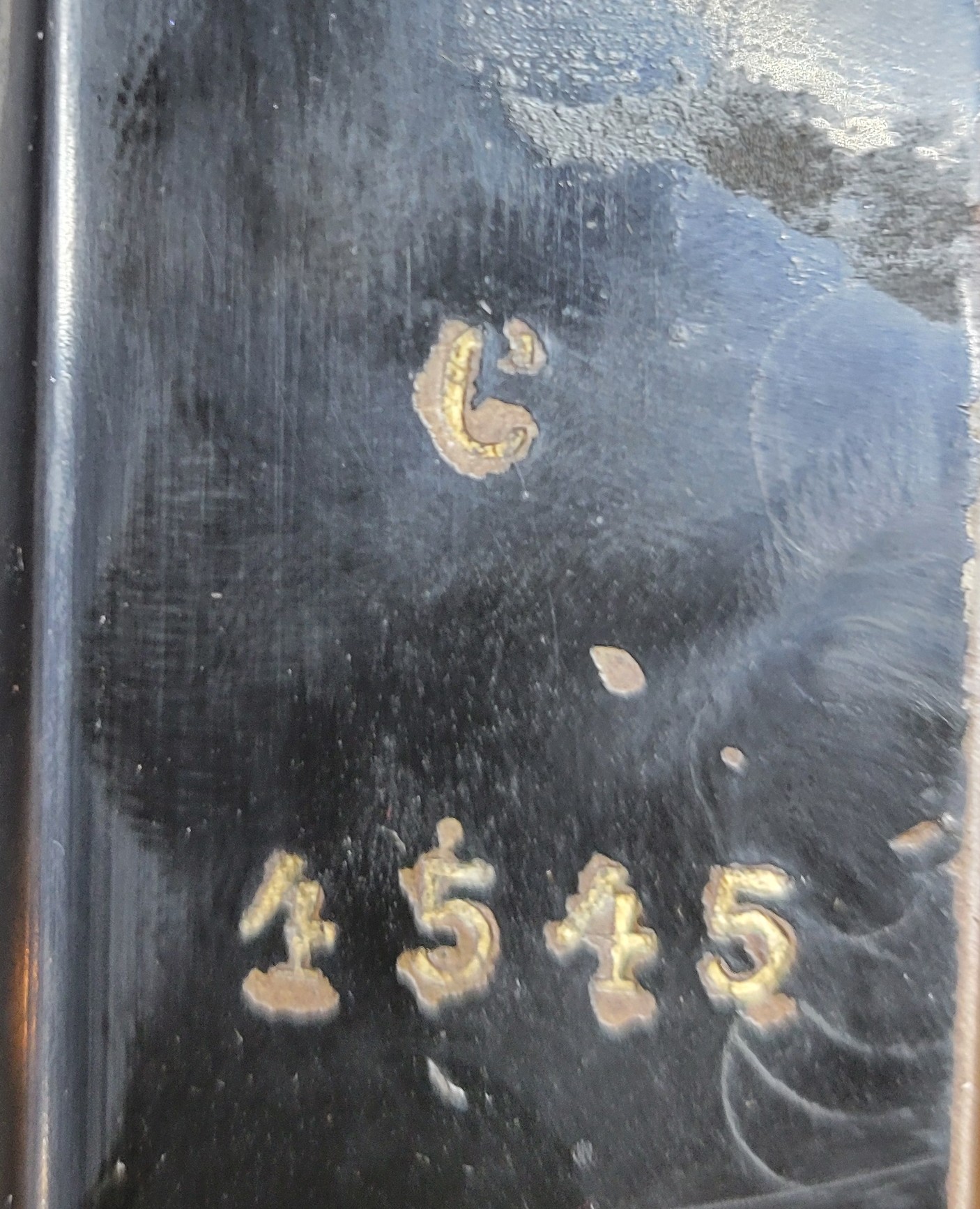
The serial range. Every published list of Manus serial numbers puts machines numbered from about 1501 to 8200 in the model C. A number of 1545 makes mine one of the first C’s built; 2545 would make it a slightly later one. Either way it falls in the early group of C’s with the low, flat base, which collectors call the first variant.
The features. The model C is the last Manus with wing-nut clearing handles at the ends of the carriage. Its successor, the model D of 1937, replaced them with push-down levers. The interlaced DTW monogram on the front is the pre-war badge; post-war machines say “DeTeWe”. On a model C the counter and result register can only be cleared with the carriage moved to its extreme left position, and the carriage has a hook-shaped transport lever at the left. Mine has all of these.
The model identification follows the revised lettering published by the German collectors’ circle in 2011 and used by Wolf-G. Blümich and Jaap Scherphuis. An older scheme, still used by Rechnerlexikon, calls my machine a “C1”. The volume on the models sets out both.
1.3 The dealer’s plate
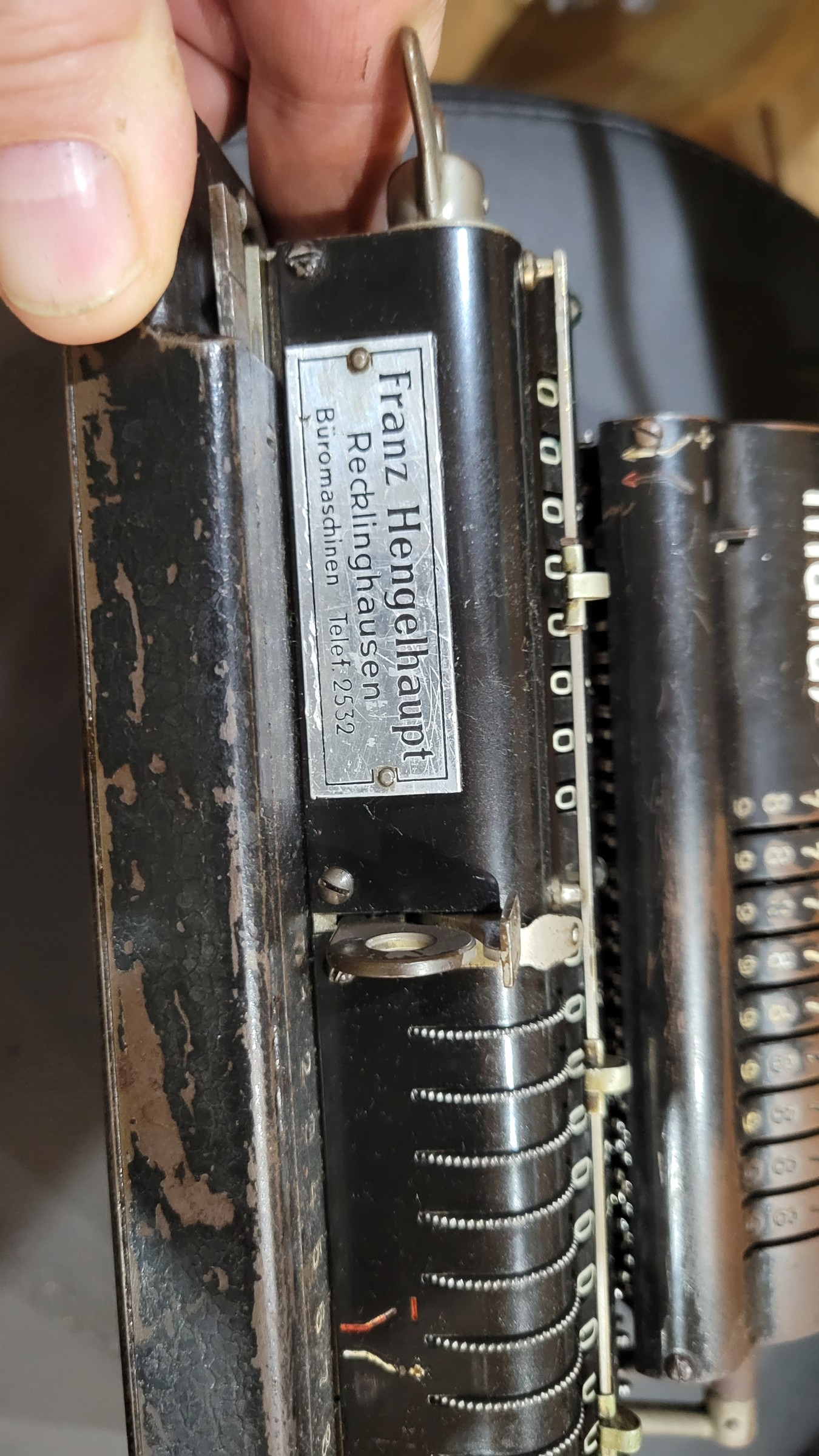
A small nickel plate on the left end of the machine reads:
Franz Hengelhaupt Recklinghausen Büromaschinen · Telef. 2532
Franz Hengelhaupt was an office-machine dealer (Büromaschinen) in Recklinghausen, in the Ruhr, and the plate is his advertisement, fixed to a machine he sold or serviced. I have found no other trace of him. A four-digit telephone number fits a German town of that size from the 1920s to the 1950s, so the plate does not narrow the date, and it may have been added at a later service rather than at the first sale.
1.4 Its condition
The black finish is heavily worn on the base and edges, and the machine shows the scratches of a long working life. It is complete as far as I can tell from the outside: all nine levers with their caps, the crank, the clearing wings, the decimal markers and the knob on top.
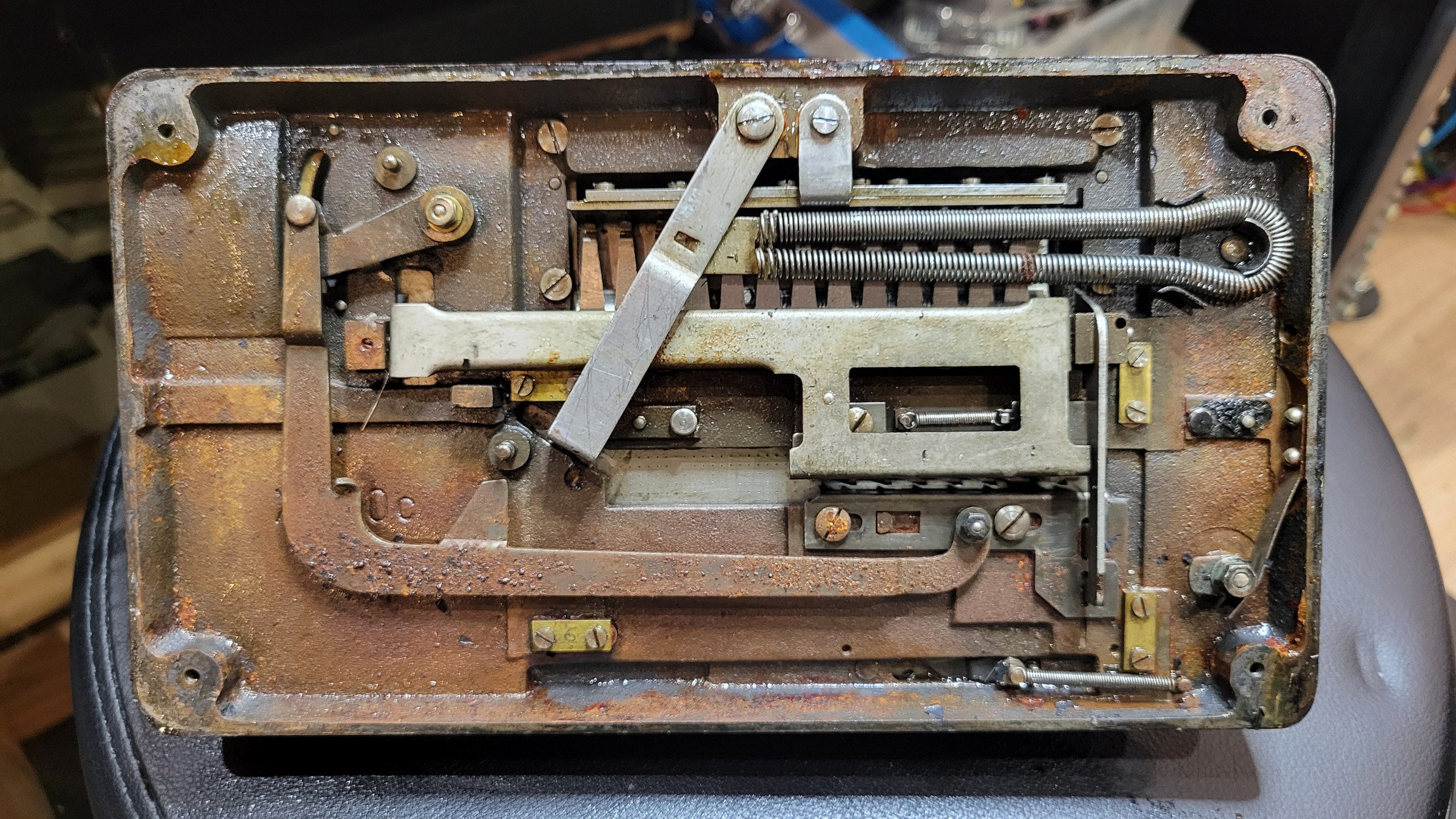
It does not run freely. It tends to jam up, and I believe it needs a thorough cleaning and a careful look over. When I took the bottom pan off to look underneath, which is four screws, a small extension spring fell out, and I do not yet know where it belongs. The volume on care and repair takes up both: what usually makes a Hamann jam, how to clean one without taking out the part that cannot easily be put back, and how to work out where a stray spring came from.
1.5 What this series covers
- Christel Hamann and the road to the Manus follows the inventor from his instrument workshop in Berlin through the Gauss and the Mercedes-Euklid to the Deutsche Telephonwerke and the switching-latch patents of 1920–25.
- The Manus line, model by model sets out every model from the A of 1925 to the R of 1959, with serial ranges, the features that identify each, and how to date a machine. It is where my C sits in the sequence.
- Theory of operation takes the machine apart on paper, using the numbered parts of Hamann’s own US patent: how a lever setting becomes a number of teeth, the tens carry, add and subtract with one crank direction, the counter, the carriage, automatic division, clearing and the safety locks. It has the exploded view.
- Operating the Manus is the factory manual in English, with worked examples I have checked: addition, subtraction and negative results, multiplication and its short cuts, automatic division, square roots and chain work.
- Care, repair and restoration covers the factory’s own warnings and service figures, what collectors have learned the hard way, cleaning and oiling, the classic faults, and my loose spring.
- The type and its relatives explains what makes the switching-latch machine different from the pinwheel, stepped-drum and proportional-lever machines of its day, and places the Manus among Hamann’s other machines and its competitors.
- Collecting covers where they turn up, what they cost new and now, what to check before buying, and the sources.
Comments (0)