Hamann Manus · Volume 5
Operating the Manus
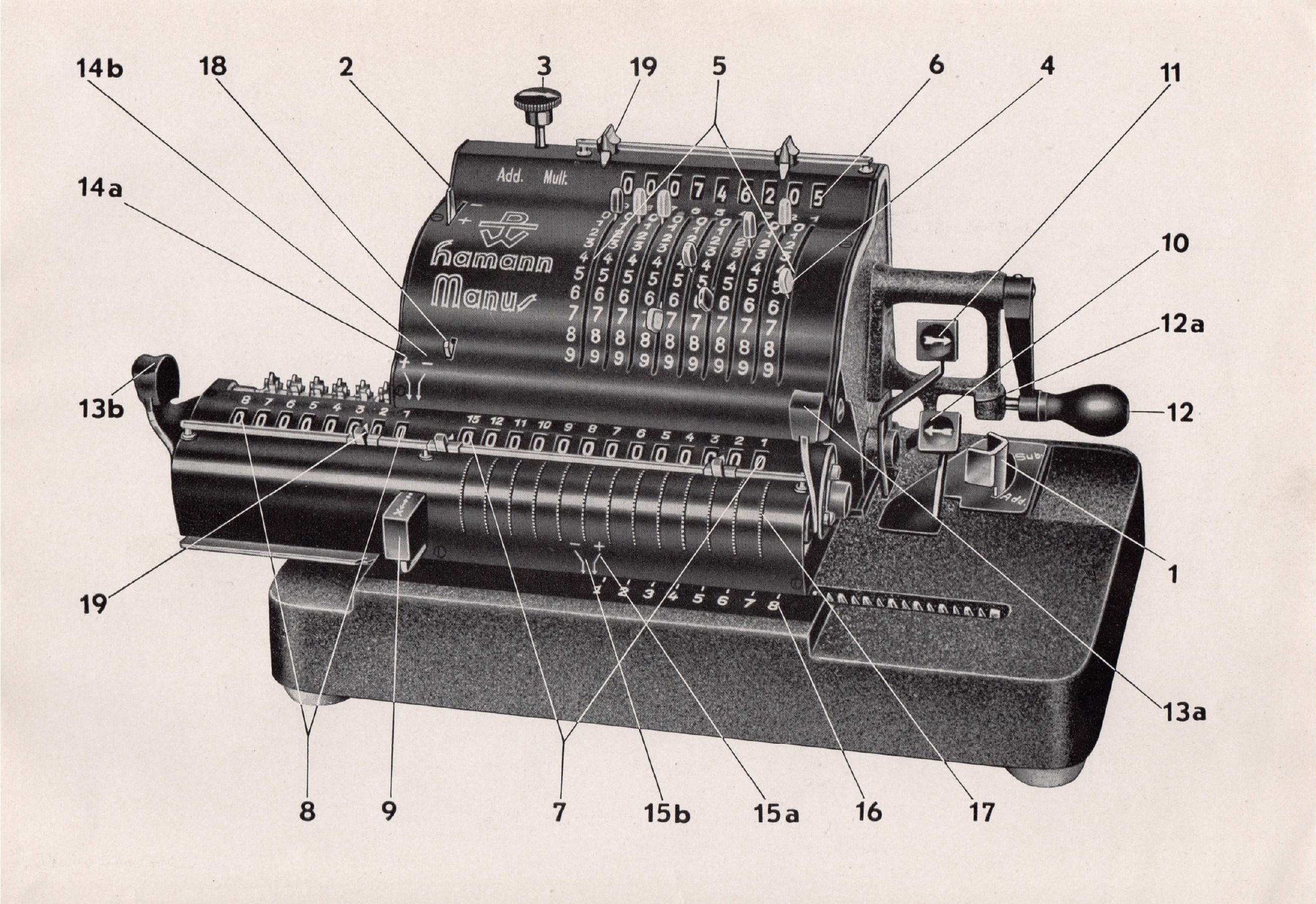
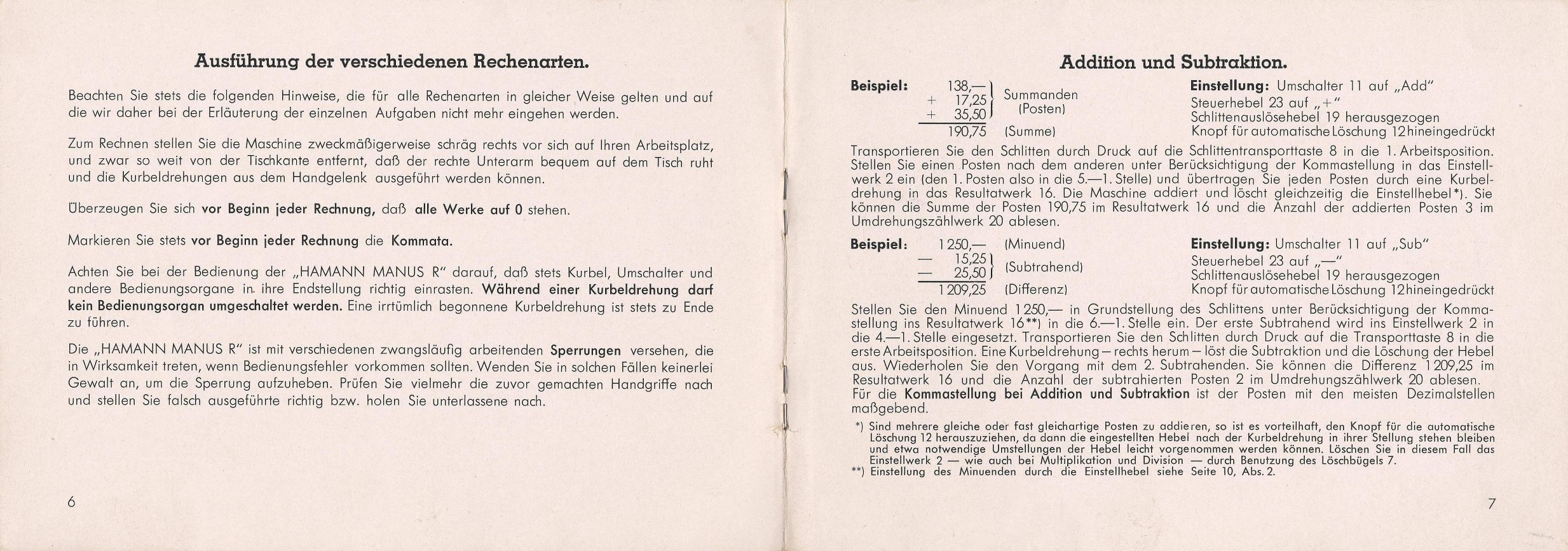
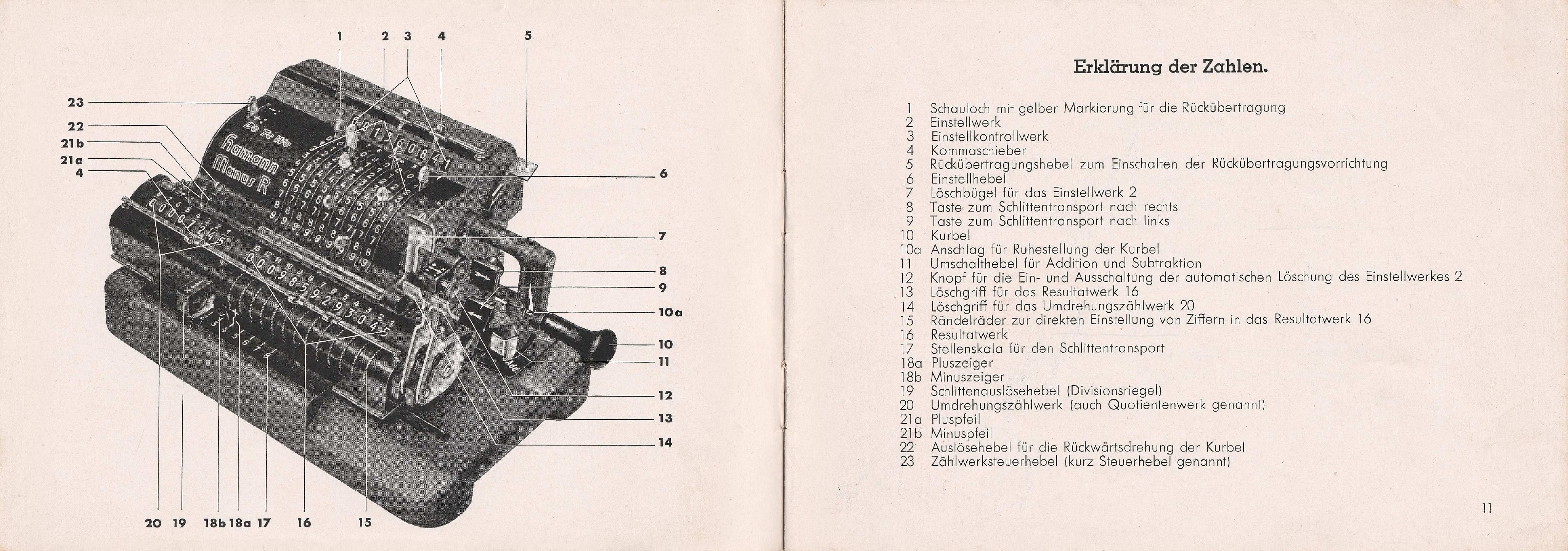
DeTeWe shipped every Manus with a small manual, Handhabung der Hamann Manus Rechenmaschine, “Handling the Hamann Manus calculating machine”. The versions that survive are for the later models: one of about 1937–44 showing a model D, and the 1953 manual for the Manus R. An English translation of the earlier one was made by Knut Faegri Jr. for the collectors’ site rechenmaschinen-illustrated, with Steven L. Carter, Heinz Schneemann and Christian Hamann. This volume follows the factory method, adapted for a model C like mine, and adds the short cuts and special methods that collectors have documented since. I have checked the arithmetic of every worked example.
5.1 The controls on a model C
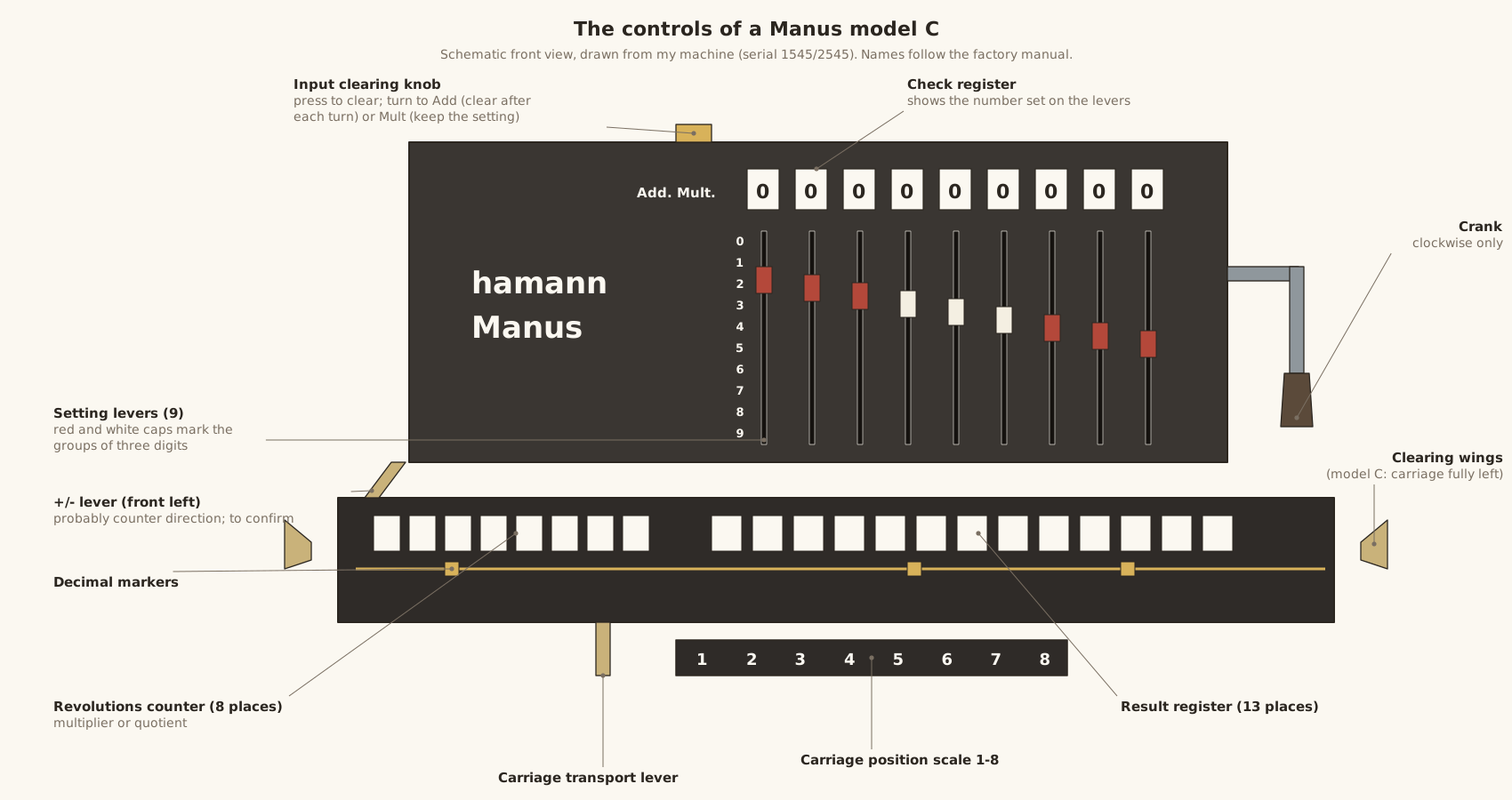
Table 1 — The controls on a model C
| Control | Where on my machine | What it does |
|---|---|---|
| Setting levers | nine slides on the curved front, red and white caps | set the number; the check register above shows it |
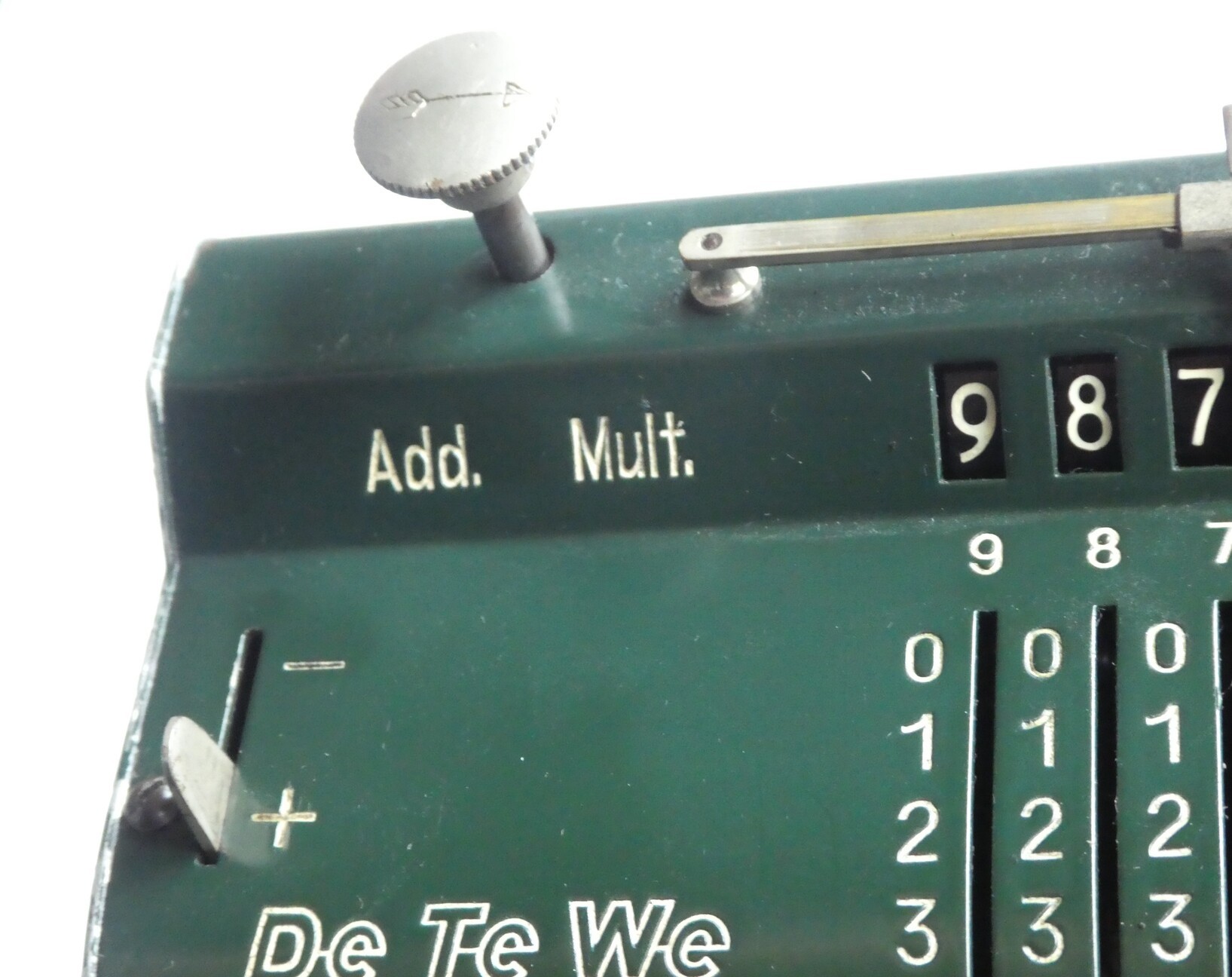
| Input clearing knob | knurled knob on top | press to clear the levers; turn while pressed to Add (levers clear after every turn) or Mult (levers keep their setting) |
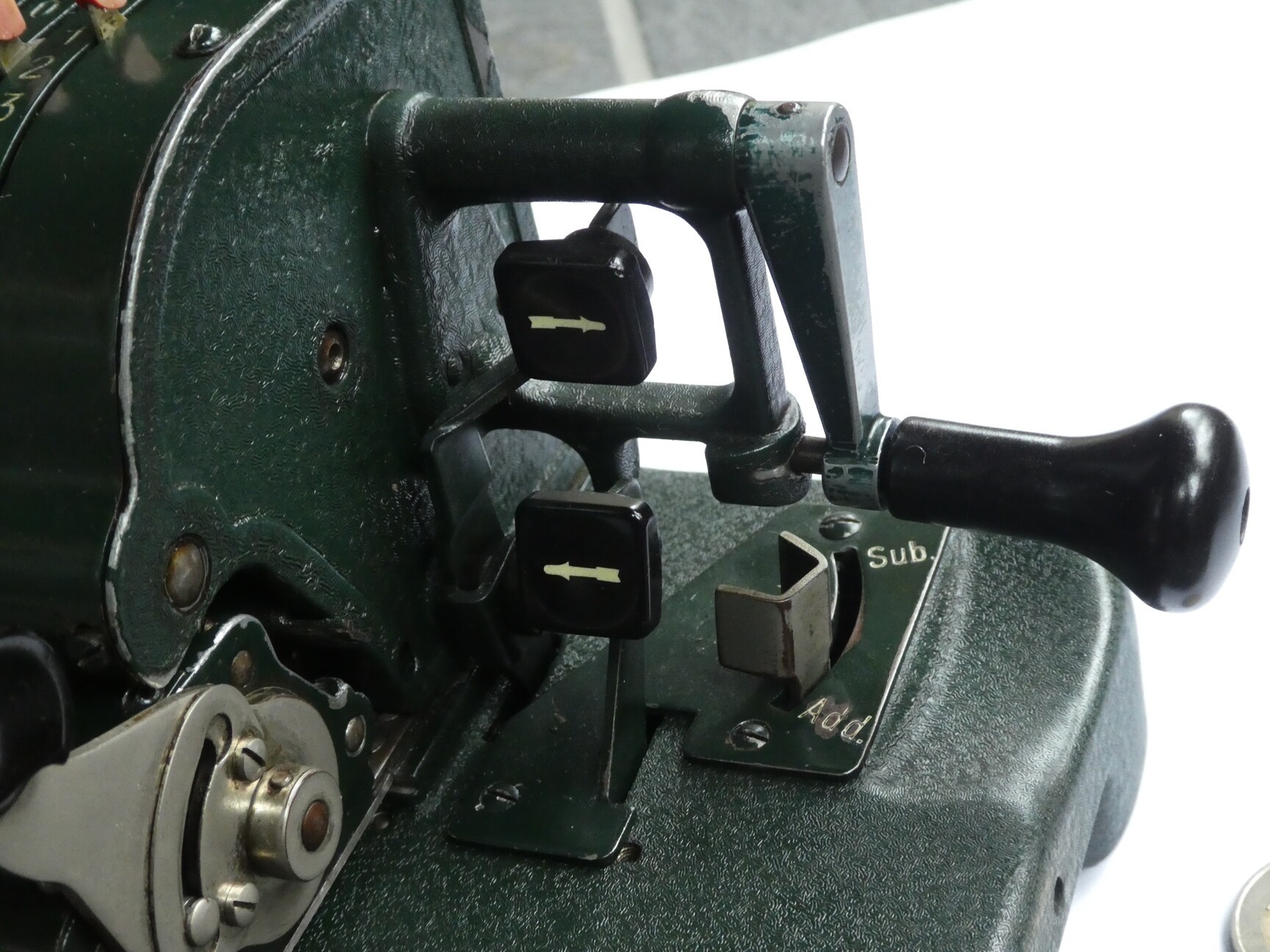
| Add/Sub lever | under the crank | chooses adding or subtracting by moving the carriage half a place |
| Counter lever (+/−) | front left (most likely; to confirm) | ”+”: counter runs with the result register (multiplication); ”−”: against it (division) |
| Carriage transport levers | front of the carriage, plus a hook lever at the left | move the carriage a place at a time |
| Carriage release / division lock | front of the carriage | frees the carriage to move several places; pushed in, it sets automatic division |
| Clearing wings | each end of the carriage | with the carriage fully left: right wing clears counter and result, left wing the counter only |
| Thumbwheels | under the result register | set a number directly into the result register, in the clearing position only |
| Decimal markers | brass riders on the rod above the registers | mark the decimal points |
| Crank | right side | clockwise only; pull it out of its holder to turn, let it snap back after the turn |
The factory names for the controls on the D differ slightly from the C’s. The main difference for a C owner is clearing, which on a C needs the carriage fully left and uses the wings. The factory text covers the D’s push-down levers instead.
5.2 Before every calculation
The manual’s rules, which apply to every model:
- Set the machine on a slight slant, with the right forearm resting on the table, and turn the crank “using the wrist only”.
- Check that every register is at zero before you start.
- Set the decimal markers first. The 1953 manual says it plainly: Markieren Sie stets vor Beginn jeder Rechnung die Kommata, “always mark the decimal points before starting any calculation”.
- Set numbers from left to right, “just as in writing and speaking”, using the thumb as a stop under the figure and pulling the lever with the index finger. The red and white caps mark groups of three digits.
- Never move a control while the crank is turning. A turn begun in error must be finished.
Clearing a model C. Push the carriage all the way left into the clearing position, with the crank at rest. A half turn of the right wing clears the counter and the result register; the left wing clears the counter alone. Then bring the carriage back to position 1 with the front transport lever. Clear the setting levers by pressing the top knob.
5.3 Addition
The factory example: 6.34 + 15.09 + 0.75 + 30.30.
- Add/Sub lever on Add; counter lever on +; input knob turned to Add, so the levers clear themselves after each turn.
- Carriage in position 1.
- Decimal markers between the second and third places in both the levers and the result register. The manual’s rule: “it is always the term with the largest number of decimals that determines the position of the decimal point.”
- Set 6.34 on the three right-hand levers; check it in the window; one turn. Then set 15.09 and turn, then 0.75, then 30.30.
- The result register reads 52.48, and the counter reads 4, the number of items added.
For a run of identical or similar items, turn the knob to Mult so that the setting stays and only the changed digits need re-setting.
5.4 Subtraction and negative results
The factory example: 23,464 − 7,386 − 87.
- Add/Sub lever on Sub; counter lever on −; knob on Add.
- In the clearing position, set 23464 directly into the result register with the thumbwheels. (Alternatively, set it on the levers and add it with one turn in Add, then clear the counter.)
- Bring the carriage to position 1.
- Set 7386; one turn. Set 87; one turn. The result register reads 15,991, the counter 2.
A mistake is corrected by setting the wrong figure again and reversing it with the Add/Sub lever.
Negative results appear as complements. Take 12 from 0, and the 13-place result register shows 9 999 999 999 988, which is 10¹³ − 12. Christian Hamann’s notes give the way to read the true value on a machine without back-transfer: set the complement figures on the levers, make one subtracting turn to bring the register to zero, and a second subtracting turn shows the true amount at the right, ignoring the leading nines. On my model C the small window between the counter and the result register, if fitted, signals the overdraft. On an A or B a bell rings.
5.5 Multiplication
The factory example: 3,845 × 246.
- Add/Sub on Add; counter on +; knob on Mult, so the levers keep the number.
- Set 3845.
- The multiplier has three digits, so move the carriage to position 3.
- Two turns for the hundreds. Hold the crank handle lightly outwards between turns so that it does not drop into its holder.
- Move the carriage one place left to position 2; four turns. Move it to position 1; six turns.
- The counter reads 246, confirming the multiplier, and the result register reads 945,870.
“After short practice,” the manual says, “one no longer visually follows the entering of the multipliers … but just listens to the rhythm of the cranking.”
Decimals: the result has as many decimal places as the levers and the counter together. Set the result marker accordingly before you start.
An extra turn is taken off by switching to Sub, turning once, and switching back.
5.5.1 Short-cut multiplication
Because the Manus subtracts as easily as it adds, a multiplier digit of 7, 8 or 9 is quicker done as “add the next ten, subtract the difference”. This needs a counter with a tens carry, which means a model B or later. My C qualifies. Christian Hamann’s examples:
- 13,974 × 9 = 13,974 × (10 − 1). Position 2, one Add turn; position 1, one Sub turn. Result 125,766; the counter, with the counter lever on ”+”, shows 9.
- 345.67 × 89 = 345.67 × (100 − 10 − 1). Position 3, one Add turn; position 2, one Sub turn; position 1, one Sub turn. Result 30,764.63: three turns instead of seventeen.
With the counter lever on ”+”, the counter counts down on the subtracting turns, so it still shows the true multiplier at the end. My own check of a harder case: 9,999 × 9,998 = 9,999 × (10,000 − 2). One Add turn in position 5, two Sub turns in position 1, result 99,970,002.
5.6 Division: automatic
The Manus’s signature feature. The factory example is 581,214 ÷ 2,468.
- Counter lever on −; knob on Mult; division lock pushed in (the ”:” setting).
- In the clearing position, set the dividend 581214 into the six left-hand places of the result register (places 13–8) with the thumbwheels. Decimal marker between places 7 and 8.
- Set the divisor 2468 on levers 6–3, “to the right of the red dot on the cover”, the manual says of the model it describes. Marker behind lever 3.
- The quotient has as many decimals as the result register has to the right of its marker, less those of the levers: 7 − 2 = 5. Set the counter marker between places 5 and 6.
- Move the carriage fully to the right and crank “with an even motion until the carriage reaches its base position or a sufficient number of digits of the quotient has been calculated.”
- The counter reads 235.50000; the remainder in the result register is 0. And 2,468 × 235.5 = 581,214.
The machine does the rest: it subtracts until it overdraws, adds back once, steps half a place, and repeats. The theory volume shows the sequence turn by turn. For this example it takes 31 turns. A place whose quotient digit is 0 still costs two turns, one to overdraw and one to restore.
Two notes from the manual: a divisor of more than six digits needs the carriage started correspondingly fewer places to the right; and a dividend added in through the levers, instead of set with the thumbwheels, leaves a stray 1 or 9 in the counter that must be cleared before dividing.
A second example, 22 ÷ 7, from Christian Hamann: with 22 in the two left-hand result places and 7 on the levers under the units, the quotient builds up as 3.1428571, remainder 3.
5.7 Square roots: Töpler’s method
The sum of the first n odd numbers is n²: 1 + 3 + 5 + … + (2n − 1) = n². On a calculating machine this gives a square root without division, by subtracting, or here adding, successive odd numbers place by place. Christian Hamann works √3029.4:
- Split the radicand into pairs from the decimal point: 30 | 29 . 40 | 00 | 00. That gives five root digits, two before the point.
- Carriage in position 5. Add the odd numbers 1, 3, 5, 7, 9 on lever 5, one turn each, until the next would overshoot. The register shows 2500 (= 50²) and the counter 5.
- Raise the last odd number by one (9 becomes 10), so the levers hold twice the root so far, and move to position 4. Add 1, 3, 5, 7, 9 again: 3025 (= 55²).
- Position 3: the next step would overshoot 3029.4, so skip it.
- Position 2: add 1, 3, 5: 3028.3009 (= 55.03²).
- Position 1: continue up to 3029.291521 (= 55.039²); one more step gives 3029.4016 (= 55.04²), the closer value.
- The counter shows the root: 55.04.
5.8 Chain calculations without back-transfer
Models A to F have no back-transfer: the only way to use a result as the next number is to set it on the levers by hand. Christian Hamann’s tips:
- Continued multiplication, 123 × 45 × 67. Work 123 × 45 = 5,535. Set 5535 on the levers and make one subtracting turn: the result register goes to zero, which proves that you set it correctly. Clear the counter and multiply by 67: 370,845.
- Sum of products, 123 × 45 + 67 × 89. Do not clear the result register between the products: 11,498.
- A cube, 327³. Keep 327 on the levers and build up the counter digit by digit to its square, 106,929, while the result register accumulates 34,965,783.
- Discount and net in one operation. Set 3 at the far left and 97 at the far right of the levers and multiply by the price, 7,683: the result register shows the 3 % discount, 230.49, at the left and the net, 7,452.51, at the right.
The Manus R of 1953 added the device that removes the hand re-setting: back-transfer carries the result into the levers with one press of a lever.

Comments (0)