Hamann Manus · Volume 2
Christel Hamann and the Road to the Manus
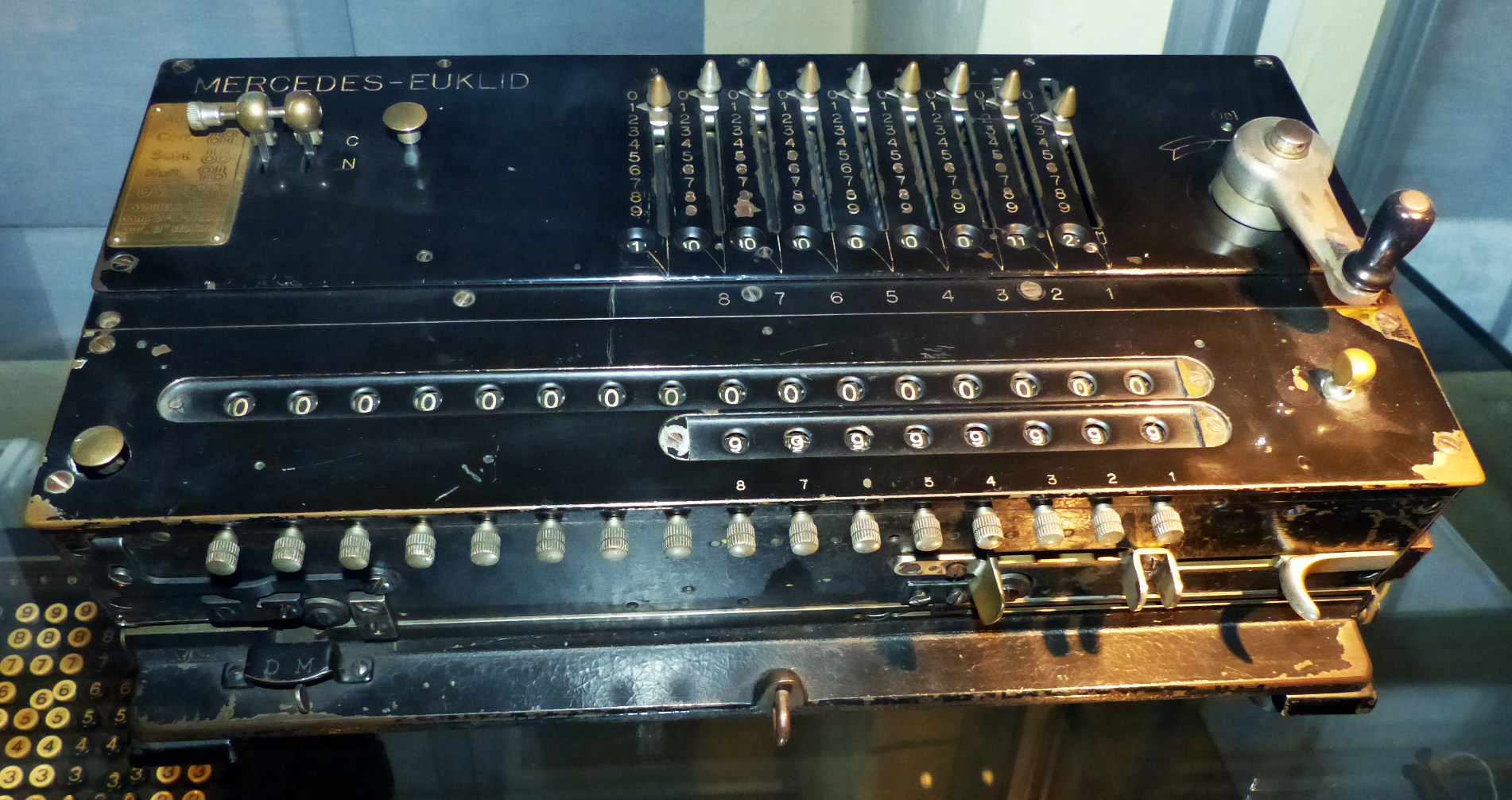
Few designers of calculating machines invented more than one way of making them work. Christel Hamann invented at least two that became standard terms in the collectors’ classification: the proportional lever of the Mercedes-Euklid, and the switching latch of the Manus. Between them his machines span forty years of German calculator making, from a round brass Gauss of about 1905 to the electric keyboard machines DeTeWe was still selling in the 1950s. Peter Haertel’s classification of calculating-machine mechanisms names him as the inventor of the switching-latch principle. The Neue Deutsche Biographie credits him with making automatic division possible on a hand machine.
2.1 The instrument maker
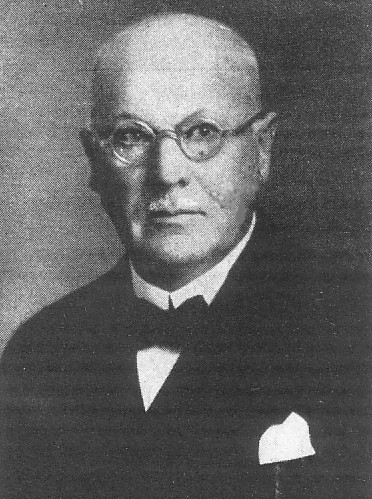
Christel Bernhard Julius Hamann was born on 27 February 1870 in Hammelwarden, in the Grand Duchy of Oldenburg, the son of a minor border official and a fisherman’s daughter. He trained as a mechanic at the Nautical Institute and the Technikum in Bremerhaven, and worked for three of the leading German instrument makers: A. Ott in Kempten, makers of planimeters and integrators; Carl Zeiss in Jena; and Carl Bamberg in Berlin, makers of survey and astronomical instruments.
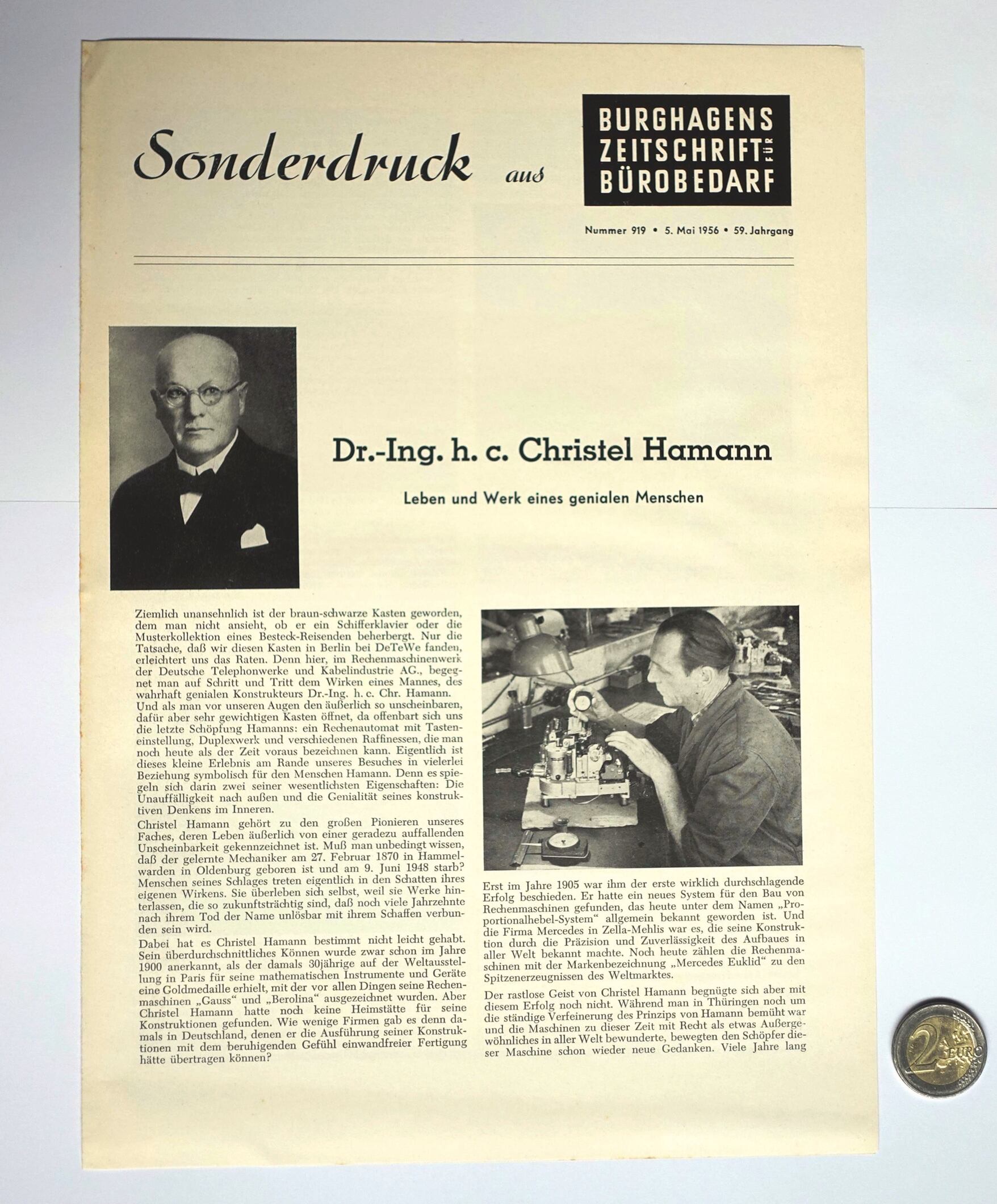
In 1896 he set up his own Mathematisch-Mechanisches Institut in Berlin-Friedenau, making geodetic and mathematical instruments, theodolites among them, and a planimeter under his own patent (DE 88,223). His instruments won a gold medal at the Paris Exposition of 1900. He married Hedwig Schindler (1872–1949); they had no children. The Technische Hochschule Berlin gave him an honorary doctorate of engineering in 1933. He died in Berlin on 9 June 1948. (Jaap Scherphuis gives 1946. The Neue Deutsche Biographie and most other sources give 1948.)
2.2 The Gauss: a calculator in the round
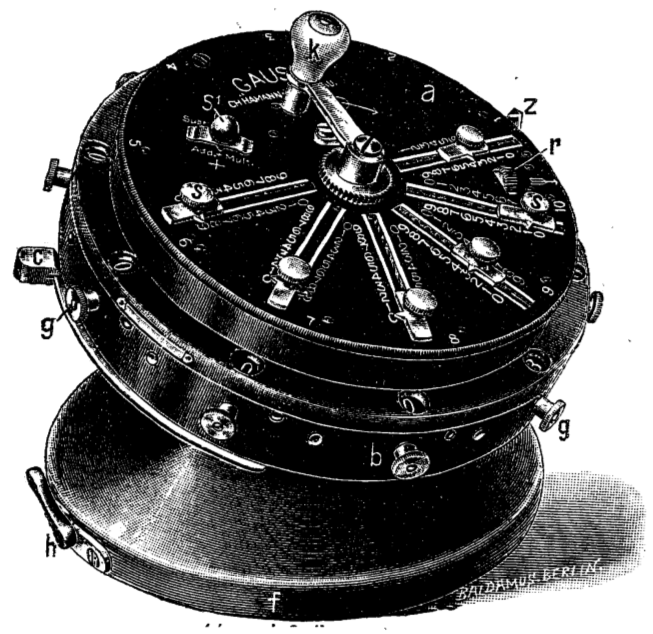
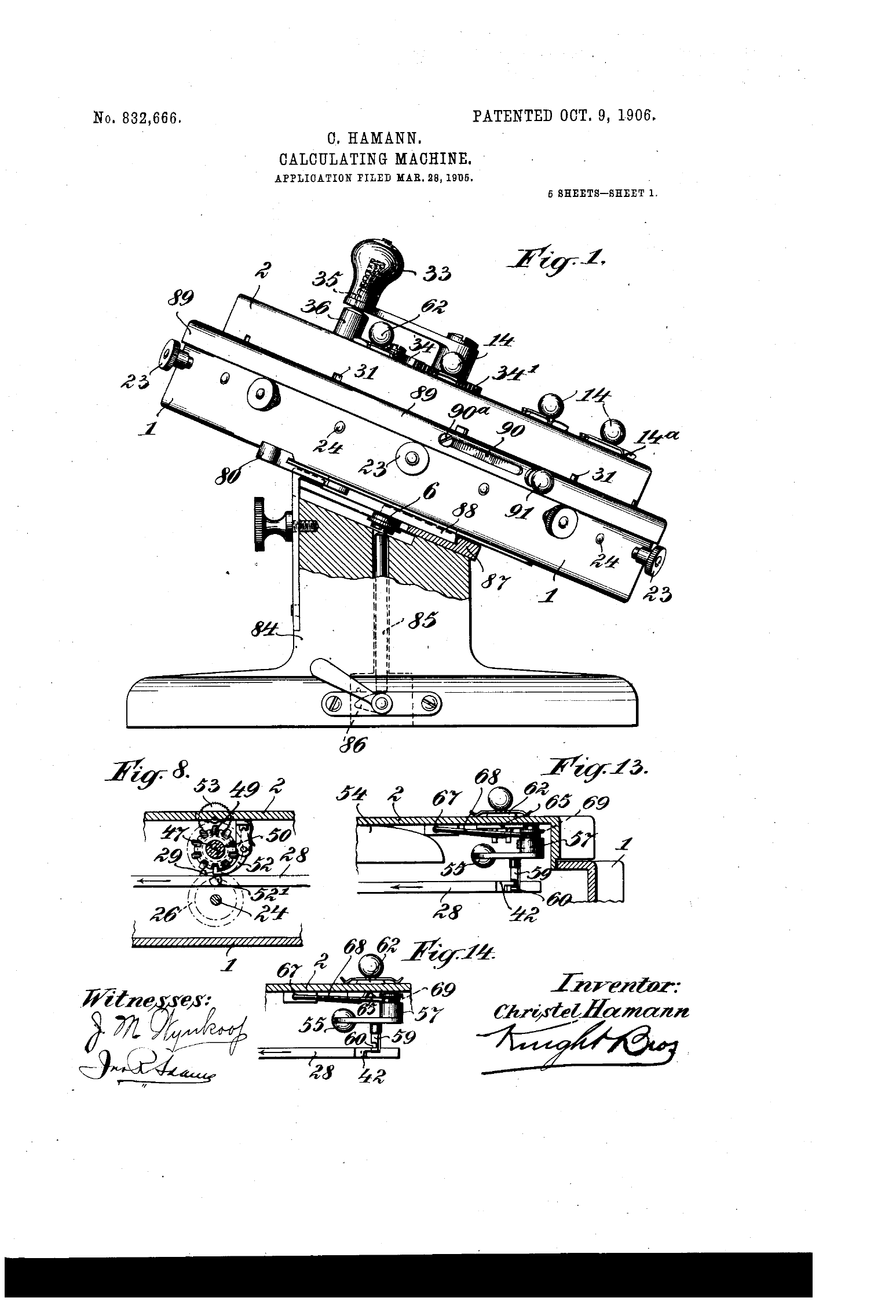
Hamann’s first calculating machine took its name from Carl Friedrich Gauss and its shape from nothing else on the market: it was round. Patented with Paul Haack around 1900 and in a modified form in 1905 (DE 194,527; US 832,666), the Gauss arranged its setting mechanism radially around a central axis, a compact solution to the problem of fitting a four-function calculator onto a desk. It was made from about 1905 in small numbers, roughly a thousand by Scherphuis’s estimate. Its importance is less the machine than what it shows: Hamann was already looking for alternatives to the pinwheel and the stepped drum, the two mechanisms everyone else used.
2.3 The Mercedes-Euklid and the proportional lever
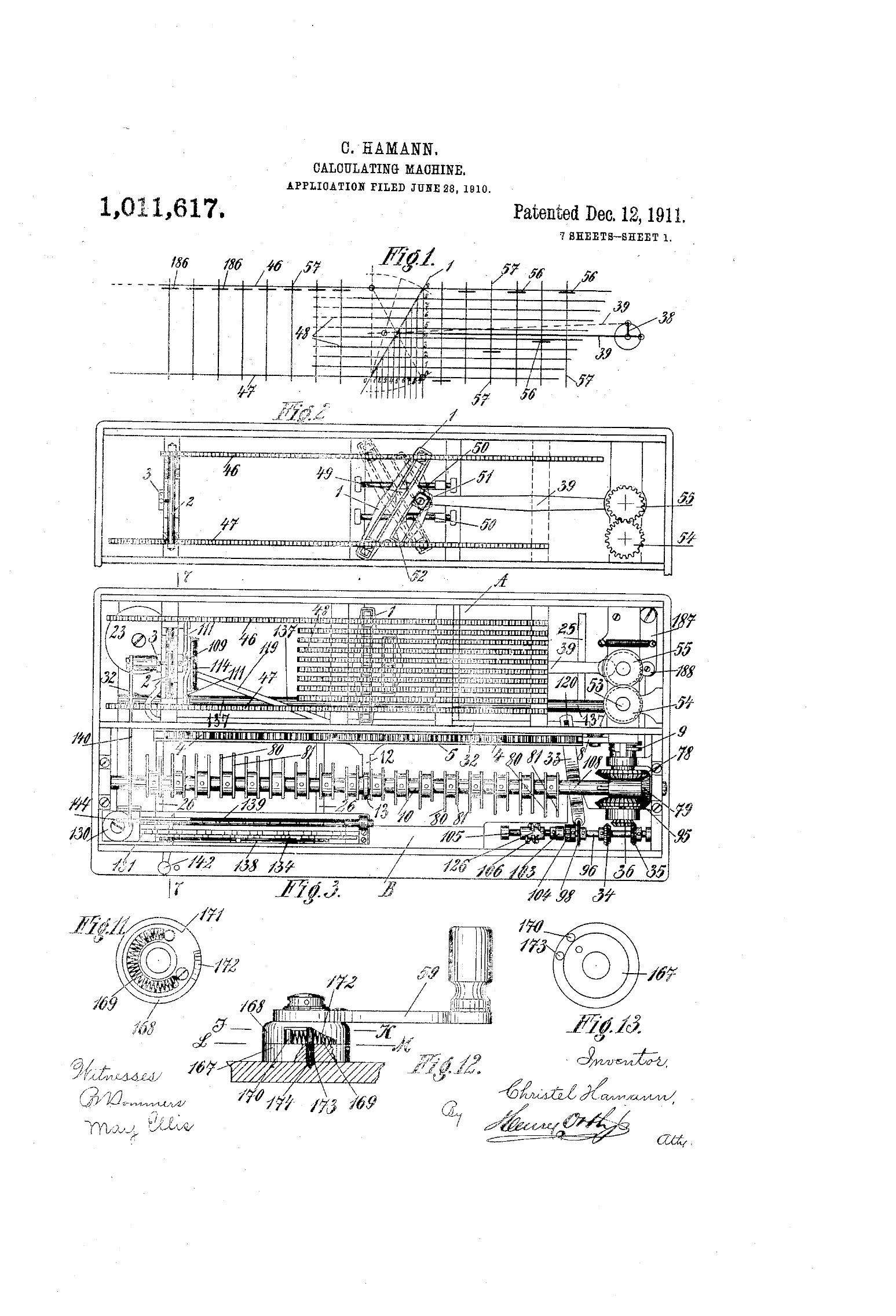
In 1907 the Mercedes Bureau-Maschinen-Gesellschaft of Zella-Mehlis took on Hamann’s work, and Hamann gave it the proportional lever. His patent DE 209,817 was filed in 1906 and published in 1909; the US equivalent is 1,011,617. In each decade a lever pivots so that a rack it drives moves a distance proportional to the digit set, and a single motion of the machine therefore transfers any digit 0–9 at once. The machine built on it, the Mercedes-Euklid, was marketed from about 1908–10. It was heavy, set by keys or slides and later motor-driven, and it acquired automatic multiplication and division under a further Hamann patent of 1914–15 (DE 287,770). Mercedes went on making Euklids until about 1970. Haertel’s classification credits Hamann as the inventor of the proportional-lever principle.
The Euklid was a large office machine. What Hamann had not yet produced was the kind of machine most offices actually bought: a compact, cheap, hand-cranked lever-set calculator of the Odhner type.
2.4 The Deutsche Telephonwerke
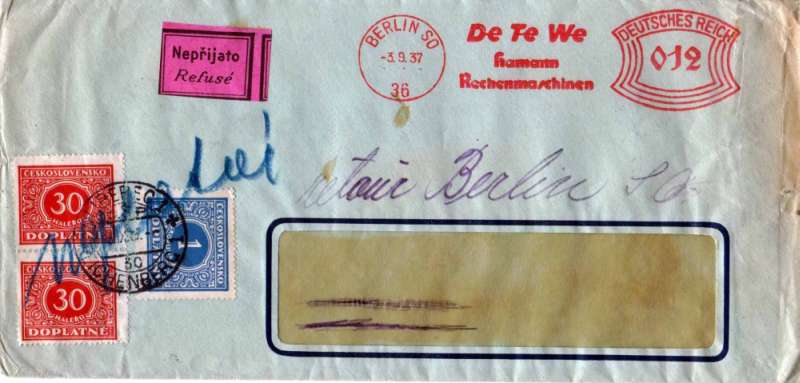
The firm that built the Manus began as a telegraph-apparatus workshop. Robert Stock founded it in Berlin-Kreuzberg on 11 May 1887. It became Deutsche Telefonwerke R. Stock & Co. in 1899 and the Deutsche Telephonwerke GmbH (DTW) in 1905. In August 1922 it merged with the Deutsche Kabelindustrie to form the Deutsche Telephonwerke und Kabelindustrie AG, and it used the name DeTeWe from 1928. In the year of the merger it moved beyond telephones into pneumatic-tube systems, typewriters and, under Hamann, calculating machines.
Hamann is usually said to have joined DTW in 1922 as chief designer of calculating machines. But the first switching-latch patent was already filed in the company’s name on 24 October 1920, so the collaboration began at least two years earlier. Why a telephone maker took up calculators is not recorded in anything I have read. The obvious reasons are precision small-parts manufacture, a telephone works’ core skill, and Hamann’s reputation.

2.5 The switching-latch patents, 1920–1926
Four German patents, all in DTW’s name, built up the mechanism that would become the Manus:
Table 1 — Four German patents, all in DTW's name, built up the mechanism that would become the Manus
| Patent | Filed | What it covers |
|---|---|---|
| DE 367,726 | 24 Oct 1920 | The switching-latch principle: gear wheels engaged by a latch for a number of teeth set by a stationary disk, instead of pinwheels; tens carry made by the drum itself through a notch |
| DE 384,150 | 24 Feb 1923 | One wheel per place with internal and external teeth; a fixed disk and a settable segment that together form the latch’s track; anti-overrun locks; the indicator wheel that shows each setting in a window |
| DE 432,435 | 19 Dec 1924 | Automatic division with the crank turning one way for all operations, by means of a reversing gear and half-step carriage movement. Its US twin is US 1,788,192, filed 1925, granted 1931 |
| DE 443,479 / 468,275 | 4 Mar 1926 | A reversible revolutions counter, and a tens carry for it (the change from the model A to the B) |
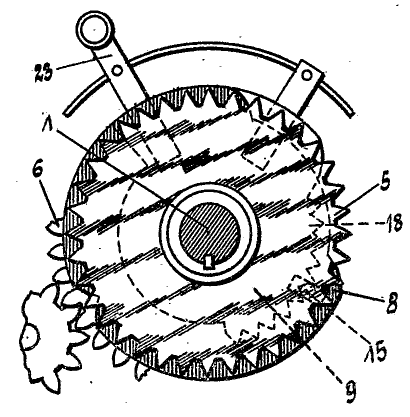
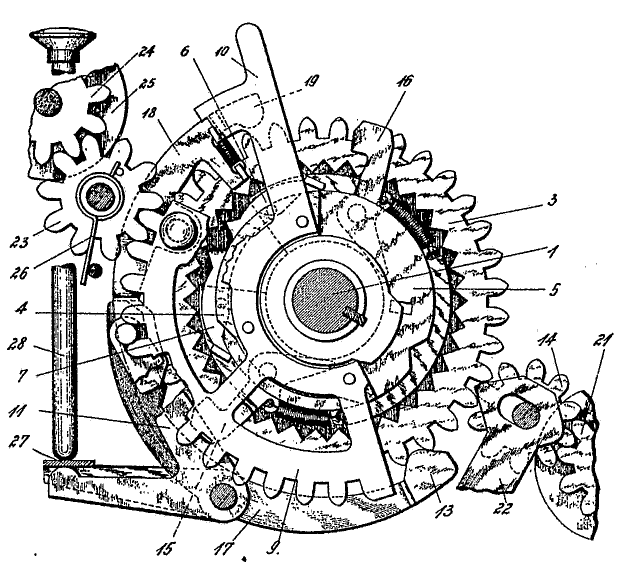
The 1920 patent states the aims plainly: ordinary gear teeth instead of pinwheels, for “the quietest possible running”; setting disks that “stay stationary while the machine works so that their position can be read in windows”; parts “suited to mass production”; and the decimal places driven “not all at once but one after another”, so the crank runs lightly. Every one of those is still visible in my machine.
2.6 The Manus, 1925
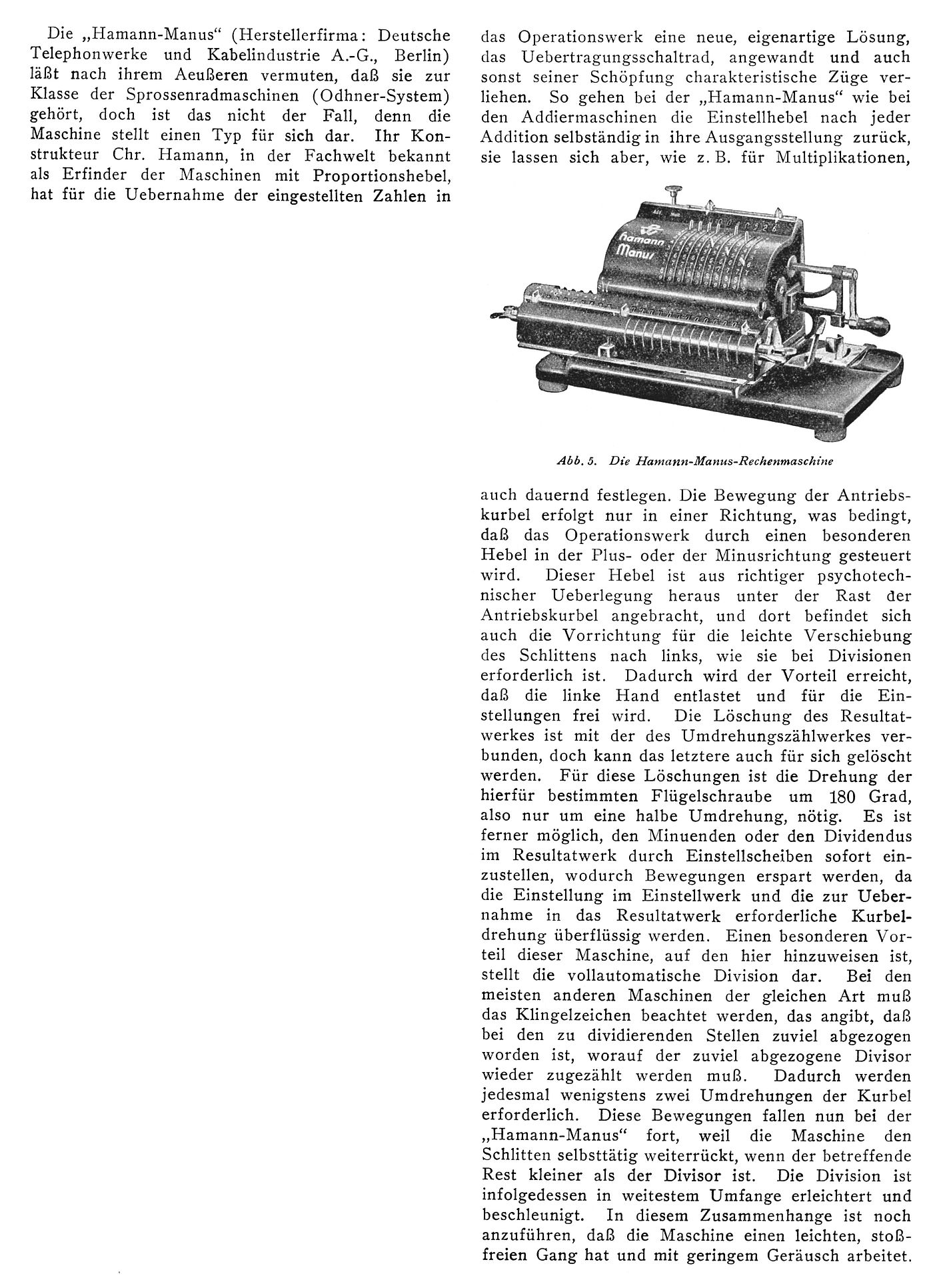
The Hamann Manus was introduced in 1925. The name is Latin for “hand”, a hand machine. Trade journals reported it that year and the next, in Büro-Industrie in 1925, and in Organisation and the French Mon Bureau in 1926.
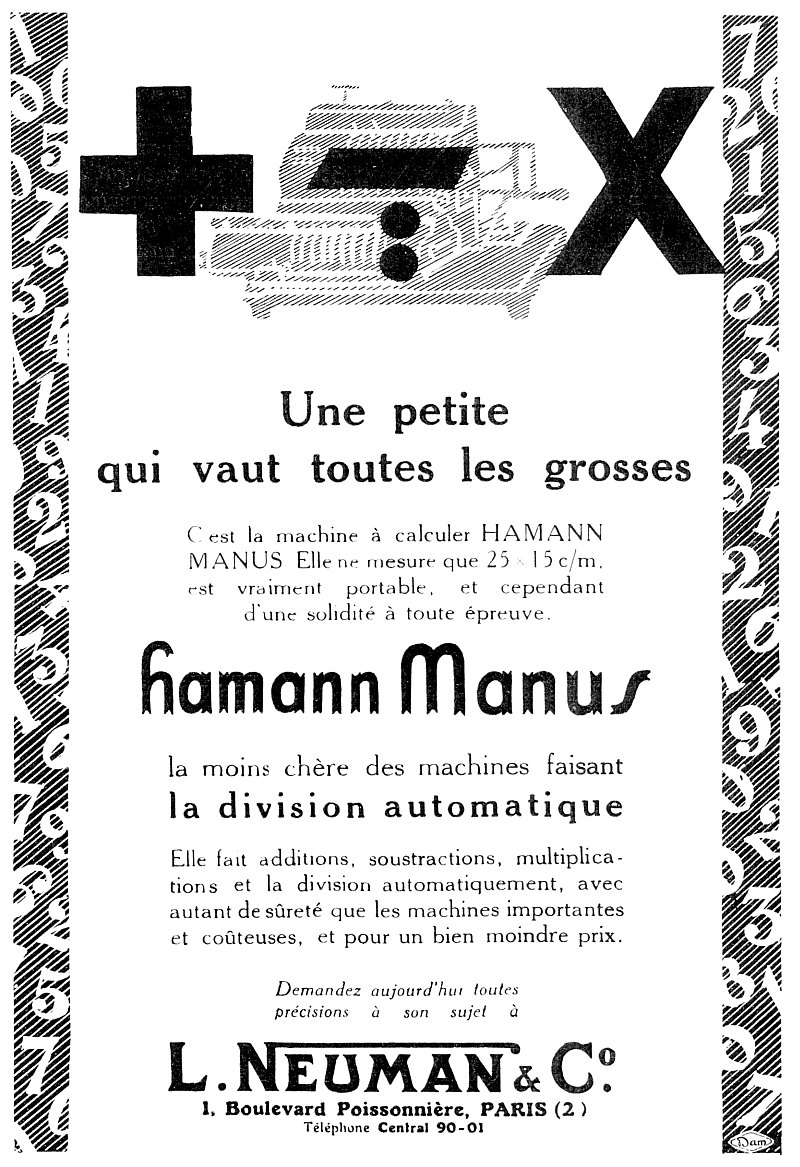
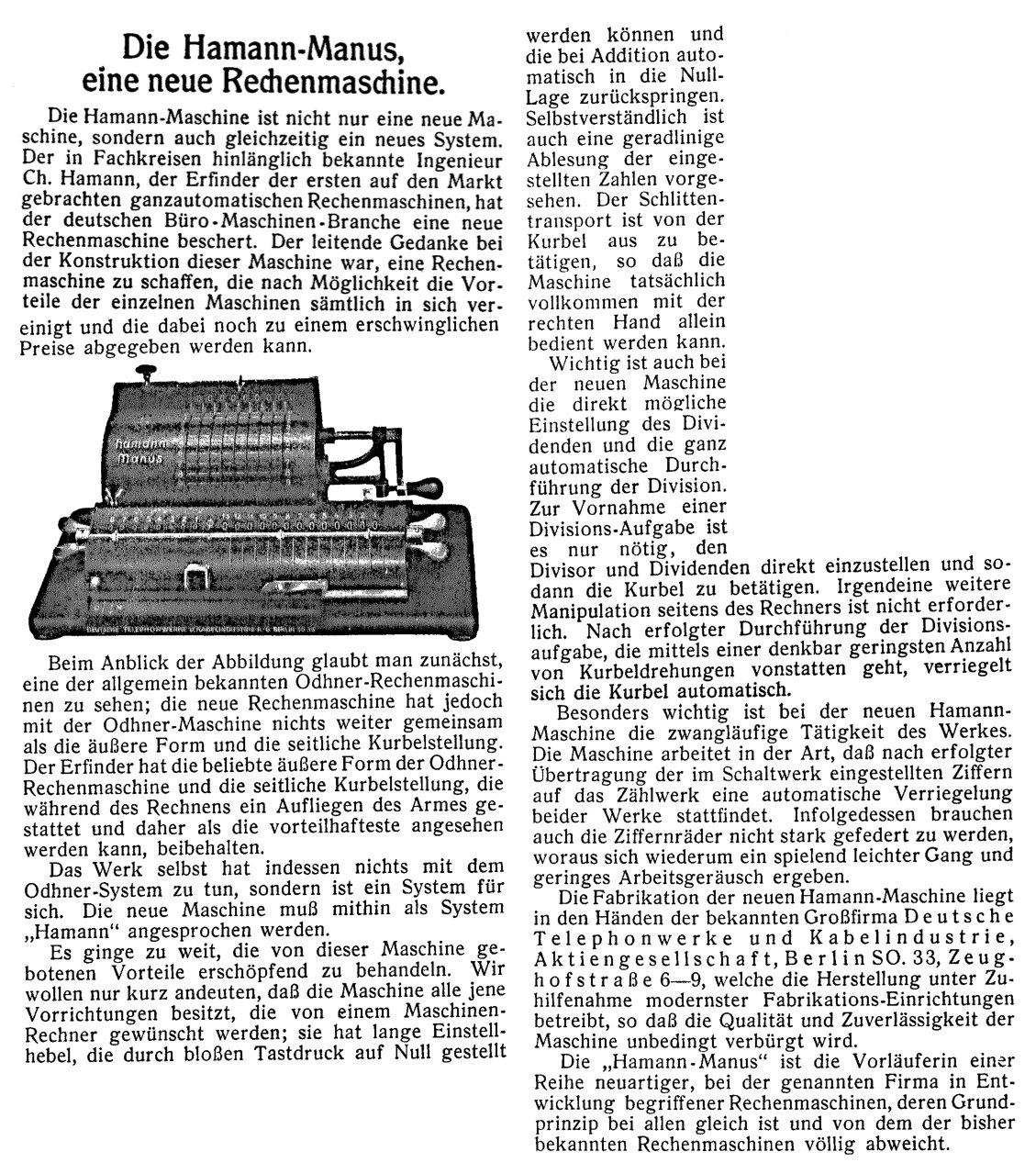
Ernst Martin’s Die Rechenmaschinen, the standard survey of the period, described it in 1925:
The designer has provided the machine with the same exterior design as that of the Odhner machines and also copied its dimensions. The interior design of the machine, however, is completely new and original and has nothing in common with the mechanical principles of the Odhner models. Its most important working part is not the pinwheel itself but a geared wheel with a thirty-six-part inner and outer gearing … It should be stressed that the Hamann-Manus is the first and only small, manual calculating machine with completely automatic division. This sets it apart from all similar calculating machines.
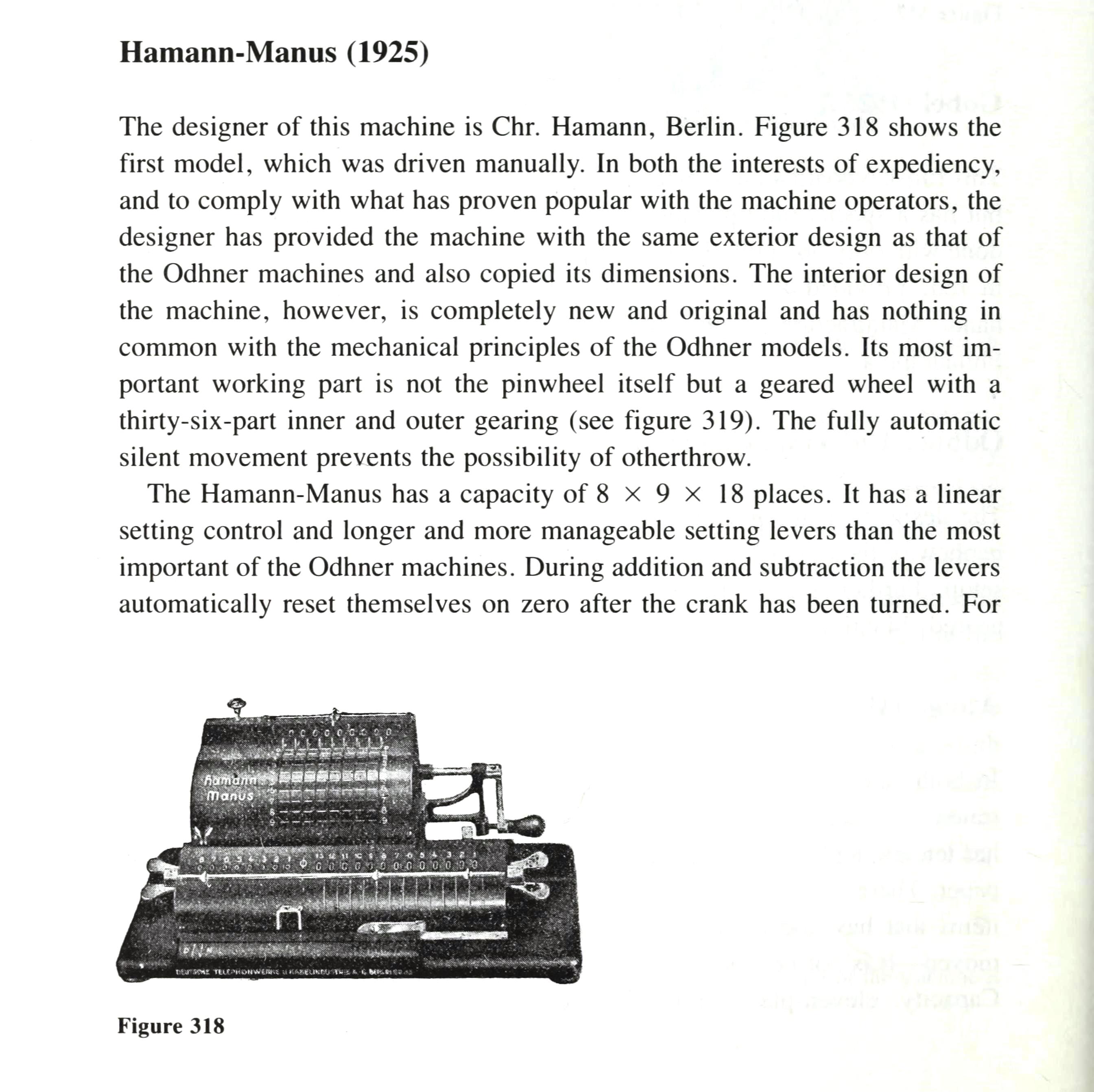
Martin also recorded that the first model’s revolutions counter had no tens carry, “since it is not necessary for automatic division”. The model B added it within two years. His capacity figure, “8 × 9 × 18 places”, does not match the 9 × 8 × 13 of every surviving Manus I have seen described, and is probably an error.
The claim to be the first compact machine with automatic division stands up. Scherphuis notes that only Madas, in Switzerland, had built fully automatic division before, in much larger machines.
2.7 After the Manus
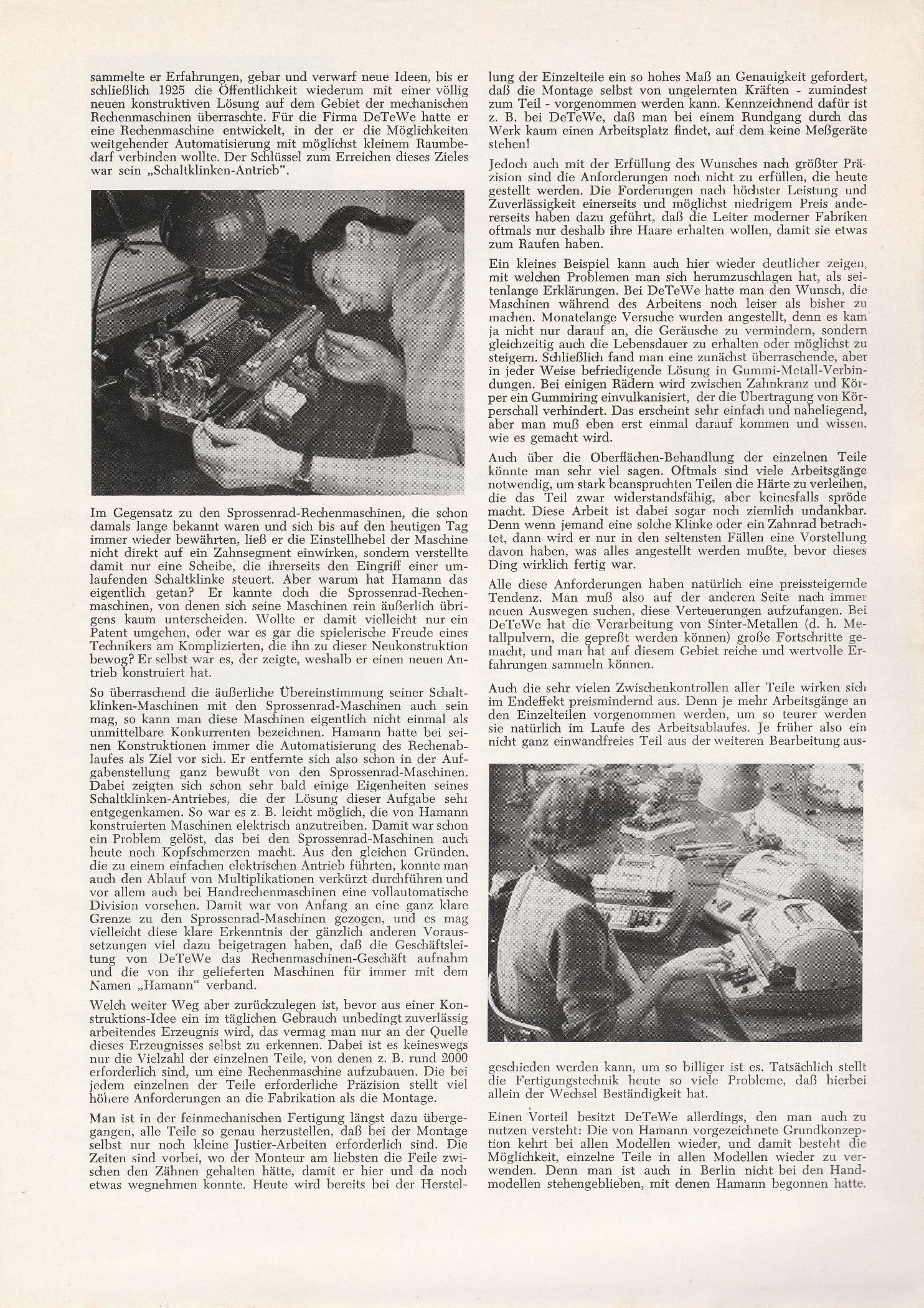
Hamann stayed with DeTeWe for the rest of his working life, and the switching latch went into every Hamann machine that followed: the electric Automat (from about 1930), the double-keyboard Selecta (1931), the full-keyboard Delta (1934), the Elma (a Manus with a motor), and after the war the Hamann 300, the Hamann E, the Automat S and the Automatic 500 and 505. His late patents (DE 748,500 of 1940 and DE 919,787 of 1949) covered back-transfer, carrying a result back into the setting levers, which became the Manus R. They are set out in the volume on the type and its relatives.
In 1958 DeTeWe sold its calculating-machine works to the American firm Marchant, soon part of SCM, and the business carried on as Hamann Rechenmaschinen GmbH into the 1960s. The last non-printing Hamann, the 505, was made until 1968.
Comments (0)