Planimeters · Volume 6
The Planimeter Family
The compensating polar planimeter is the commonest kind, but there are many others: instruments that run on rails or rollers instead of swinging about a pole, that work on circular charts, that measure moments as well as areas, that have no wheel at all, or that read out in digits. This volume is a short field guide to them.
6.1 Polar planimeters
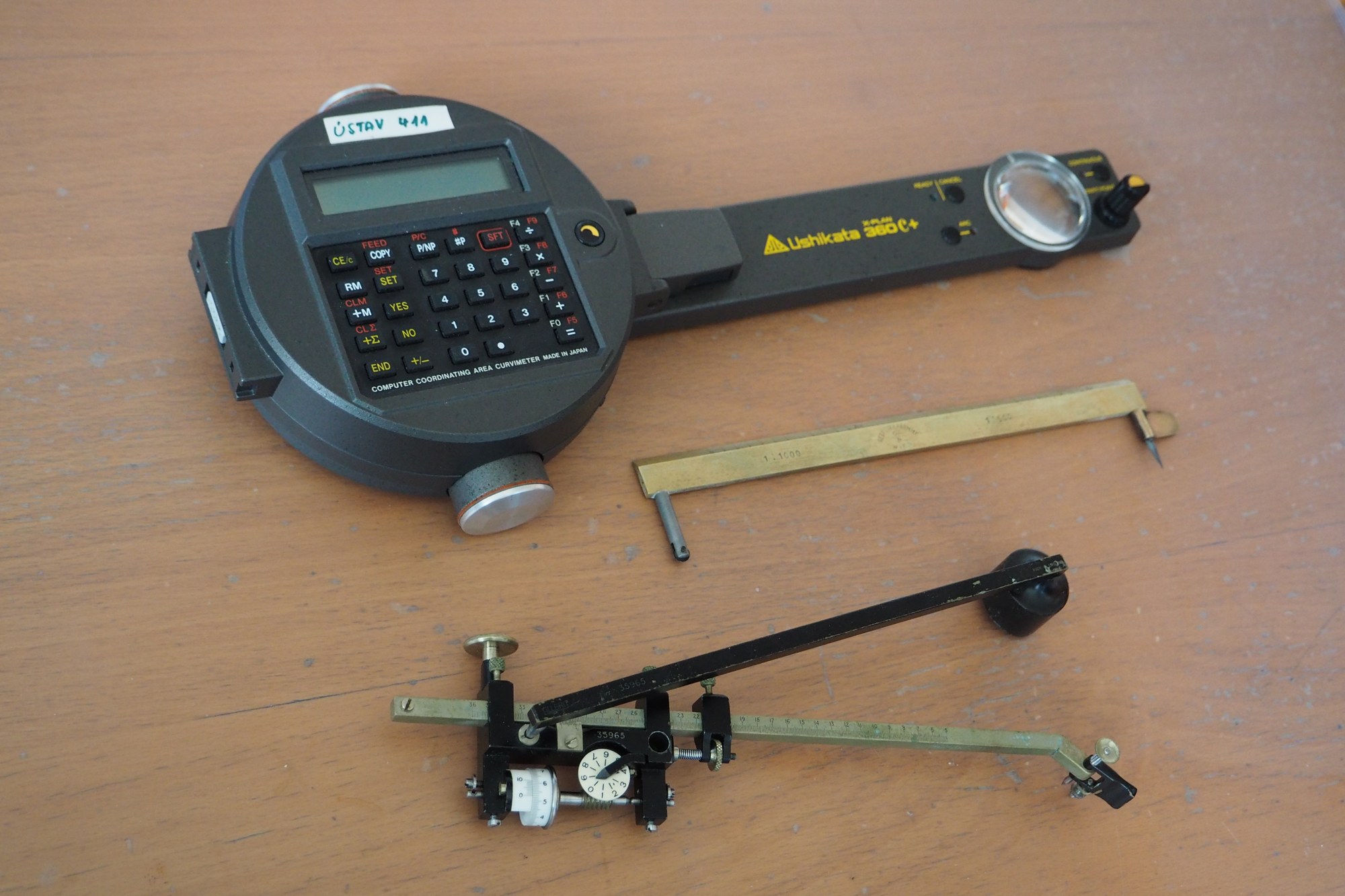
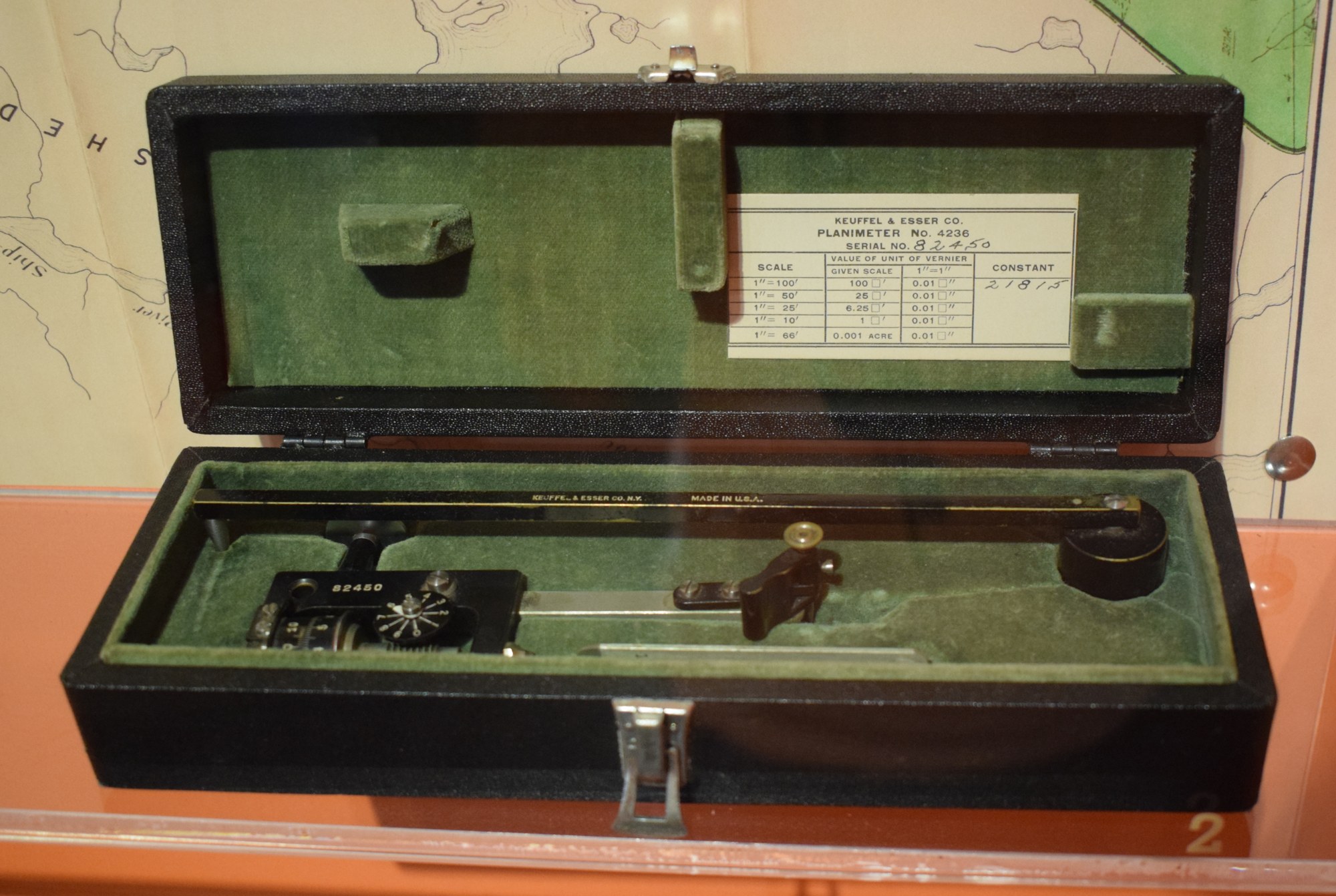
- Fixed-arm polar planimeters, Amsler’s original type: the two arms are hinged and of fixed length, reading in one unit only. K&E’s 4236 read in square inches, the 4236M in square centimetres, and the 4237 directly in acres for a particular map scale.
- Adjustable polar planimeters: the tracer arm (and on the best instruments the pole arm) can be set to read in different units or to the scale of a drawing.
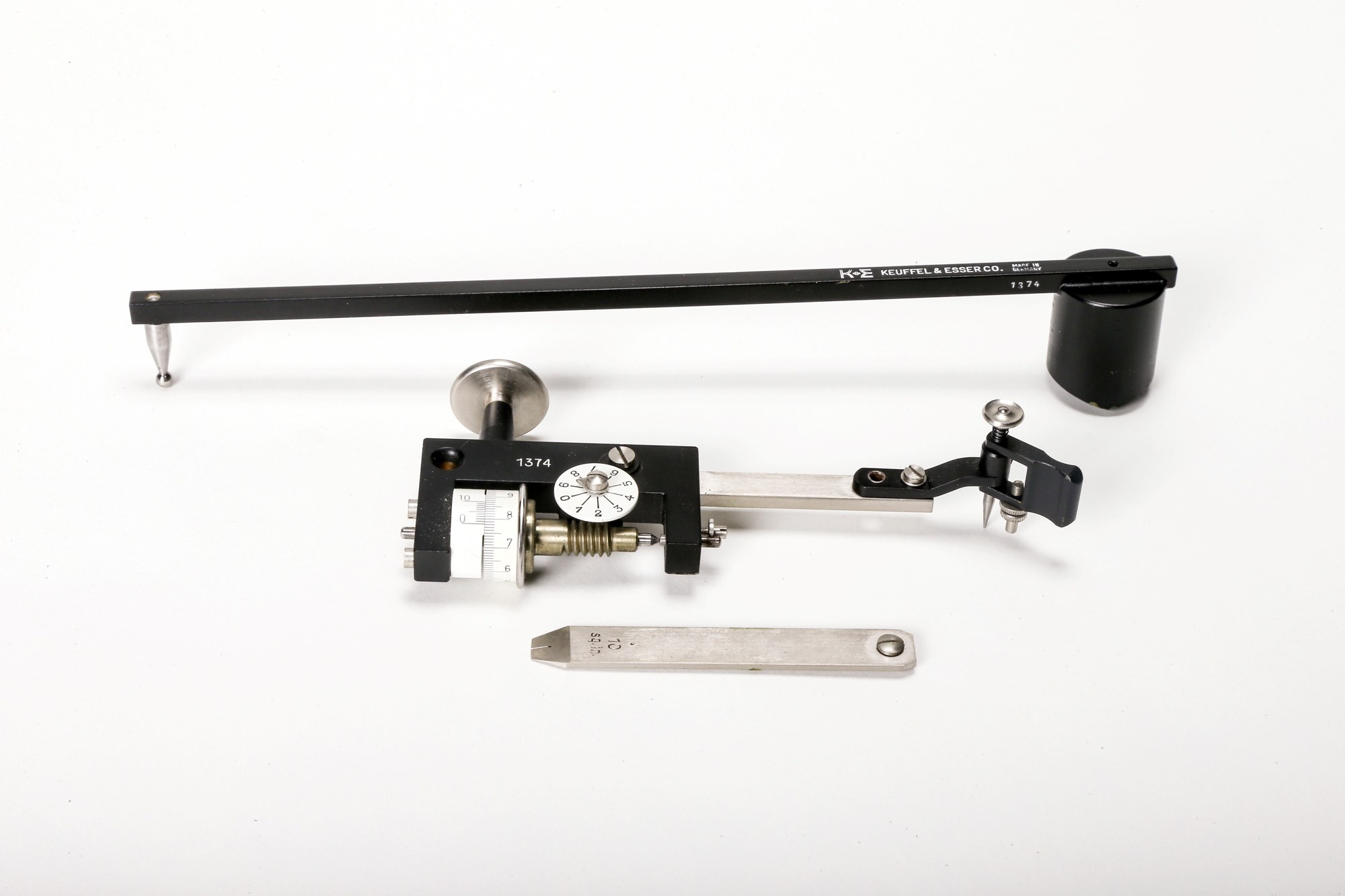
- Compensating polar planimeters, Coradi’s improvement of 1894: the arms meet in a ball joint so the instrument can be used either way round and the readings averaged. The K&E 4240 and 4242 families, and my 4242½, are of this kind.
- Precision polar planimeters, in which the measuring wheel runs on a disc or a polished glass plate instead of the paper, so that the paper surface no longer matters.
6.2 Linear and rolling planimeters
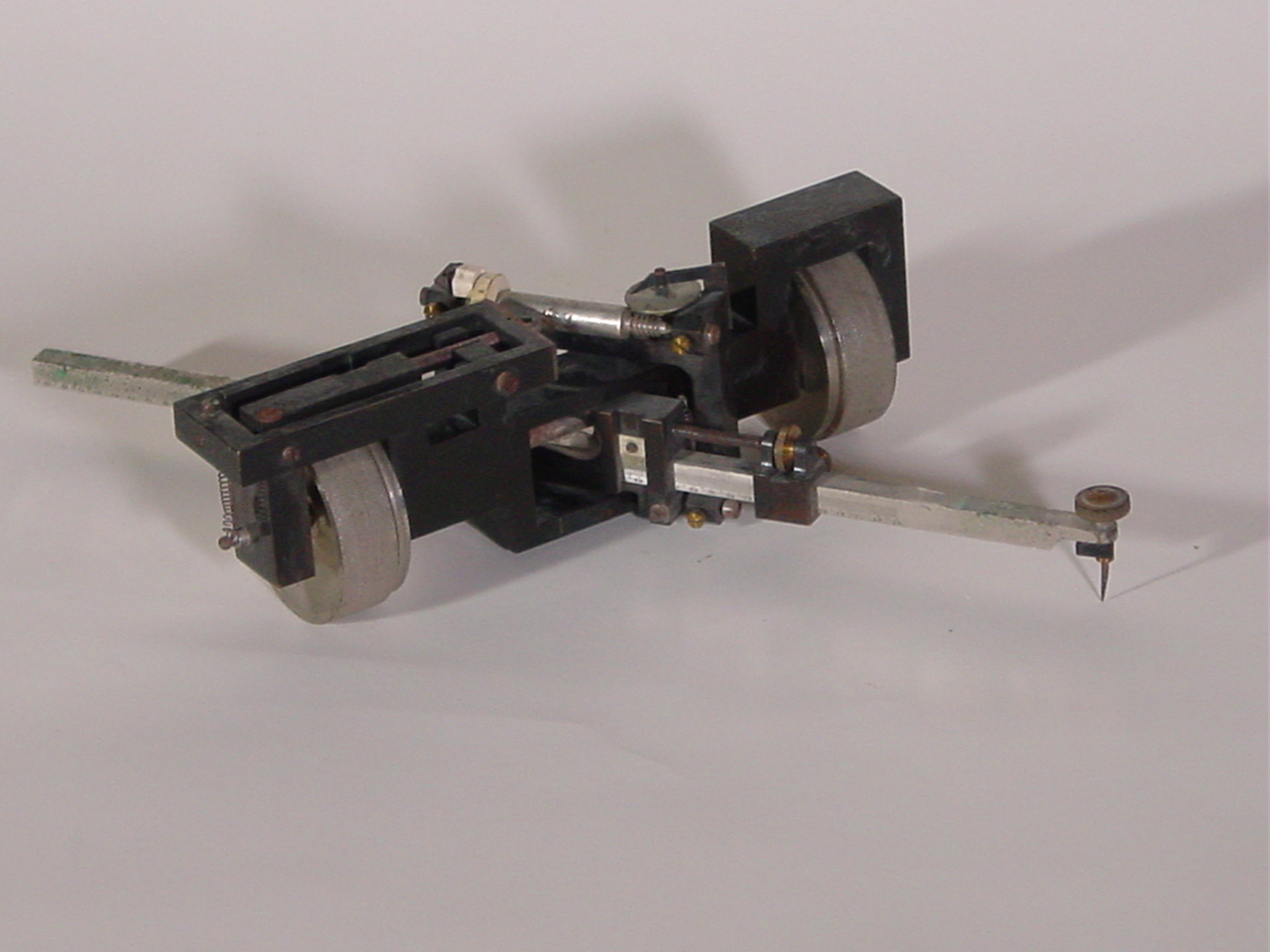
A rolling planimeter has no pole: its carriage runs in a straight line on two heavy rollers, and the tracer arm swings from it. The length of figure it can measure is unlimited, and the best of them, by Coradi and Ott, were the most accurate planimeters made. In the rolling-disc and rolling-sphere types the measuring wheel is driven by a disc or a spherical cap turned by the rollers, so it does not run on the paper at all. K&E sold Coradi rolling planimeters as its 4260 and 4262.
6.3 Radial planimeters
Recording instruments (thermometers, pressure gauges, flow meters) often draw on circular charts. A radial planimeter, such as K&E’s 4215, measures the area under such a curve in polar coordinates, to give the average value. Square-root planimeters, such as the one Ott made for K&E as its 62 0105, were made for the charts of differential-pressure flow meters, where the flow is proportional to the square root of the recorded pressure.
6.4 Integrators
Amsler’s 1856 paper already described instruments that measure not only the area of a figure but its static moment and moment of inertia: the quantities a naval architect needs for a ship’s stability, and an engineer for the strength of a beam. Amsler’s moment integrators do this in one tracing with several wheels. Coradi’s integraph draws the integral curve of a curve, and the Henrici–Coradi harmonic analyser finds its Fourier coefficients. These are the rarest and most valuable instruments of the family: an Amsler integrator in its case sold at Bonhams in 2015 for £1,375.
6.5 The hatchet planimeter
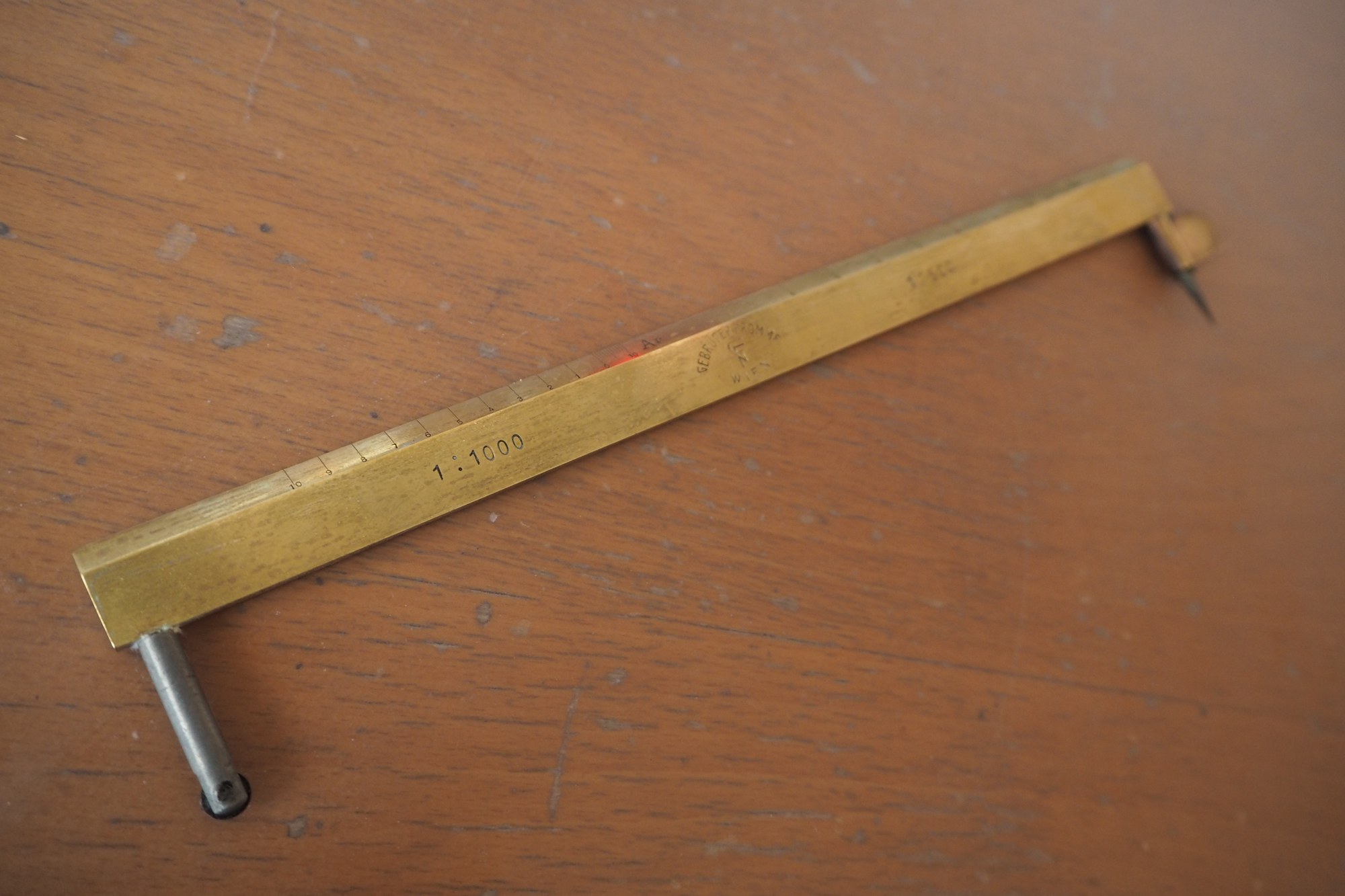
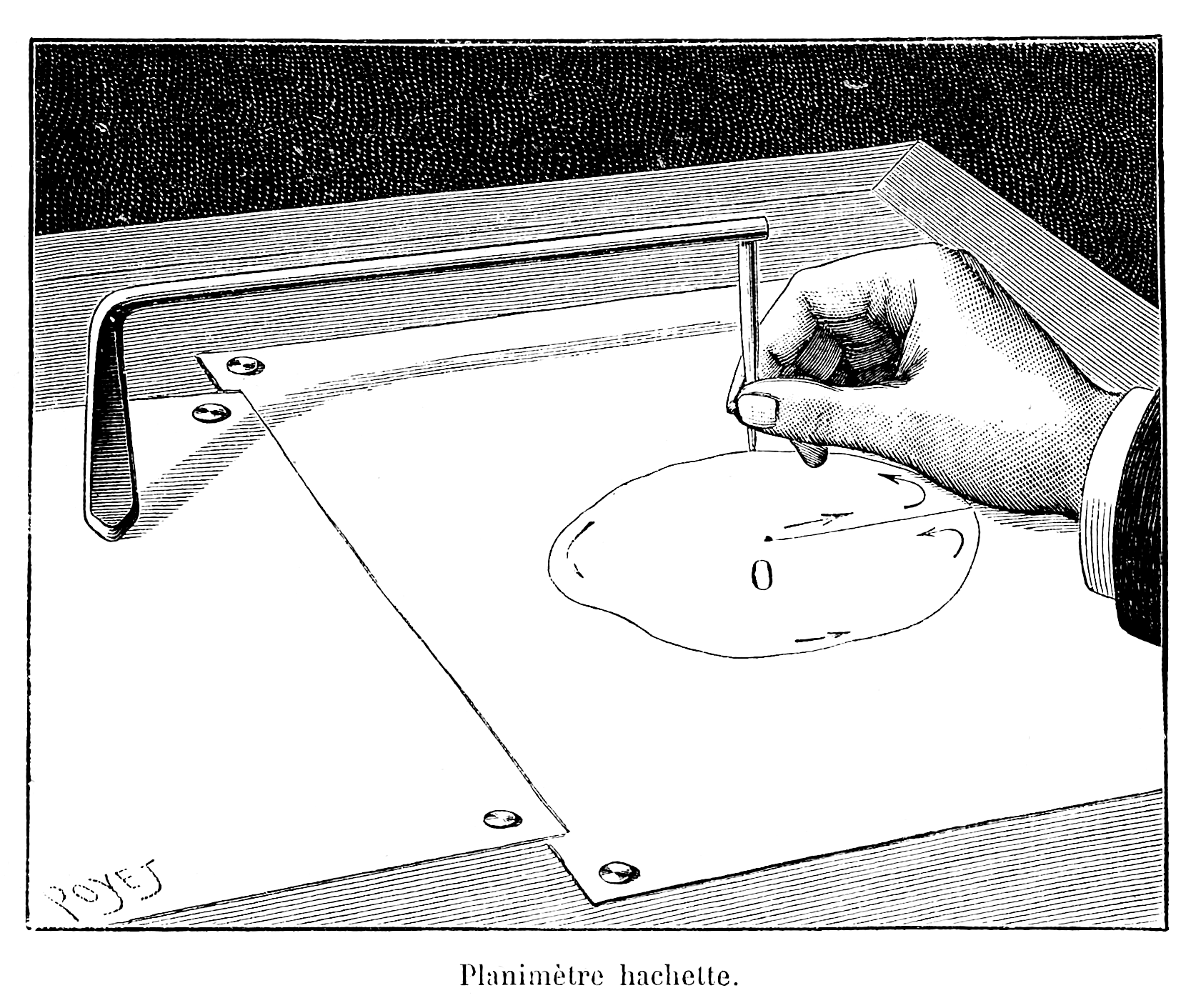
The Prytz or hatchet planimeter, invented by the Danish cavalry officer Holger Prytz about 1875 and made by Cornelius Knudsen of Copenhagen from 1887, has no moving parts at all: a bent rod with a pointer at one end and a knife edge at the other. The pointer is run round the outline from its centre and back, and the knife edge, dragged along, ends up displaced sideways. The area is approximately the length of the rod times that displacement. It is a clever and cheap approximation; its mathematics, that of the tractrix and of bicycle tracks, has occupied mathematicians to this day (Robert Foote’s Geometry of the Prytz Planimeter; Foote, Levi and Tabachnikov’s Tractrices, Bicycle Tire Tracks, Hatchet Planimeters, 2013). It caught on in Europe more than in America.
6.6 Digital planimeters
From the later twentieth century, makers replaced the measuring wheel’s dial and vernier with an electronic encoder and a digital display, with unit conversion, scale setting and averaging built in: the Tamaya Planix series, the Koizumi Placom (made 1975–99), Ushikata, Haff’s 320E and 321E, and Lasico. Used Planix 7s sell for about $20–125.
6.7 Where the K&E 4242½ fits
The 4242½ is an adjustable compensating polar planimeter, the general-purpose engineer’s and surveyor’s instrument of the mid-twentieth century: accurate to about 1 part in 1,000, quick to use, adjustable for any scale, and small enough to keep in a drawer.
Comments (0)