Planimeters · Volume 5
Care, Adjustment and Repair
A planimeter is a precision instrument with few parts, and almost all of its accuracy lives in one of them: the measuring wheel, its rim and its bearings. Looked after, it lasts a lifetime; K&E’s manual says the bearings “will not wear perceptibly” even after long use. Dropped, or handled carelessly, it is quickly ruined. This volume collects K&E’s own care instructions, the checks that tell you whether an old instrument is sound, and what can and cannot be put right at home.
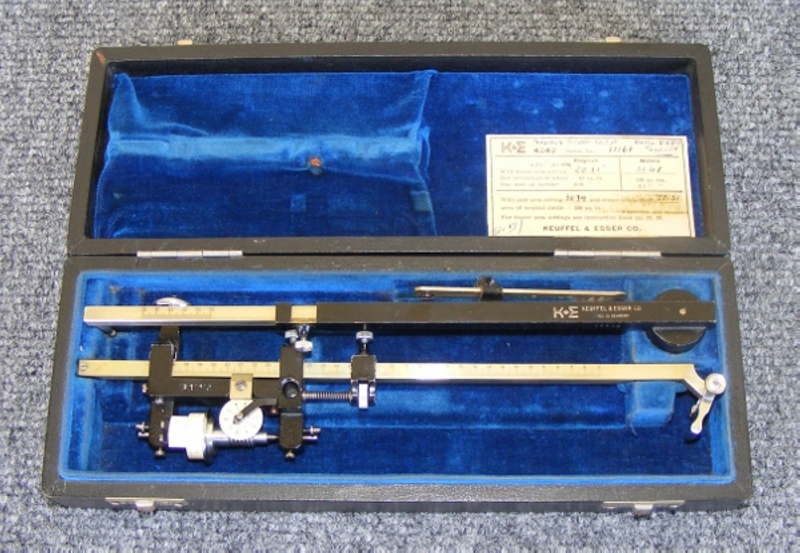
5.1 K&E’s rules
From chapter II of K&E’s manual:
- “If dropped, they will almost certainly be damaged.” Do not use a planimeter on a sloping board, and do not leave it lying where drawings are being moved about. Keep it in its case when not in use.
- The most critical parts are the rim of the measuring wheel and the axle bearings. The rim has a matte surface of hardened steel that must be kept from rust and corrosion. Do not touch it with your fingers. If it gets damp, wipe it with a soft clean cloth.
- For storage, particularly in a humid climate, give the rim a coating of watch oil, and wipe it off before using the instrument again.
- Lubricate the axle bearings occasionally with a small drop of watch oil on a toothpick, and wipe off the excess. The wheel should spin freely but without perceptible end-play.
- Do not attempt to adjust the bearings. The instrument’s accuracy can always be checked with the testing rule. If adjustment is needed, K&E said, return it to the factory or, failing that, to “an instrument specialist or a good watchmaker”.
5.2 Checking an old instrument
- The wheel spins freely when the carriage is lifted and the wheel is flicked gently by its hub (not its rim), and runs down smoothly. Grinding, sticking or sudden stopping means dirt or damage in the bearings.
- No end-play. The wheel should not move along its axle. Play here makes the readings inconsistent.
- The rim is clean, round and unmarked. Look at it under a lens: rust spots, a polished band, nicks or a flat are the worst faults a planimeter can have, because the rim’s surface and diameter are what the readings depend on.
- The counting dial steps on once for each turn of the wheel, cleanly, at the wheel’s zero. A dial that slips or drags makes the thousands wrong.
- The vernier reads cleanly against the wheel, with its zero exactly at the wheel’s zero when the instrument is set to 0000.
- The tracer arm is straight, its scale legible, and the carriage slides smoothly when screws A and C are loose and clamps firmly when they are tight. Screw B should turn smoothly.
- The ball and socket is clean and free; the pole weight’s needle is present and sharp; the tracer point is present and its stop works.
- The testing rule test (operating volume, section 10). Ten circuits of the 10 sq in mark should read within a few vernier units of 10,000. If the instrument reads consistently high or low, the tracer arm setting has drifted and can simply be reset. If the readings scatter, or differ markedly between pole-left and pole-right, the wheel or its bearings are at fault.
5.3 Cleaning
- Dust and old oil: a soft brush and a dry cloth. Old, thickened oil in the wheel bearings can be loosened with a drop of fresh watch oil and the wheel spun gently, the excess wiped off; repeat until it runs freely. Do not flood the mechanism.
- The wheel rim: a soft, clean, lint-free cloth only. Do not polish it, and never use abrasives or metal polish on it. Its matte finish is functional: it is what makes the wheel grip the paper instead of skidding.
- Brass and nickel parts: the pole arm and the fittings can be cleaned with a soft cloth. Avoid metal polish near the wheel, the dial and the scales: it leaves residue and wears the engraving.
- The scales on the tracer and pole arms are engraved; do not scrub them.
- The case: brush the velvet, keep it dry, and air it if it smells damp. A damp case is the usual cause of rust on the wheel rim.
5.4 Faults and what to do
Table 1 — Faults and what to do
| Fault | Likely cause | Remedy |
|---|---|---|
| Readings consistently high or low | tracer arm setting drifted | reset with the testing rule (operating volume, section 10) |
| Readings scatter on repeated traces | dirty or dry bearings; end-play; paper surface | clean and oil the bearings; check the paper; check end-play |
| Pole-left and pole-right disagree | wheel axle slightly misaligned | average equal numbers of readings both ways, which is what the compensating design is for; if large, professional adjustment |
| Wheel skids | glazed or oily rim; paper too smooth or uneven | clean the rim; use good drawing paper |
| Dial slips | worn or dirty dial drive | clean; professional repair |
| Rust on rim | damp storage | do not abrade; consult a specialist; light surface marks may not matter, pitting does |
| Missing testing rule | lost | a measured circle can stand in: an 11.284 inch circle is exactly 100.00 sq in, and a rule can be improvised from a strip with a pivot and a mark at a measured radius (5.642 in for 100 sq in, 1.784 in for 10 sq in) |
| Missing tracer point, pole needle or stop | lost | small parts can be made by a watchmaker or a model engineer |
5.5 What not to do
- Do not take the wheel or its bearings apart unless you have the skills of a watchmaker. Their adjustment sets the instrument’s accuracy, and K&E itself told owners not to touch them.
- Do not touch the wheel rim, or turn the wheel while it is on the paper.
- Do not use abrasives, metal polish, solvents or penetrating oil near the wheel, the dial or the scales.
- Do not store the instrument out of its case, in a damp place, or with the rim un-oiled for long periods.
5.6 Parts and accessories
There is no maker’s service for a 1950s K&E planimeter. Spare parts come from other instruments: incomplete planimeters are common and cheap, and a K&E or Haff donor of the same family can supply a pole weight, a testing rule or a tracer point. K&E’s manual is in the Library, as is Haff’s current manual for its planimeters 313, 315 and 317, whose instructions are almost word for word K&E’s and apply equally to an older instrument.
Comments (0)