VFD Calculators · Volume 9
Collecting
Fluorescent-display calculators are the easiest of the early electronic calculators to collect. Millions were made, many still work, and most cost less than a meal. At the top of the field are the first machines, the single-tube Sharps and their clones of 1969–72, which are scarce and sought after. Between the two lies a huge range of pocket and desk machines from dozens of brands, many of them good-looking, nearly all of them cheap, and very few of them documented.
9.1 What is common and what is rare
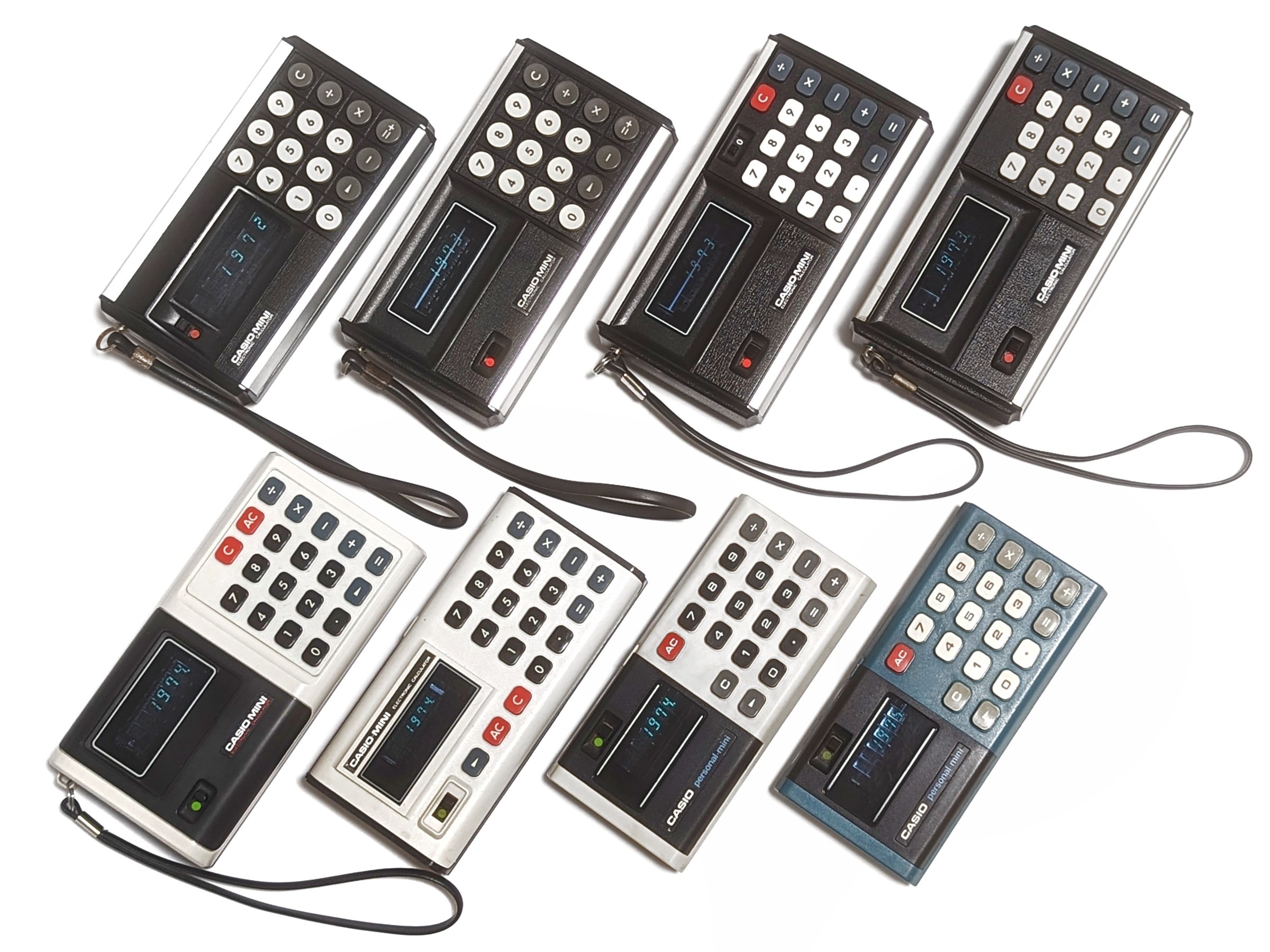
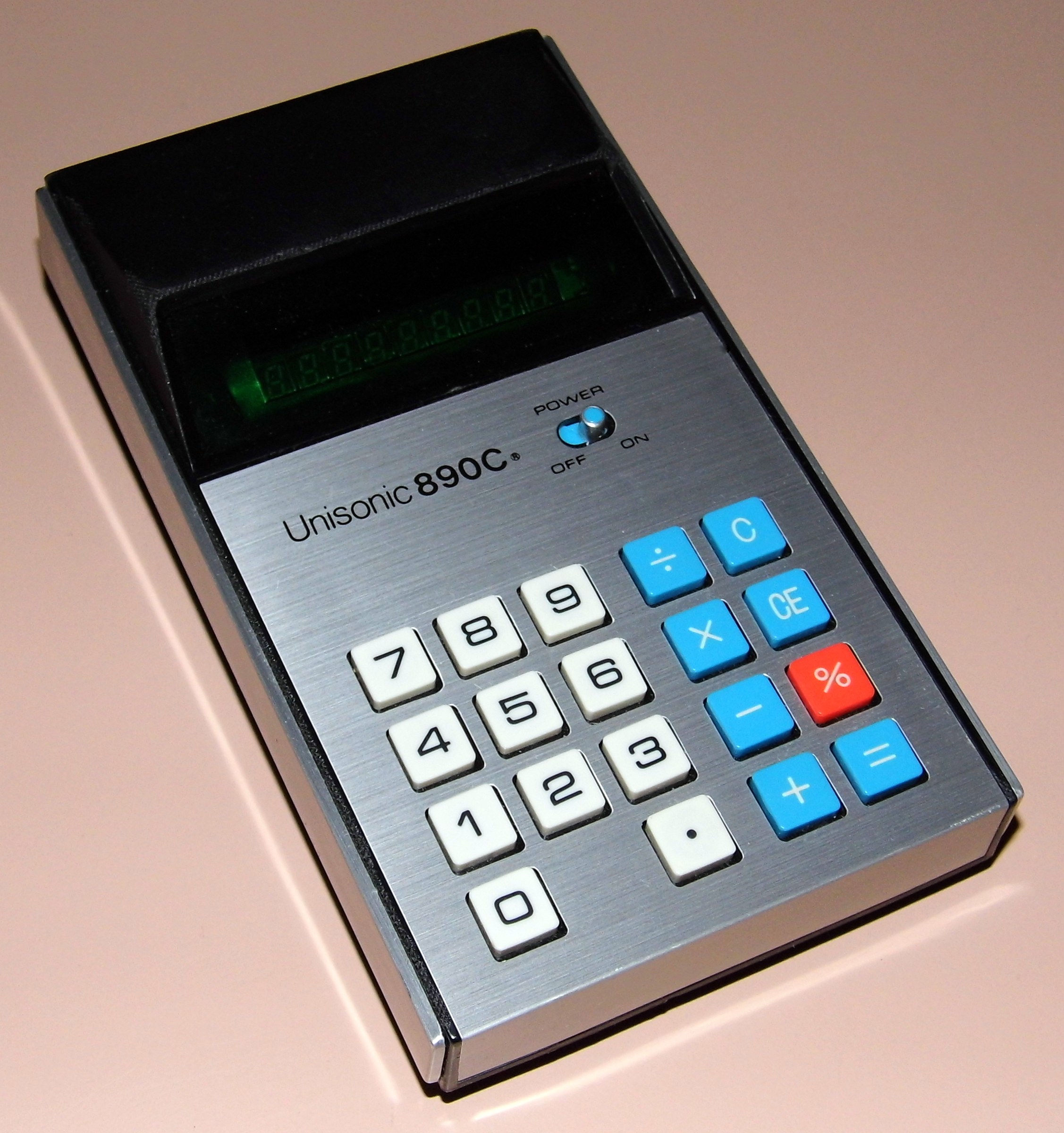
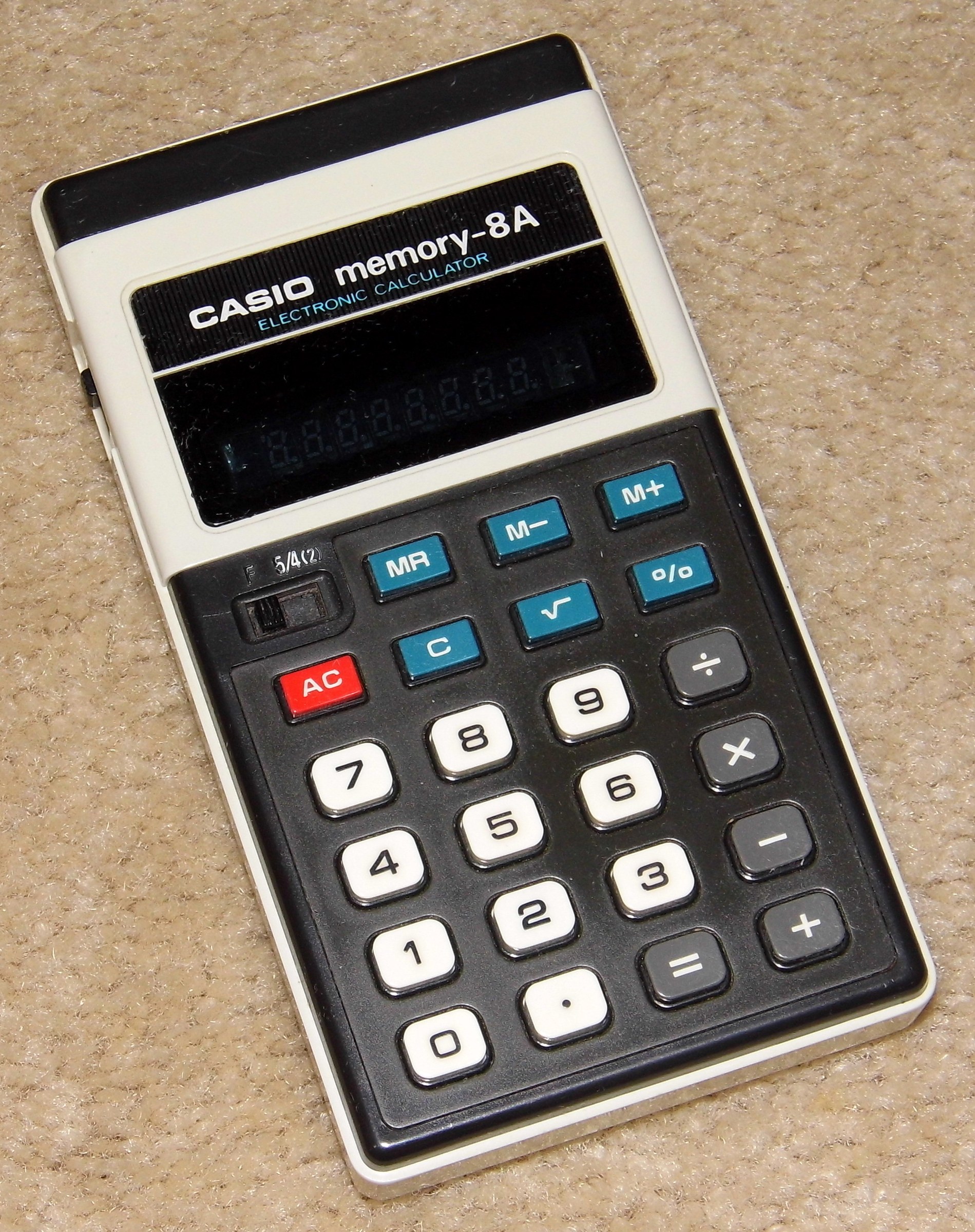
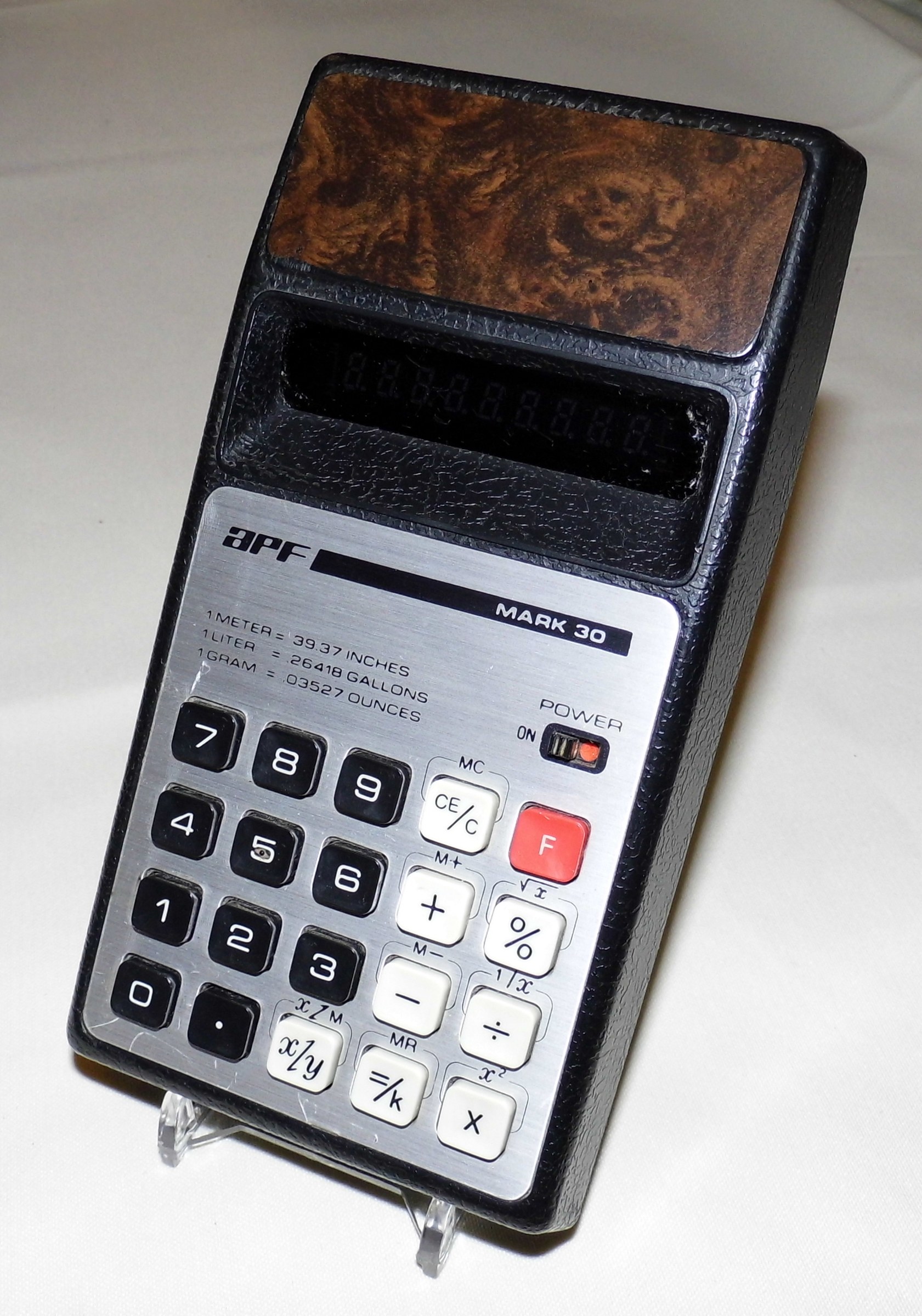
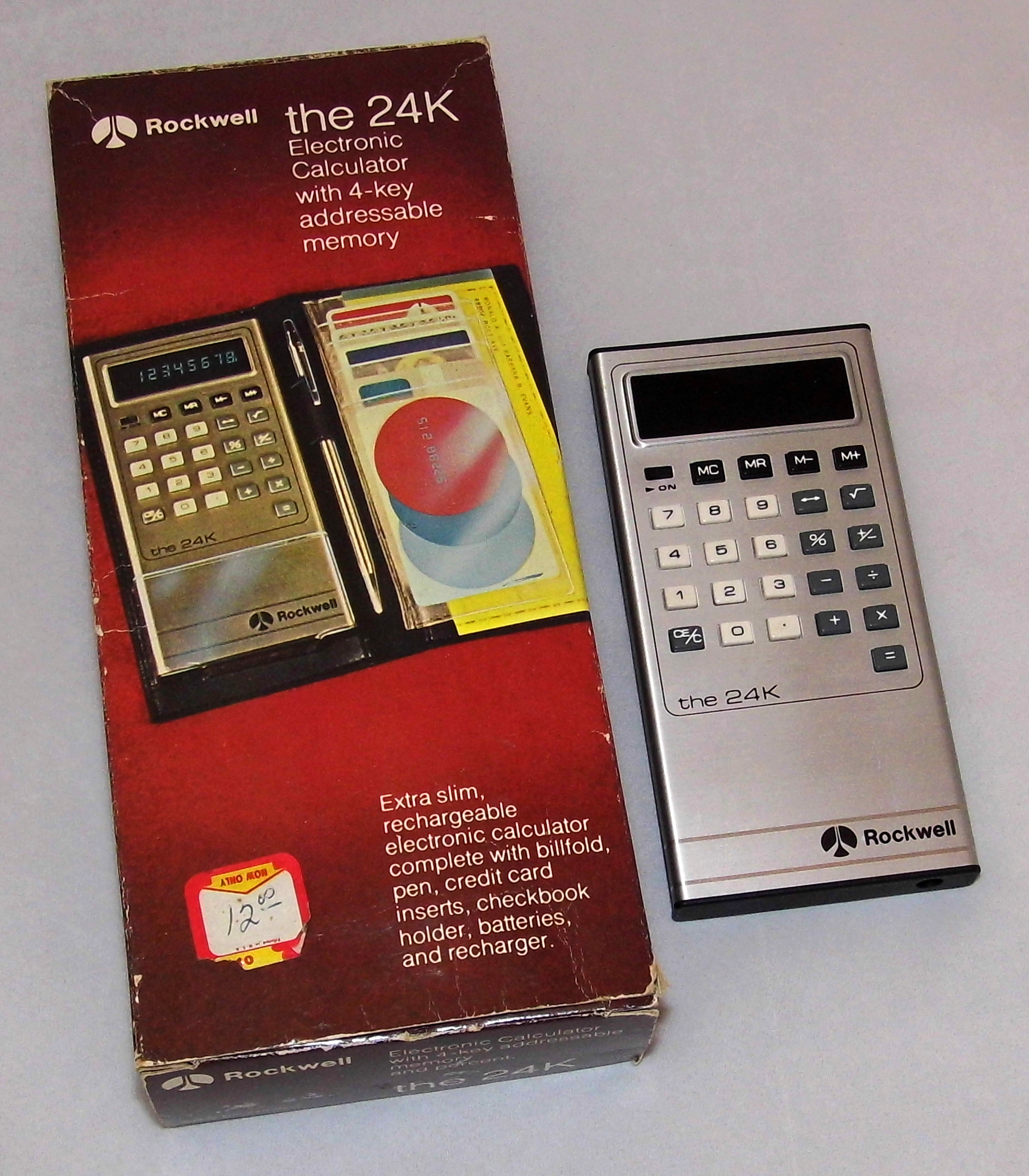
- Common (about $10–50): the Casio Mini, Personal-mini and Pocket-mini; the Sharp ELSI MATE pocket machines of the mid-1970s; Commodore, Unisonic, Lloyd’s, Craig, Rockwell and the many other American-badged pocket machines; and almost every fluorescent desk machine of the later 1970s and 1980s, which often sell for a few euros.
- Less common: the early scientifics (Casio fx-10, fx-20, fx-101, fx-201P; Sharp PC-1802 and EL-5001), the Casio CQ-1 clock-calculator, and the first-generation Casio and Toshiba desk machines with single tubes.
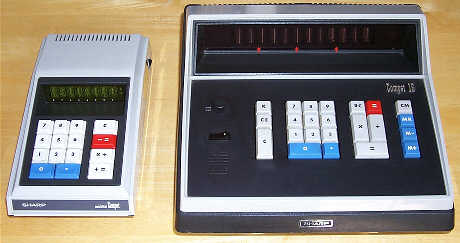
- Scarce and sought after: the Sharp QT-8D and QT-8B, the EL-8 and EL-8M and their Facit 1111, 1115 and Addo-X clones, the Burroughs-badged Sharps, the Busicom Junior and NCR 18-16, the Friden EC-1117A, and the Sharp CS-16A, which as the first VFD calculator of all is rarely seen outside Japan. The Calcuseum database rates the QT-8D and EL-8 at 8.5 out of 10, against 7.5 for the Casio Mini CM-602.
9.2 What they cost
Asking prices from eBay listings, plus a few sold results from Catawiki; none of these is a statistical guide.
Table 1 — What they cost
| Machine | Price | Kind | Source |
|---|---|---|---|
| Sharp EL-8A, working | about $285 | asking | eBay.de |
| Sharp EL-8, working, 1971 | about $225 | asking | eBay.de |
| Sharp EL-8, untested, no adapter | about $119 | asking | eBay.de |
| Casio Mini CM-602 with case | about $20 | asking | eBay US |
| Casio Mini with case and batteries | about $49 | asking | Etsy |
| Casio √121-S desk, twelve-digit VFD, 1973 | €24 | sold, no reserve | Catawiki |
| Sperry Remington SSR-8, about 1974 | €3 | sold | Catawiki |
| Cimatron Escort desk, VFD | about $40 | sold | eBay.de |
For comparison, the machines new: Sharp QT-8D, $395 in 1970 (¥99,800); QT-8B, $495; Sharp EL-8, $345 in 1971 (¥84,800); Casio Mini, ¥12,800 in 1972, and $59.95 in the United States that November.
9.3 Search terms
The display has many names, and the sellers use all of them:
- “VFD calculator”, “vacuum fluorescent”, “fluorescent display”, “green display”.
- Maker names for the tube: “Itron” and “Iseden” (Ise Electronics), “Digitron” (Casio’s word in its manuals), “FIP” (NEC).
- Sharp’s family names: “ELSI”, “ELSI MATE”, “Micro Compet”, “Compet”. Commodore’s “Green Line”.
- Tube type numbers, which some sellers quote: DG10L, DG10B, DG12B, DG12C, 9-ST-, 9-CT-, 13-MT-, LD80.
- In other languages: “Taschenrechner VFD” or “Röhrenanzeige” in German, “calculatrice VFD” or “afficheur fluorescent” in French, “蛍光管 電卓” or “蛍光表示管 電卓” in Japanese.
- Model numbers, always.
9.4 Where to look
- eBay, especially eBay.de and the other European sites for office machines, and eBay US for the American-badged pocket machines.
- Catawiki, which holds weekly calculator lots and shows its sold results.
- Kleinanzeigen in Germany, Leboncoin in France and Marktplaats in the Netherlands for desk machines from offices.
- Yahoo! Auctions Japan and Mercari Japan, through a proxy service such as Buyee or ZenMarket: the deepest pool of Casio, Sharp, Canon and Toshiba fluorescent machines, including the early desk models. The Japanese searches above help.
- Barnebys, which gathers auction-house lots; Etsy for pocket machines; and the classifieds of the Hewlett-Packard Museum forum.
9.5 Before buying
- The battery compartment. Look for corrosion, a leaked pack and rusted springs. This is the commonest fault, and the most often hidden in photographs.
- The display lit. Even brightness from end to end and on every segment; no white or flaky patch where the getter should be a silvery mirror.
- The keys. Every key registering once, without bounce or sticking.
- The adapter or charger. A special connector, as on the Sharp EL-8, the Royal Digital V and several Sanyos, is hard to replace. An original adapter adds value.
- The rechargeable pack. If there is one, treat it as dead and price in the repair.
- A test. If the machine can be tried, run its manual’s examples, including the overflow; for a QT-8D or EL-8, the decimal point call-back as well.
- The extras. The original box, manual and case all add value.
9.6 Weights, for shipping
Pocket machines are light. Early desk machines are heavier: the QT-8D weighs 1.4 kg and the CS-16A 4 kg. All the tubes are glass, and single tubes on flying leads are fragile: pack a desk machine so that nothing can press on the display window.
9.7 Museums and online collections
- Whipple Museum of the History of Science, Cambridge: the Francis Hookham collection of calculators, catalogued online with photographs, including the Sharp EL-8, Canon LD-81 and Casio fx-201P.
- Smithsonian National Museum of American History: a large collection of hand-held calculators, many of them VFD.
- Ridai Museum of Modern Science, Tokyo: early Japanese calculators.
- Old Calculator Web Museum (Rick Bensene): detailed exhibits of the Sharp QT-8D, EL-8, Burroughs C3260, Busicom 120-DM, Friden EC-1117A, Casio Mini and Crown CL-80K.
- John Wolff’s Web Museum: maker-by-maker pages with tube and chip identifications and repair notes.
- Brent Hilpert’s Early Electronic Calculators: schematics, measurements and fault logs.
- Calcuseum: a large database with ratings.
- Vintage Calculators Web Museum (Nigel Tout), with its pages on display technologies.
9.8 The documents in the Library
Everything in the Reference Library for this series:
- The tube: Tanji’s patents US 3,508,101 and US 3,723,789; Ise’s US 3,786,295 and US 4,081,716; Ise’s papers of 1976, 1979 and 1983; the Electronics report of 1967 and two Japanese newspaper reports of July 1967; the Hitotsubashi case study of Ise Electronics.
- Tube data: the Ise Itron DG-12C and DG-19 datasheets of 1968, with a later scan of the DG12B sheet; the Soviet IV-4 and ILC1-8/8LV sheets.
- Driving the display: Noritake APN201, Allegro’s VF Display Fundamentals, National Semiconductor AN-440, and the Microchip HV5812 datasheet.
- Chips: the TI TMS 1000 Series Data Manual of 1976, the TMS0117 datasheet, the Mostek Integrated Circuit Guide of 1974, a Mostek calculator-chip advertisement, Rockwell’s MOS LSI building blocks for calculators of 1971, the GI Data Catalog of 1976, National’s MOS integrated circuits of 1974, and Trinity College Dublin’s catalogue entry for a Busicom machine, with Joerg Woerner’s notes on the Mostek chips.
- Schematics: twenty of Brent Hilpert’s redrawn schematics of VFD machines, listed in the inside volume, and the Sanyo ICC-0081 logic circuit diagram.
- Owner’s manuals: the sixteen manuals listed in the operating volume.
9.9 Gaps
No factory service manual for a VFD calculator has been found online; Calcuseum catalogues several Toshiba, Panasonic, Casio, Rockwell, Sharp and Olympia service documents in its own collection. No datasheets for Futaba, NEC or Ise multi-digit calculator tubes have been found. The prices above are almost all asking prices; sold results on WorthPoint and eBay could not be reached.
Comments (0)