VFD Calculators · Volume 1
VFD Calculators: The Green Glow
From the end of 1967 until the late 1970s, most of the world’s electronic calculators showed their answers in blue-green light. The light came from a small glass tube that worked like a radio valve and a television screen at once: a heated filament, a wire mesh, and a set of segments coated with zinc-oxide phosphor that glowed wherever electrons struck them. The Japanese makers called it the Itron, the Digitron or the fluorescent indicator panel; collectors now call it the vacuum-fluorescent display, or VFD. It took the calculator from a 25 kg desk machine, by way of the first handhelds, to the shirt pocket, and it is still made today.
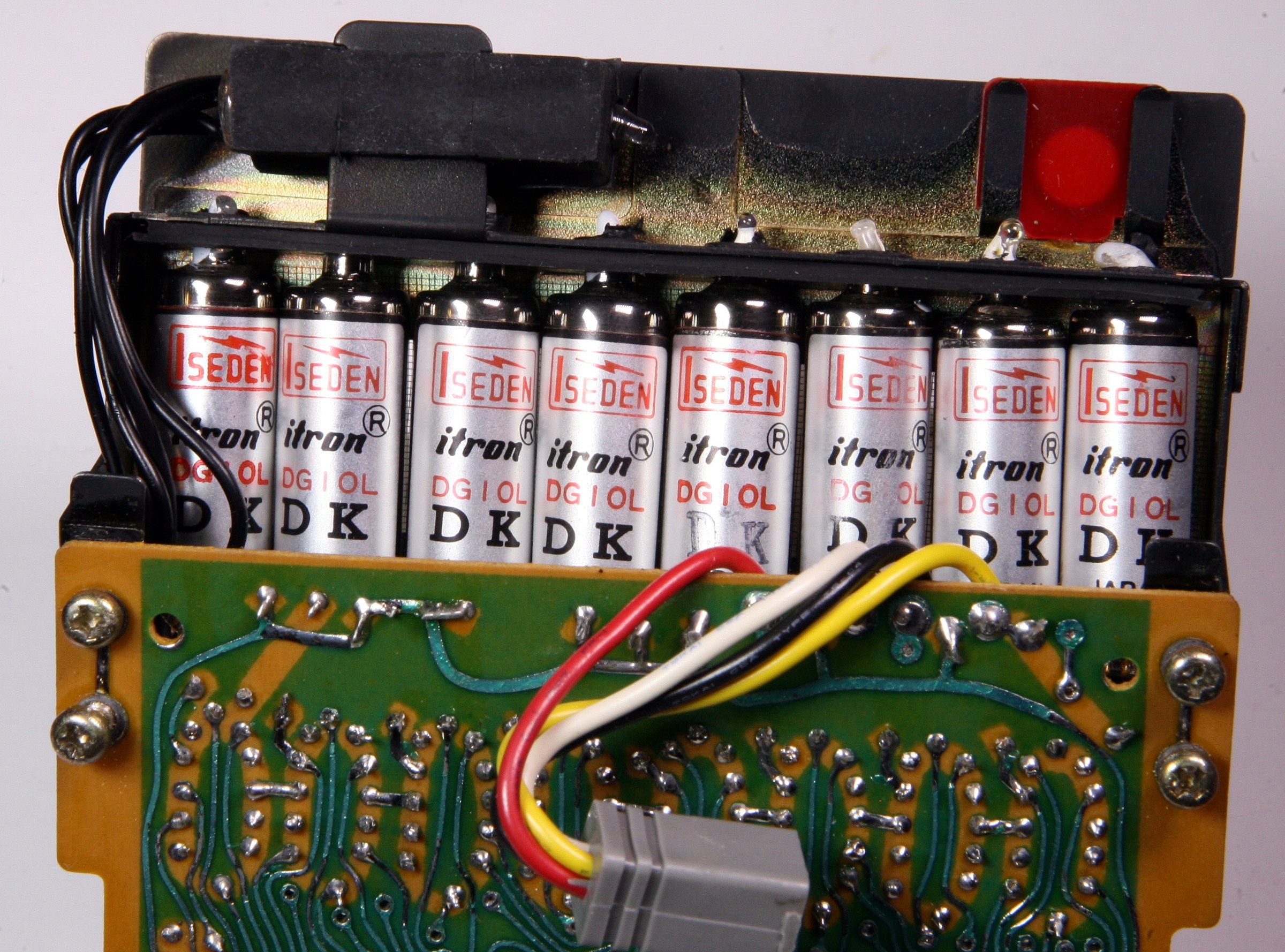
I do not have a VFD calculator in my collection yet.
1.1 What they are
A VFD calculator is an electronic calculator whose display is a vacuum-fluorescent tube, or a row of them. The tube is a triode, a three-element vacuum tube. A fine filament, heated to a dull red, gives off electrons. A mesh grid in front of it controls them. Behind the grid sit the anodes, shaped as the segments of a figure and coated with phosphor. When the grid and a segment are both made positive, electrons pass the grid and strike that segment, and it glows. The viewer looks at the lit segments through the filament and grid, which are too fine to see.
What made the tube a success was its voltage. A Nixie tube needs about 170 volts to strike, and every Nixie calculator carried a high-voltage supply and a set of high-voltage drivers. A VFD lights at 20 to 30 volts, close to the voltages at which the MOS integrated circuits of the late 1960s worked. In many machines the calculator chip drives the tube directly, with nothing between them but a resistor on each line. The tube is bright, readable in daylight, cheap to make in quantity, and it was free of the Nixie patents that the Burroughs Corporation held.
The machines fall roughly into three groups:
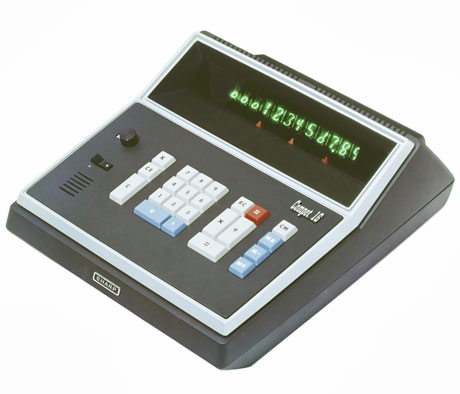
- Desk machines with single-digit tubes (1967–73): the Sharp CS-16A and the QT-8D Micro Compet, the Busicom Junior, the Toshiba BC series, the Friden EC-1117A and many more, each digit a separate glass tube on a row of flying leads.
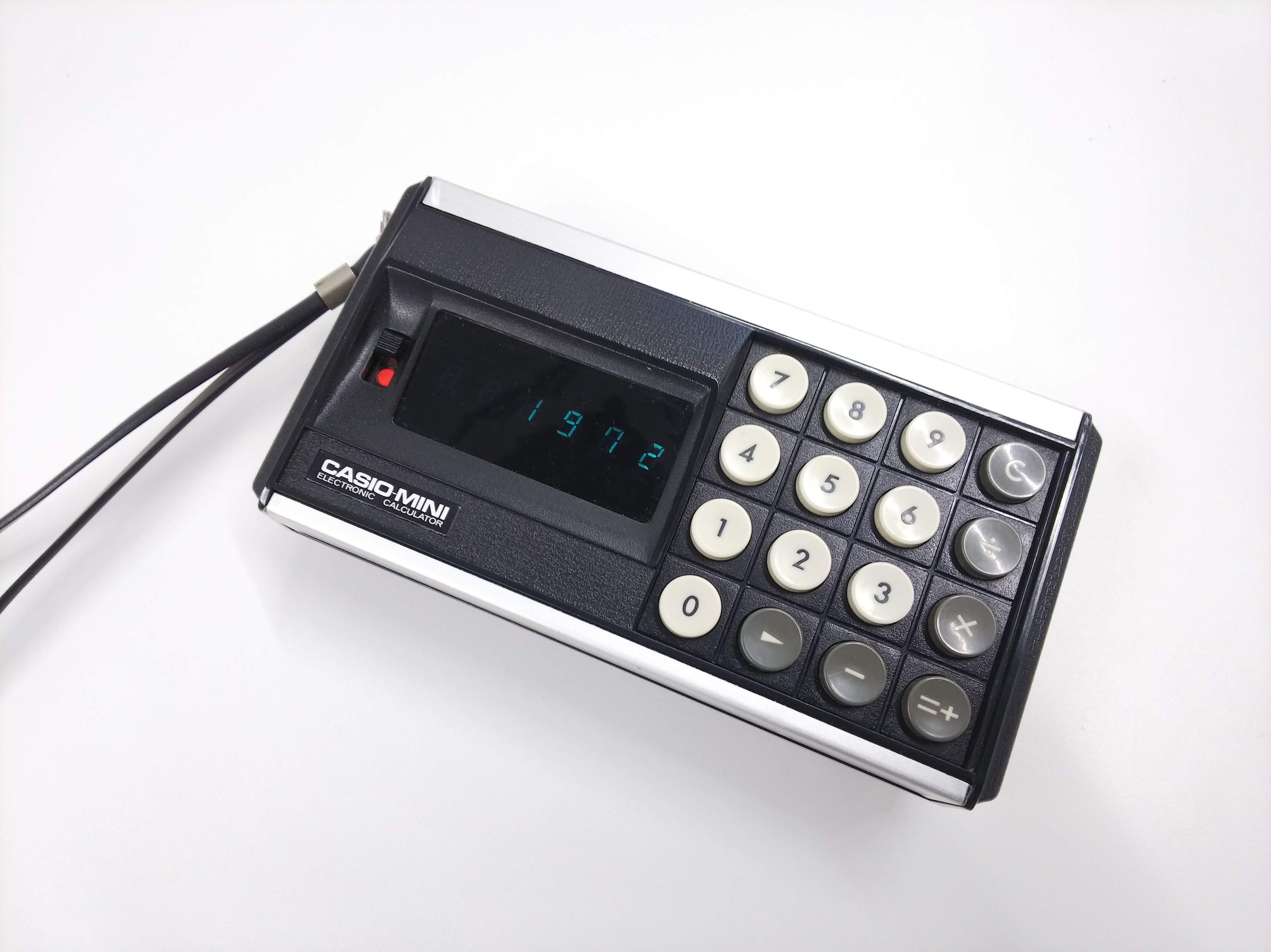
- The first handhelds (1971–74): the Sharp EL-8 and its many relatives, then the Casio Mini of August 1972, which sold more than a million in a year and made the calculator a consumer product.
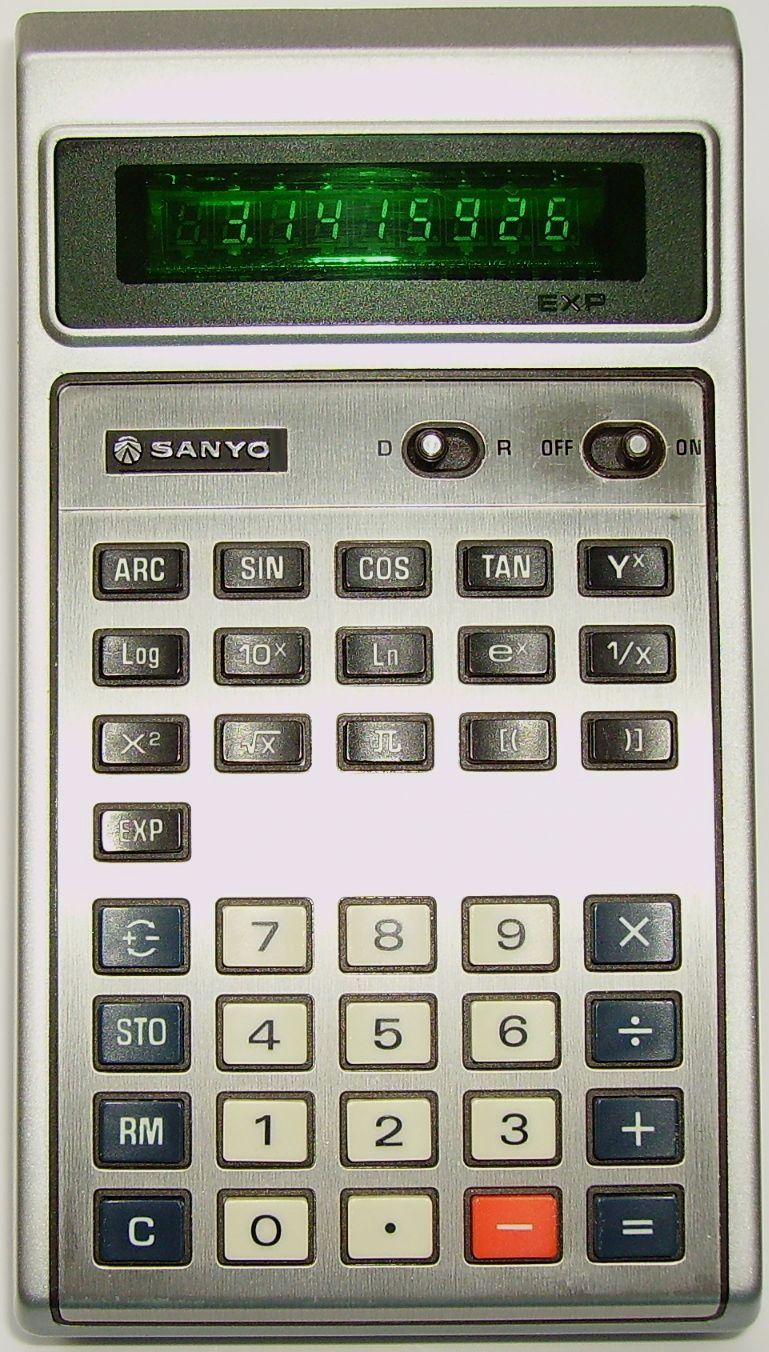
- Pocket and desk machines with multi-digit tubes (1972–c. 1985): one glass envelope holding eight to sixteen digits, first round, then flat. Thousands of models from Casio, Sharp, Canon, Sanyo, Toshiba, Rockwell, Commodore and dozens of smaller brands, including scientific and programmable machines such as the Casio fx-201P.
1.2 Why green?
The phosphor that made the VFD possible is zinc oxide with a slight excess of zinc, written ZnO:Zn. It is one of very few phosphors that glows brightly when struck by slow electrons, at a few tens of volts, and its light is a broad blue-green band peaking near 505 nanometres. For most of the 1970s it was the only practical choice, so calculators were green or blue-green; a tinted window over the tube deepened the colour and hid the faint red of the filament. Other colours came later and were dimmer.
1.3 The machines
The model volume takes the makers one by one; in brief:
- Sharp (Hayakawa Electric): the company that asked for the tube. The CS-16A (1967), the four-chip QT-8D Micro Compet (1969), the hand-held EL-8 (1971), the EL-8xx ELSI MATE pocket line, and scientific desks such as the EL-5001.
- Casio: the AS-8 (1971), the Casio Mini (1972) and its family, the fx-10 pocket scientific of 1974, the fx-101 and fx-201P, and the CQ-1 clock-calculator of 1976.
- Busicom: the Junior 120-DM, the first machine with Mostek’s single-chip MK6010.
- Canon, Toshiba, Sanyo, Hitachi, Omron and the brands they built for: Friden, Facit, Addo-X, Burroughs, Commodore, Royal, Lloyd’s, Sears, Triumph-Adler and many more.
- Rockwell, which made the chips inside the early Sharps and later its own VFD pocket machines, and Texas Instruments, whose chips drove VFD, LED and gas-discharge displays alike.
1.4 The end of the green glow
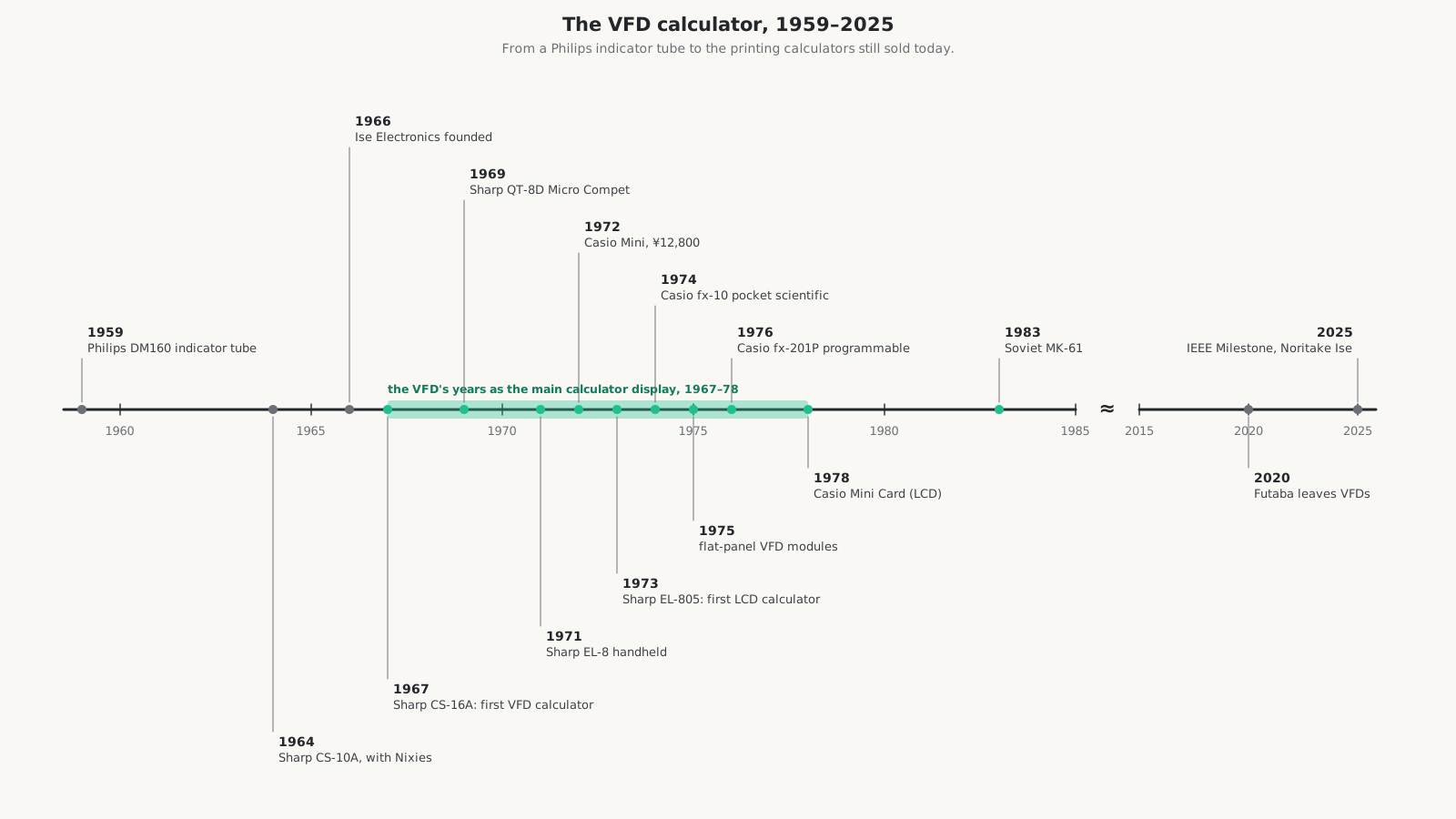
The VFD’s weakness was power. Its filament must be kept hot whether or not anything is lit, and the 25 to 45 volts for the grids and anodes have to be made from a battery by a small converter. A pocket VFD calculator ran for about ten hours on its cells. Red LED displays, used by most American makers, were no better. Liquid-crystal displays used almost nothing: Sharp’s EL-805 of 1973, the first LCD calculator, ran for about a hundred hours on one AA cell. By 1978 the pocket VFD was giving way to the LCD in Japan, and by the early 1980s it was almost gone from pockets.
On the desk it lasted. Mains-powered desk and printing calculators kept their bright green displays through the 1980s and beyond, and printing calculators with fluorescent displays are still sold new. Ise Electronics, now Noritake Ise, still makes the tubes; in November 2025 the IEEE dedicated a Milestone to the vacuum-fluorescent display at its works in Mie Prefecture.
1.5 What is in this series
- The Green Glow: this introduction.
- The Vacuum-Fluorescent Tube: where it came from, how it is made, and how it works.
- The Machines: the important VFD calculators, maker by maker, with dates, prices and the tubes and chips inside.
- Driving the Display: filament supplies and bias, why PMOS chips could drive the tube directly, multiplexing, blanking, and the keyboard scan that shares the same lines.
- Inside the Machines: real circuits, desk and pocket, from Brent Hilpert’s schematics, and the calculator chips behind them.
- Operating Them: step-by-step instructions and worked examples from the owner’s manuals.
- Repair and Restoration: what fails, how to test a tube, safe first power-up, batteries and adapters.
- Building One Today: modern VFD calculators and how to build one.
- Collecting: what to look for, what they cost, where to find them, and the documents in the Library.
1.6 A note on the sources
The invention of the tube is documented by Ise Electronics’ own papers and by the IEEE Milestone proposal, which reproduces the 1967 press reports and the patents. The calculators are documented by collectors and museums: Brent Hilpert’s Early Electronic Calculators pages, whose redrawn schematics, with measured voltages and scan rates, are the backbone of the theory volumes; John Wolff’s Web Museum; Rick Bensene’s Old Calculator Web Museum; the Calcuseum database; the Whipple Museum’s Hookham collection; and the owner’s manuals scanned at wass.net. Where sources disagree on a date, a tube type or even a display technology, the text says so. The manuals, schematics, datasheets and papers behind the series are in the Reference Library.
Comments (0)