Soviet Calculators · Volume 4
The Pocket Calculators, 1974–1992
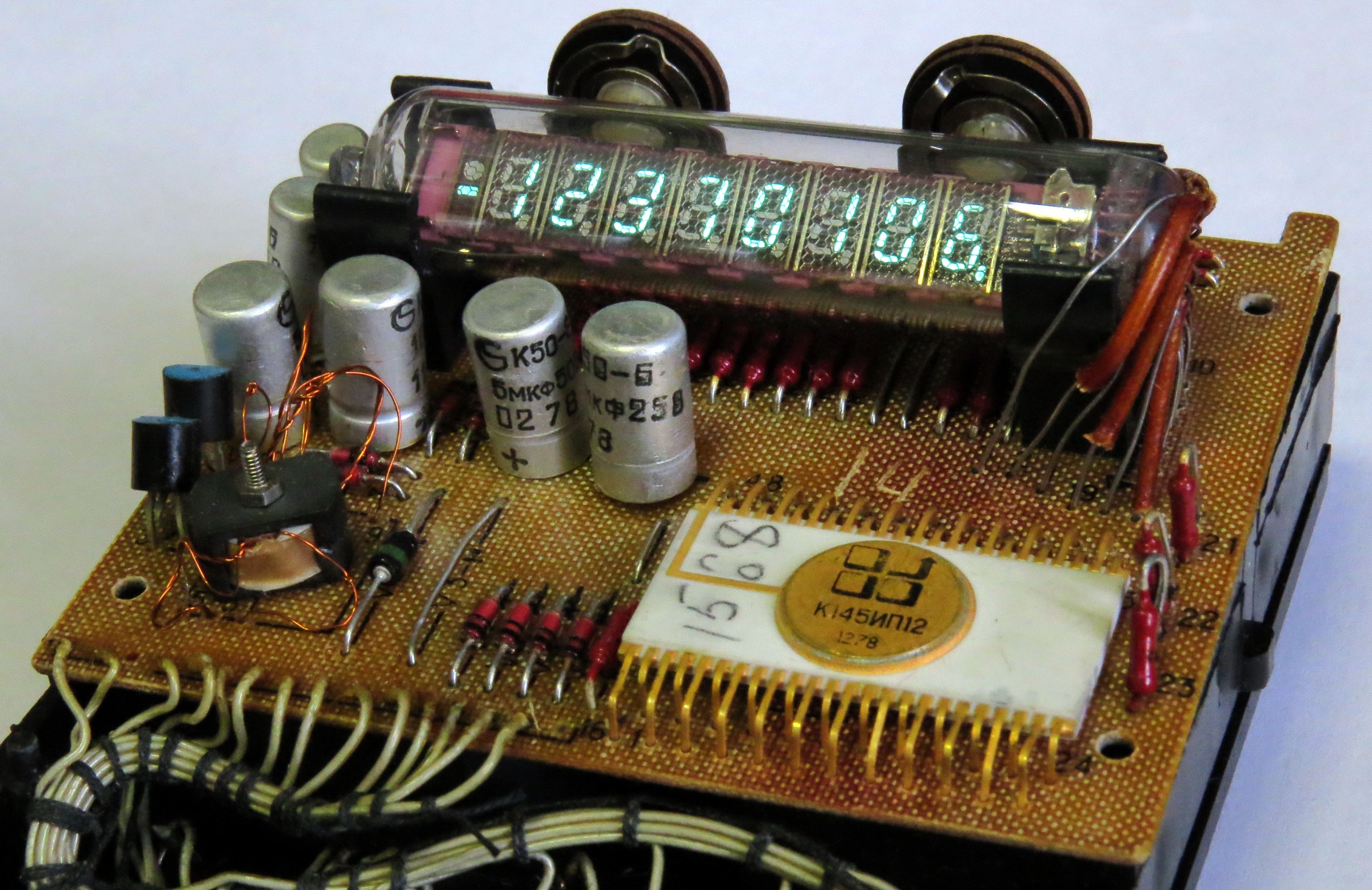
The Soviet pocket calculator began with a deadline. In August 1973 the Ministry of the Electronics Industry set the Angstrem works at Zelenograd the task of building one within a year. A team of 27 had prototypes in five months, put the machine before the state commission in nine, three months early, and had it on sale early in 1974. Over the next eighteen years the Elektronika line grew to dozens of models: four-function, scientific, solar, programmable, and finally pocket computers that ran BASIC.
4.1 The first pockets
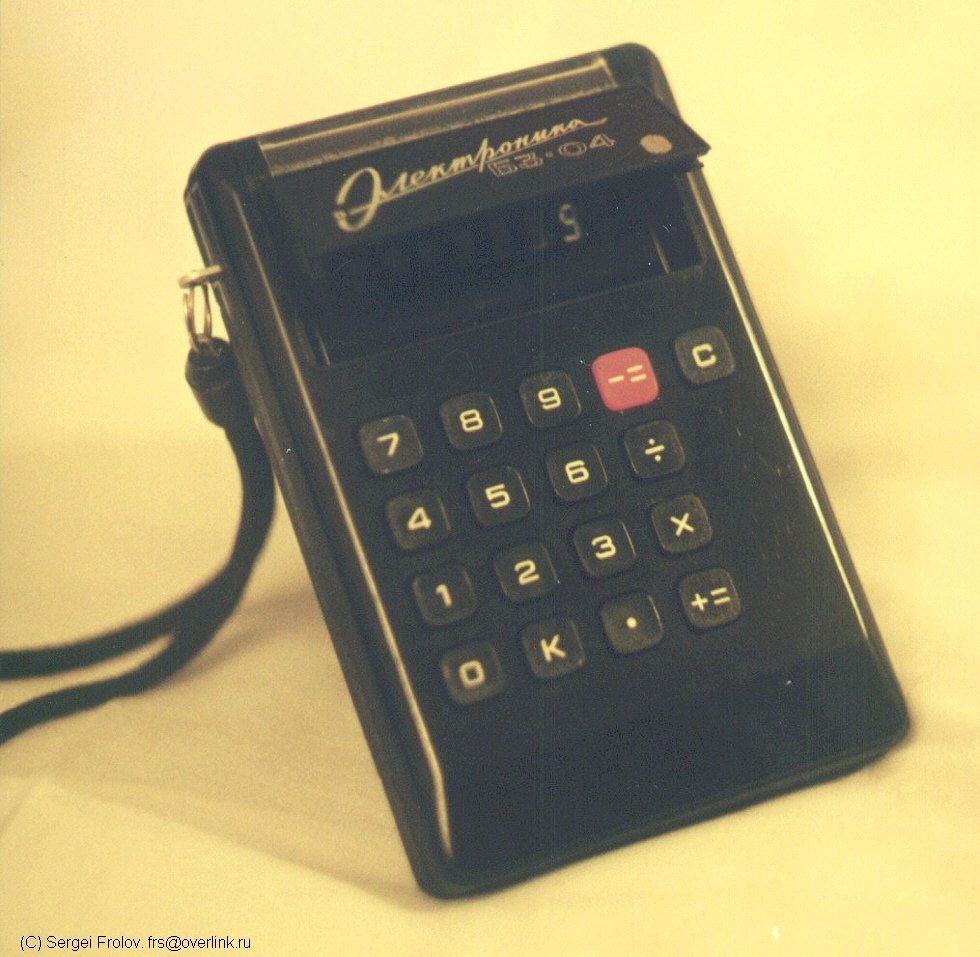
B3-04 (1974). Four chips, К145ИП1 (processor), К145ИП2 (operating register), К145АР1 (a 23-bit shift register) and К145ПП1 (display control), about 3,400 elements on a 5 × 5 mm die, on a board of glass; an inverse, light-on-dark liquid-crystal display; one AA cell; 118 × 78 × 20 mm and about 200 g; 220 roubles. Its outside closely resembles the Sharp EL-805 of May 1973, and five sources say so; its chips were Soviet. One catalogue describes its display as fluorescent, but Frolov and others describe it as an LCD.
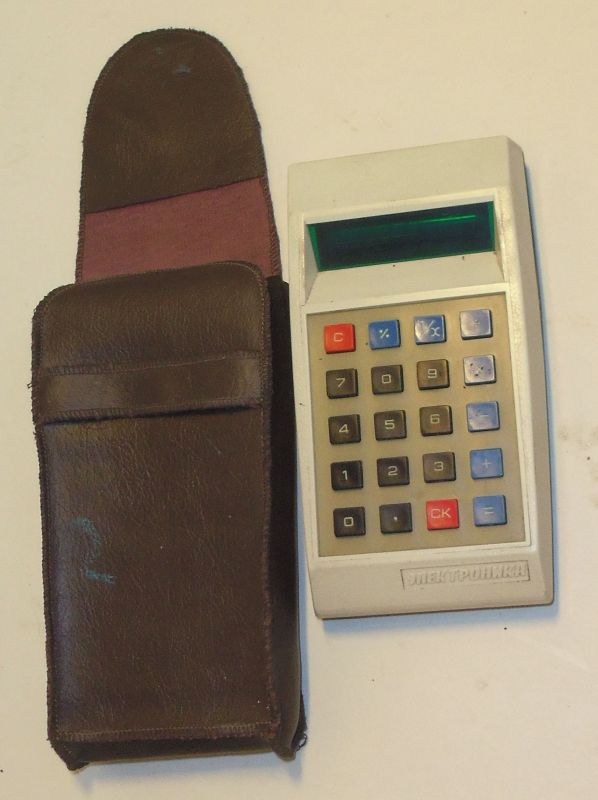
B3-09M and B3-14 (1975–76). About a year after the B3-04 came the first fluorescent-display pocket machines: a К145ИК2 processor with a phase generator, mains or four AA cells, 90 roubles for the B3-09M, falling to 55 in 1979, and later the B3-14 on three AA cells at 55, then 30 roubles. Frolov notes a bug in the B3-09M: 9.9999999 + 10 gives 120.
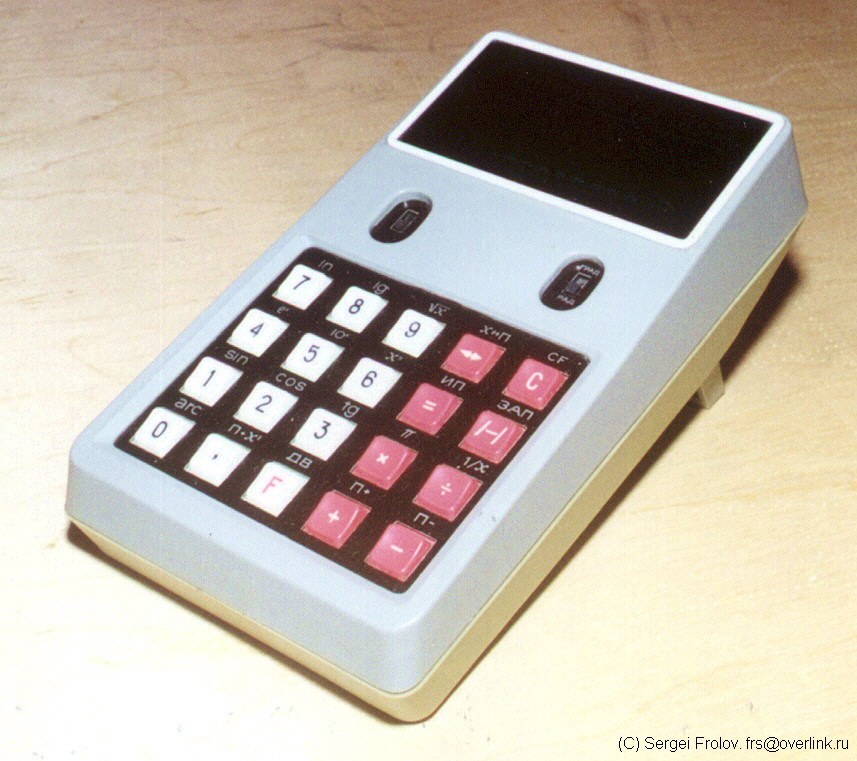
B3-18 (1975–76): the first scientific. One chip, the К145ИП7, on a die of 5 × 5.2 mm, with about 45,000 elements by Frolov’s count (another source gives about 10,000 transistors); an eight-digit green fluorescent display; four NiCd cells; 220 roubles in 1976; and the first Soviet calculator with an “F” key to reach second functions. It was made at Angstrem, at the Elektronika plant in Boguchar and at Billur in Ganja. Frolov records that its chip needed an exact supply voltage, which was often written in pencil on each chip to a hundredth of a volt. It is said to follow Rockwell designs, the 202SR and, for the B3-18A, the 61R. The B3-25A was a cut-down B3-18A, and the B3-37 an LED version on AA cells.
B3-19M (1977): the first RPN pocket. An eight-digit engineering calculator with reverse Polish notation and an X, Y, Z stack, the first Soviet machine with exponent entry, and a twelve-digit red LED display, at 240 roubles. Frolov records it as made in, or with engineers from, East Germany.
4.2 The programmable calculators
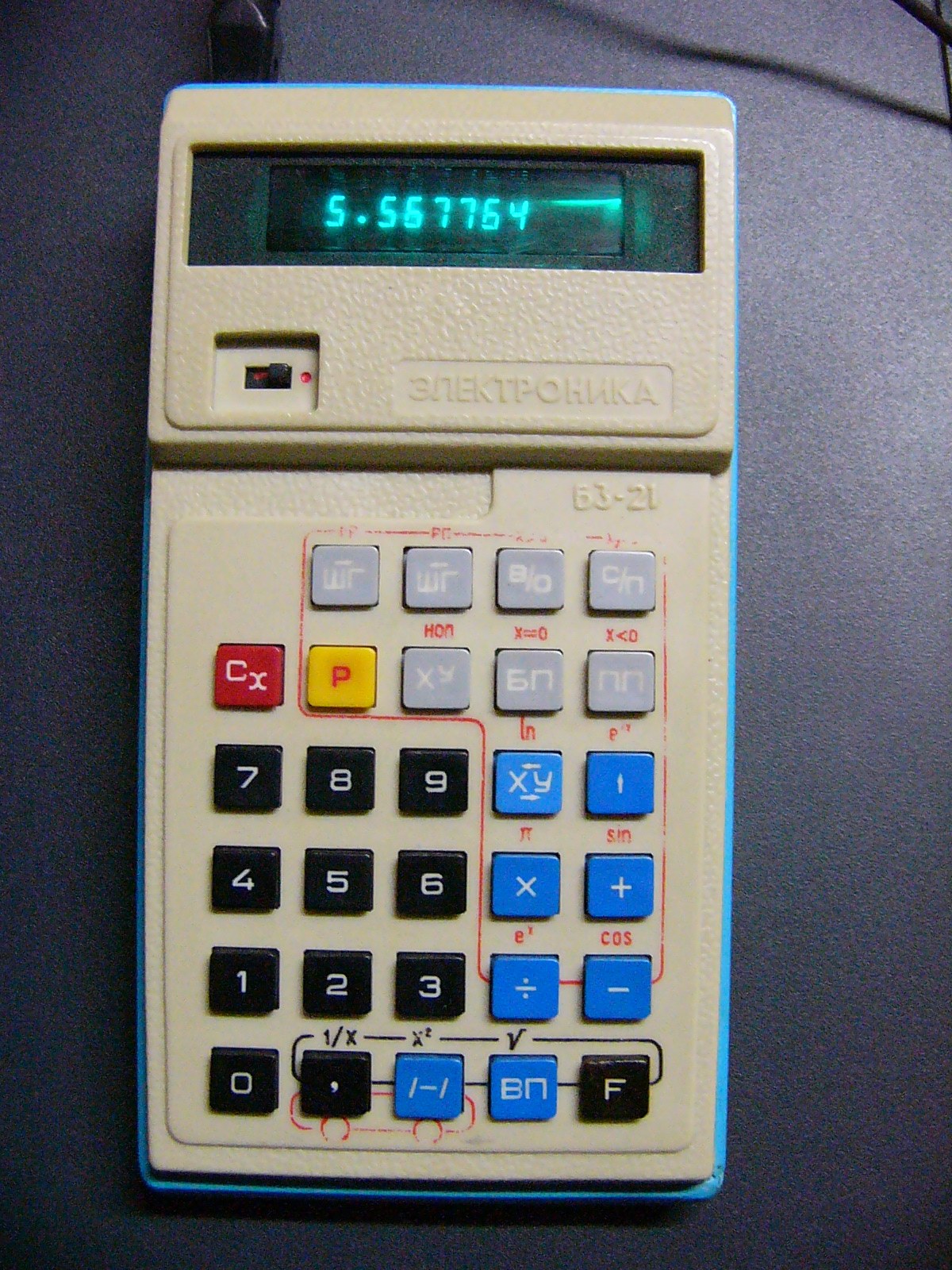
B3-21 (1977). Developed in 1975, in production at the Kalkulyator works in Svetlovodsk from early 1977 and in the shops from early 1978, the B3-21 was the first Soviet pocket programmable: sixty program steps in ten pages of six, reverse Polish notation with a six-number ring stack, seven memories, and at first a red LED display, later a green fluorescent one that is said to have been about 20 per cent slower. It cost 350 roubles, then 190, then 80. Desk relatives, the MK-46 and MK-64, added inputs for sensors and a printer and were used in school physics laboratories; the MK-47 was the only Soviet calculator with magnetic cards.
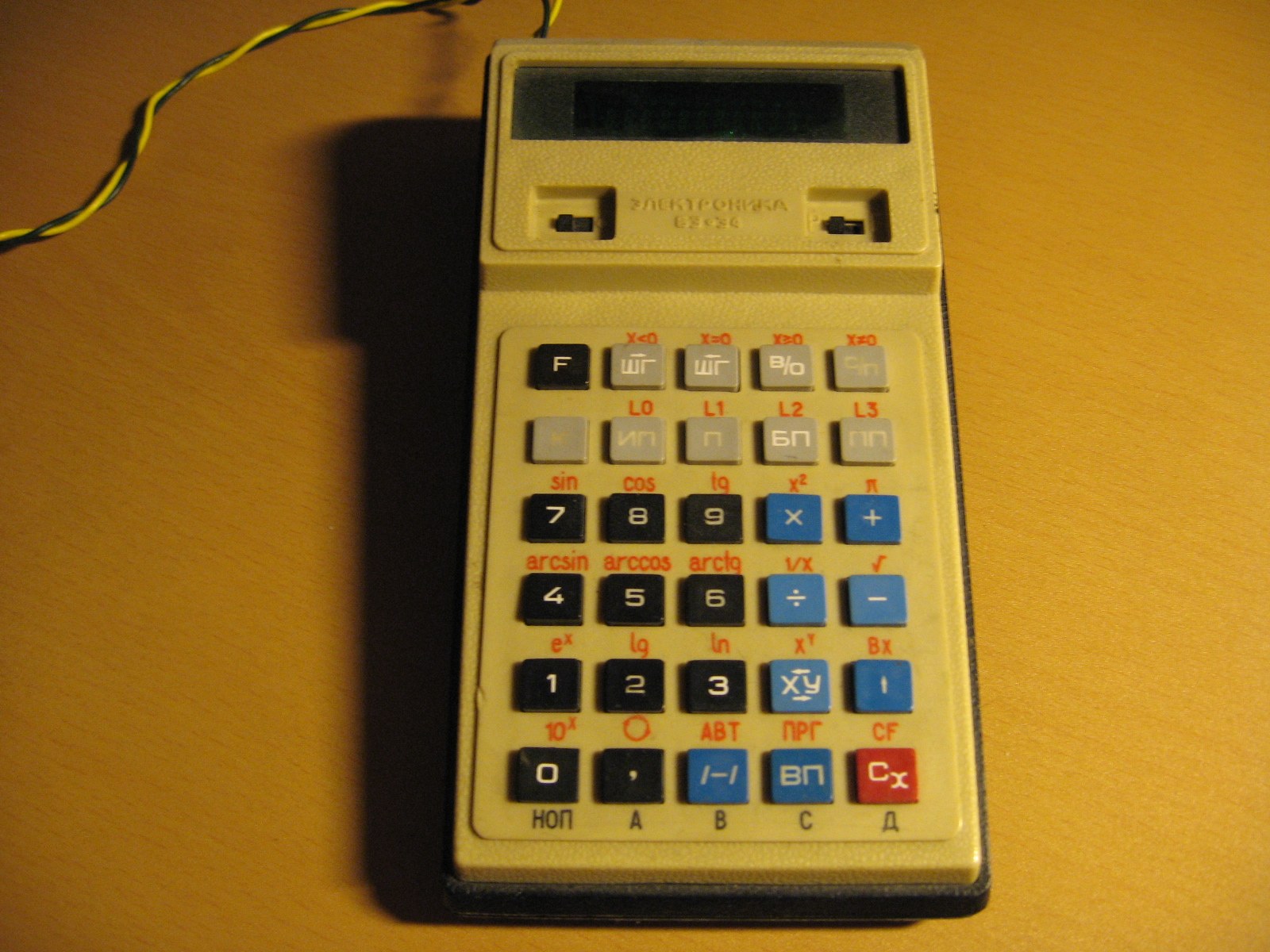
B3-34 (1980). The machine that founded the Soviet programmable culture: 98 program steps, fourteen memory registers, a four-level stack with a “previous X” register, indirect addressing and loops, at 120 roubles and later 85. Its chips, the К145ИК1302 and К145ИК1303 processors, two К145ИР2 memory chips and a К165ГФ3 clock, are described in the inside volumes. It was made at Svetlovodsk; Kon-Tiki says that plant was the only maker of the B3-21 and B3-34. The MK-54 of 1982 from Kiev was the same machine in a slimmer case on three AA cells, at 65 roubles; the MK-56 a desk version.
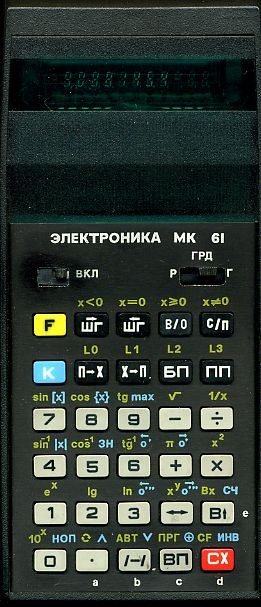
MK-61 (1983–85). Made in Kiev under chief designer A. G. Sherevenya, the MK-61 added a third processor chip, the К745ИК1306, which brought the program to 105 steps, the registers to fifteen, and added degree conversions and logical operations. The tube is the twelve-position ILC2-12/8L. Sources date it to 1983, 1984 or 1985. It cost 85 roubles, and it became, in one writer’s phrase, “the most popular PMK in the country”.
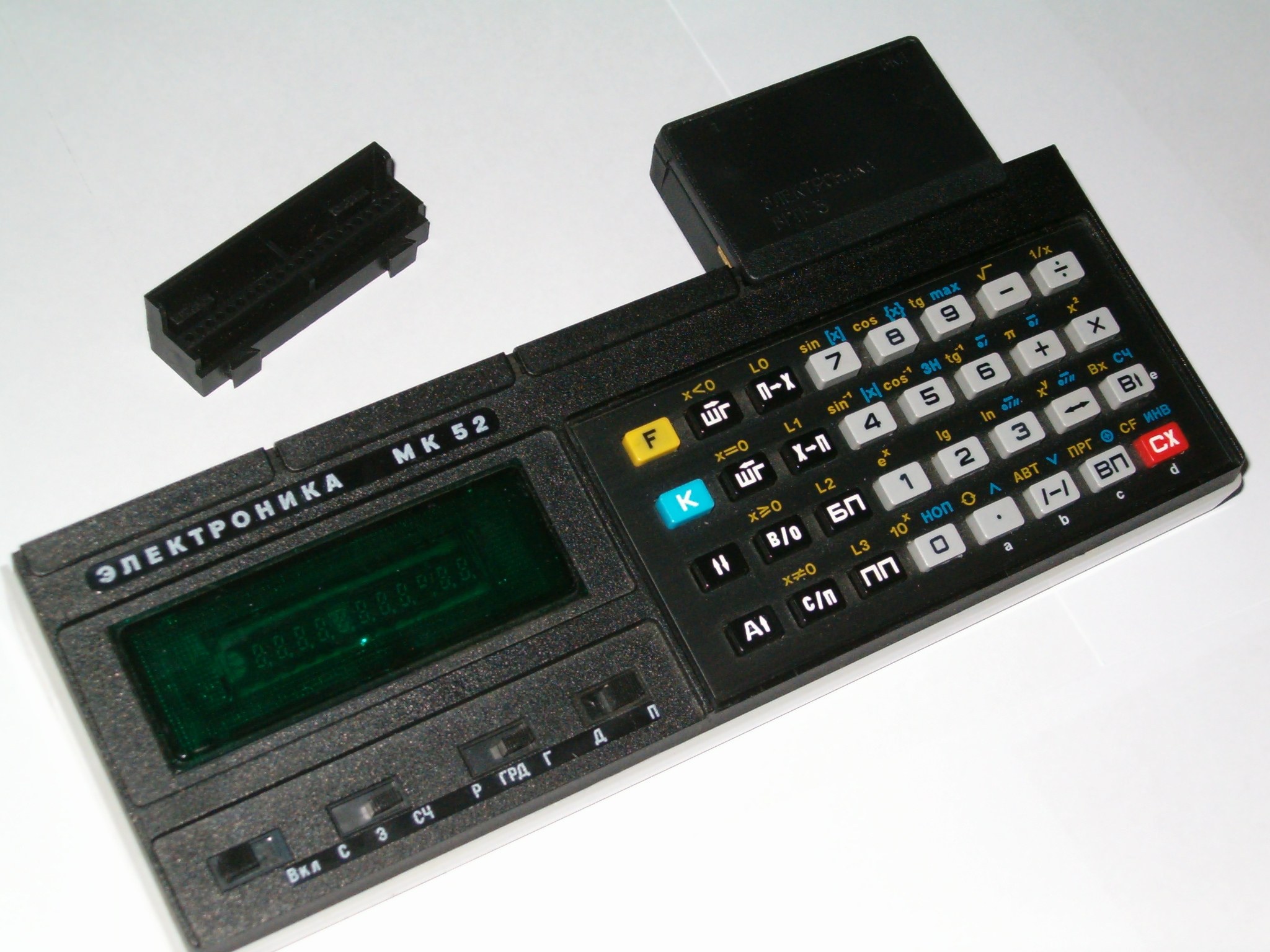
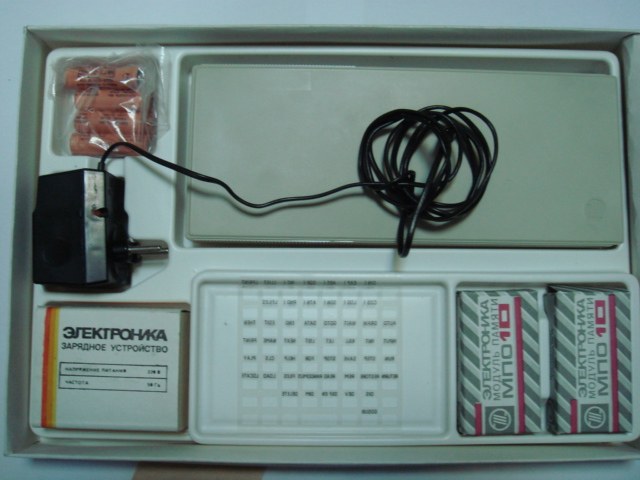
MK-52 (1985). The MK-61’s big brother: the first Soviet calculator with non-volatile memory, a КР1601РР1 EEPROM of 512 bytes rated for 10,000 rewrites, and a slot for plug-in ROM modules, the БРП: BRP-2 “Astro” for navigation, BRP-3 with sixty mathematical programs, BRP-4 with games. It cost 115 roubles. The navy used it for astronomical navigation from 1988. It is also reported to have flown on Soyuz TM-7 in November 1988, as a backup for working out a landing trajectory if the on-board computer failed; but every published account traces back to a single article by Frolov in 1998, so this is better said as “reportedly”.
4.3 Scientifics, solar machines and the smallest
- B3-26 (1977) and its family on the К145ИП11 chip: four-function machines at 45 roubles and less; the B3-23A, at 18 roubles, was the cheapest Soviet calculator.
- B3-30 (1978): the second Soviet LCD calculator, using 8 mW against the B3-26’s 600 mW; 58 roubles, then 40.
- B3-36 (1979): an algebraic scientific with two levels of brackets, 220 roubles, falling to 70 by the end of 1981; renamed MK-36.
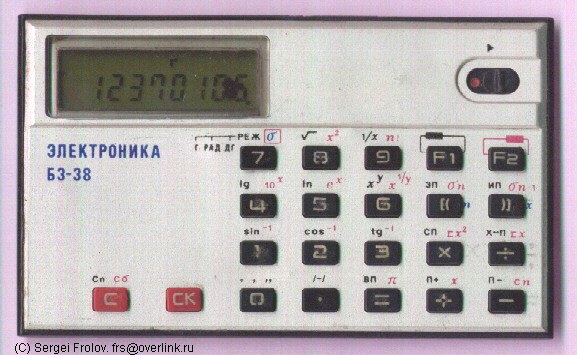
- B3-38 (1979–81): at 91 × 55 × 5 mm the smallest Soviet calculator, with statistics and digit-by-digit function algorithms.
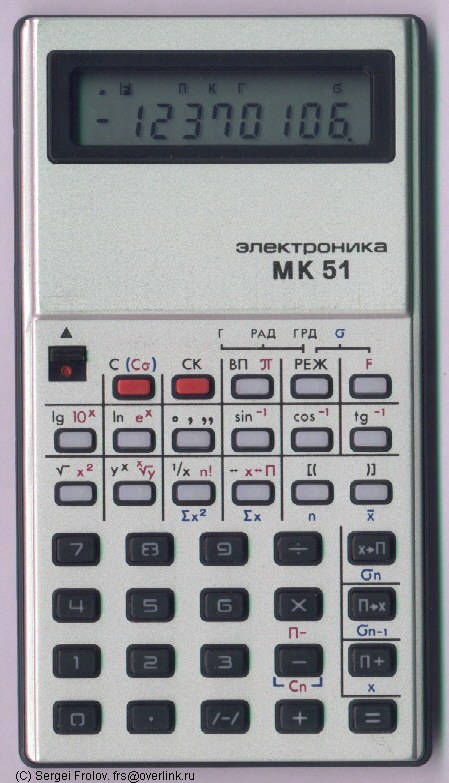
- MK-51 (from 1982): the long-lived scientific, made to 2000: a nine-digit LCD, one К757ИП1-2 chip containing, as its manual says, “18 thousand transistors”, 35 operations, two levels of brackets, statistics, 0.001 W from one cell, 128.5 × 70 × 8 mm and under 100 g, at 64 roubles.
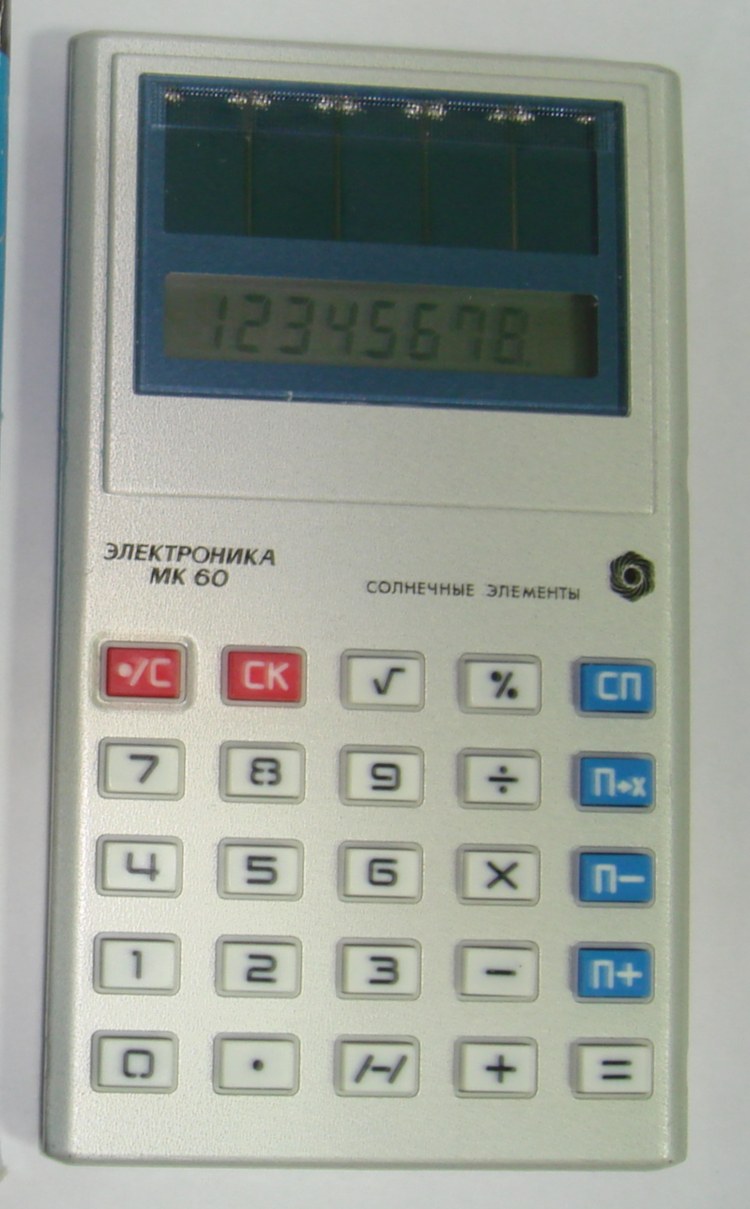
- MK-60 (1982–93): the first Soviet solar calculator, at 50 roubles; an export version had Latin keys.
- MK-71 (1986–92): a solar scientific from Angstrem, at 75 roubles.
- MK-53 (1980): made for the Moscow Olympics, with a clock, alarm and stopwatch.
- MK-40 (1982): the only Soviet pocket printing calculator, made only as a pilot batch.
4.4 BASIC in the pocket
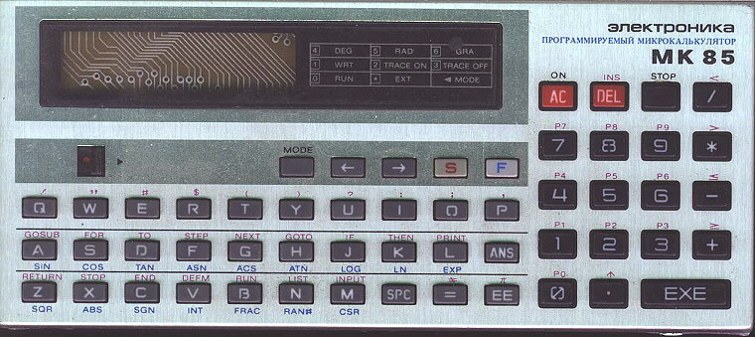
MK-85 (1986). Designed at the NIITT institute in Zelenograd under chief designer L. Minkin and built at Angstrem. Begun in 1984 as a ministry task to reproduce the Casio FX-700P, it looks like one because Minister Shokin demanded it; inside it has a 16-bit CMOS processor with the PDP-11 instruction set and a gate array, not Casio’s 4-bit chip, with 2 KB of memory in the MK-85 and 6 KB in the MK-85M. It went on sale early in 1986 through the ministry’s own shops; more than 150,000 were made, to 2000. A version with encryption, the MK-85S “Ankrypt”, was made for the Bank of Russia and the security services.
MK-87 (1987). An electronic notebook on the MK-85 base, of which about 7,000 were made, given to delegates to a Party congress.
MK-90 (1988). From Kristall in Minsk: BASIC, a 16-bit PDP-11-compatible processor, 16 KB of memory and 32 KB of ROM, a 120 × 64 dot graphic LCD, plug-in memory modules and a dock for a plotter and cassette recorder. It cost 3,500 roubles, later 1,500.
4.5 The machines in brief
Table 1 — The machines in brief
| Machine | Year | Kind | Display | Price, roubles |
|---|---|---|---|---|
| B3-04 | 1974 | four-function | LCD | 220 |
| B3-09M | 1975 | four-function | VFD | 90 |
| B3-18 | 1975–76 | scientific | VFD | 220 |
| B3-19M | 1977 | scientific, RPN | red LED | 240 |
| B3-21 | 1977 | programmable, 60 steps | red LED, later VFD | 350 |
| B3-26 | 1977 | four-function | VFD | 45 (1980) |
| B3-30 | 1978 | four-function | LCD | 58 |
| B3-36 | 1979 | scientific | VFD | 220 |
| B3-34 | 1980 | programmable, 98 steps | VFD | 120 |
| MK-54 | 1982 | programmable, 98 steps | VFD | 65 |
| MK-51 | 1982 | scientific | LCD | 64 |
| MK-60 | 1982 | four-function, solar | LCD | 50 |
| MK-61 | 1983–85 | programmable, 105 steps | VFD | 85 |
| MK-52 | 1985 | programmable, EEPROM | VFD | 115 |
| MK-85 | 1986 | BASIC pocket computer | LCD | 145 |
| MK-90 | 1988 | BASIC, graphic display | LCD | 3,500 |
The Library holds the manuals of the MK-61 (Russian, and in José Mesquita’s English translation), the MK-52 (two Russian books and an English manual), the B3-34, the B3-21 with its passport, the MK-51 and the MK-90.
Comments (0)