Soviet Calculators · Volume 1
Soviet Calculators: Elektronika
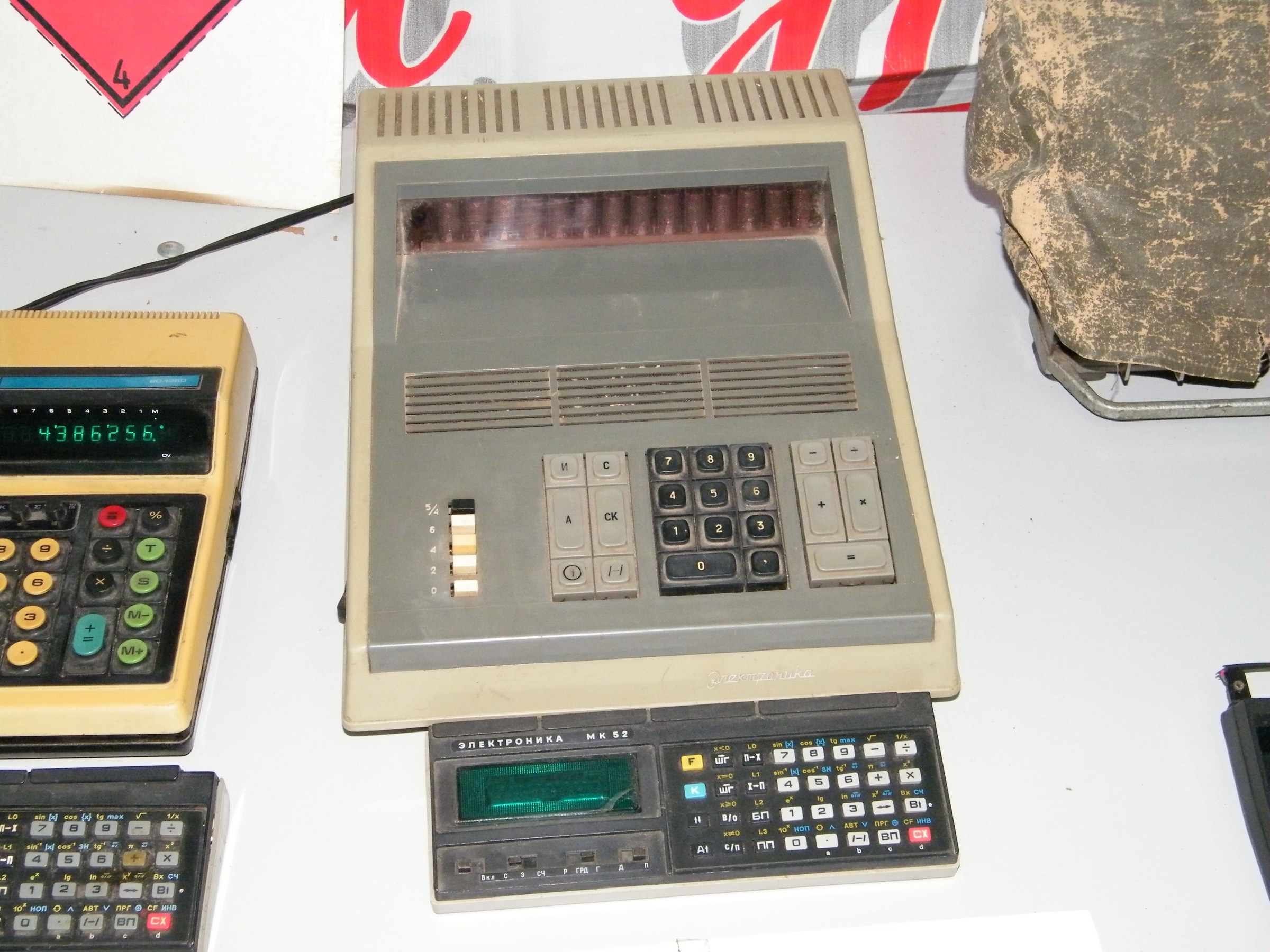
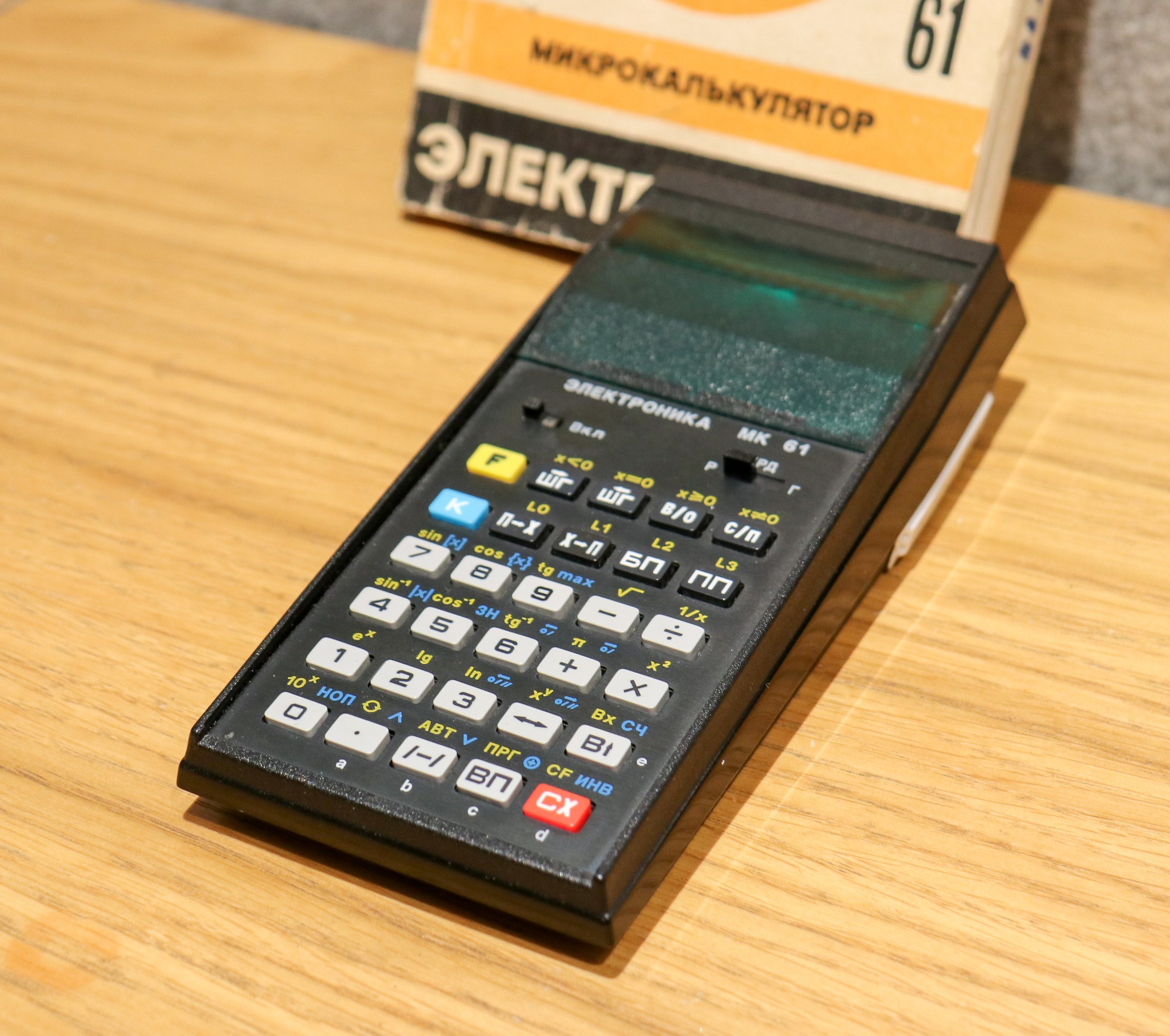
The Soviet Union built its own electronic calculators from 1962 until the country ceased to exist, and went on building some of them for years afterwards. They form a world of their own: machines designed in state institutes, made in factories from Leningrad to Azerbaijan, priced in roubles that could be a month’s wages, sold with a printed passport and an inspection stamp, and carrying names that read like part numbers. A few were copies of Japanese and American machines. Many were not. The best known, the programmable Elektronika MK-61 and its relatives, gathered a following of their own in the 1980s, with magazine columns, science-fiction serials written as programs, and a whole study, half joke and half serious research, of the things the calculators could do that their makers had never documented.
I do not have a Soviet calculator in my collection yet.
1.1 A field of their own
The other series on this site divide electronic calculators by display: cathode-ray tubes, Nixie tubes, vacuum-fluorescent tubes. Soviet calculators used all of those and more, and they are best seen together, because they share a history, a naming system, an industry and a culture that set them apart from everything made in the West or in Japan.
- They were made by two rival ministries. The desk machines called Vega and Iskra came from the office-machine industry; the pocket calculators called Elektronika came from the Ministry of the Electronics Industry, the same ministry that ran Zelenograd, the Soviet Silicon Valley.
- Their names are codes. Б3-34 is not a model name but a classification: Б for consumer goods, 3 for calculators, 34 for the model. The later МК- names mean simply microcalculator.
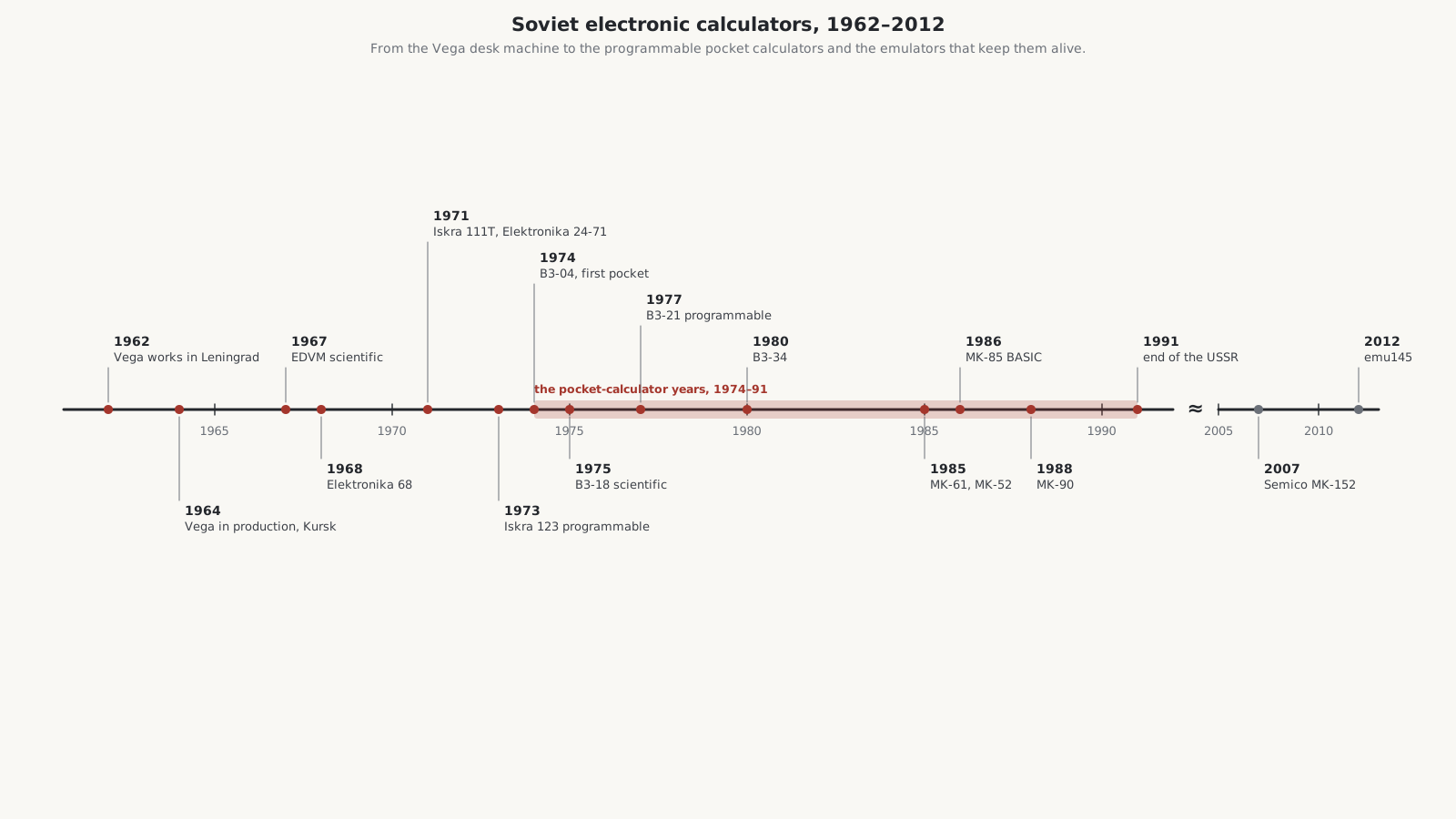
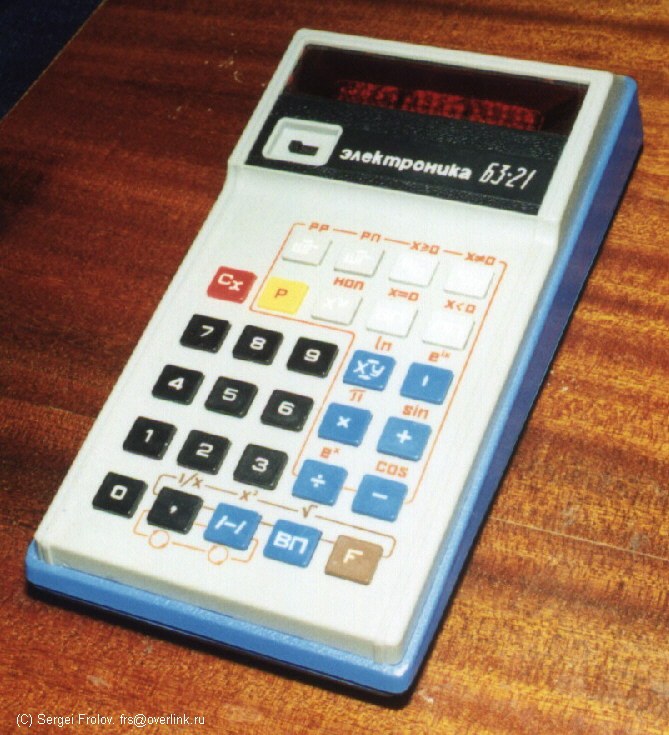
- They were expensive. The first pocket programmable, the B3-21 of 1977, cost 350 roubles when the average monthly wage was about 150. The price was often moulded into the plastic of the case.
- They were documented. Almost every Soviet calculator came with an operating manual, a passport and often a full circuit diagram, with winding tables for the transformer and measured voltages at every transistor.
- Some were copies, and many were not. The Elektronika 68 of 1968 followed a Sharp desk machine closely; the B3-04, the first pocket model, looked like a Sharp EL-805; the MK-85 pocket computer was made to look like a Casio by ministerial order. But the chips inside the programmable calculators were Soviet designs, and Western enthusiasts decapped and photographed them in the 2010s to find out how they worked.
1.2 The machines in brief
- Desk machines (1962–1980): the Vega of 1962–64, the first, with an electroluminescent display and ferrite-transistor logic; the military EDVM scientific of 1967; the Elektronika 68 with fourteen Nixie tubes; the Iskra family from Kursk, from the Iskra 11 to the programmable Iskra 123 and the CRT-display Iskra 1122; and the Elektronika 24-71 of 1971, the first Soviet calculator on large-scale integrated circuits and the first with vacuum-fluorescent tubes.
- Pocket calculators (1974–1992): the B3-04 of 1974, an LCD machine; the fluorescent-display B3-09M, B3-14 and B3-18, the first Soviet scientific; the B3-19M, the first with reverse Polish notation; the programmable B3-21, B3-34, MK-54, MK-61 and MK-52; the scientific MK-51; the solar MK-60 and MK-71; and the BASIC pocket computers MK-85 and MK-90.
- Elsewhere in the Eastern Bloc: Bulgaria’s ELKA Nixie desk calculators from 1965, East Germany’s Soemtron 220, Poland’s TMK-204 and Elwro machines.
1.3 The display, machine by machine
The series on Nixie and fluorescent calculators mention the Soviet machines only in passing. Here is where they used each technology:
Table 1 — The series on [Nixie](https://calculators.fubsypoly.com/nixie-calculators/) and [fluorescent](https://calculators.fubsypoly.com/vfd-calculators/) calculators mention the Soviet machines only in passing. Here is where they used each technology
| Display | Machines |
|---|---|
| Electroluminescent | Vega (1964) |
| Nixie tubes | EDVM (IN-16), Elektronika 68 (IN-8-2), Iskra 11M and Iskra 12 (IN-14), Iskra 110 to 123, ELKA (Bulgaria), Soemtron 220 (East Germany) |
| Cathode-ray tube | Iskra 1122, Elektronika T3-16, perhaps the Elektronika-70 |
| Vacuum-fluorescent | Elektronika 24-71 (IV-1, IV-2, the first), S3-07, B3-02, B3-05, B3-09M, B3-14, B3-18, B3-34 (IVL2-8/12), MK-54, MK-61 and MK-52 (ILC2-12/8L), Iskra 122-1 (IV-6) |
| Red LED | B3-19M, early B3-21, B3-23, S3-33, B3-37 |
| Liquid crystal | B3-04, B3-30, B3-38, MK-51, MK-60, MK-71, MK-85, MK-90 |
1.4 What is in this series
- Elektronika: this introduction.
- The Industry: the ministries, the factories, how the names work, what they cost, and how much was copied.
- The Desk Machines, 1962–1980: from the Vega to the Iskra family and the first Elektronikas, with the Bulgarian, East German and Polish machines.
- The Pocket Calculators, 1974–1992: the B3- and MK- series, from the B3-04 to the MK-90.
- Inside: Displays and Power: the tubes, the converters, the mains adapters, with the factory schematics.
- Inside the MK-61: the chips, the memory ring, the timing, the keyboard scan, and the hardware behind ЕГГОГ.
- Operating Them: the MK-51 scientific and the MK-61 programmable, from the factory manuals, with a translated key list, a first program and the game Lunolet-1.
- Repair and Restoration: what fails, a safe first power-up, and spare parts.
- Collecting: what they cost, what to look for, buying from Ukraine and Russia today, and the emulators and modern successors.
1.5 A note on the sources
The history of Soviet calculators was gathered almost single-handed in the 1990s by Sergei Frolov of St Petersburg, whose Soviet Digital Electronics Museum and two-part history, written in 1998, are the starting point for nearly everything published since. His museum site is now offline; its pages and photographs survive in the Internet Archive. Other sources include the Mytishchi Museum of Computing Technology, the Kon-Tiki programmable-calculator community and its library, Russian and English Wikipedia, articles on Habr, Boris Malashevich’s histories of Zelenograd, and, for the hardware, the factory schematics of the MK-61 and the B3-34 and Felix Lazarev’s emulator of their chips, built from microscope photographs of the dies. Where sources disagree, which for Soviet dates is often, the text says so. The manuals, schematics, books and magazines behind the series are in the Reference Library.
Comments (0)