Soviet Calculators · Volume 2
The Industry
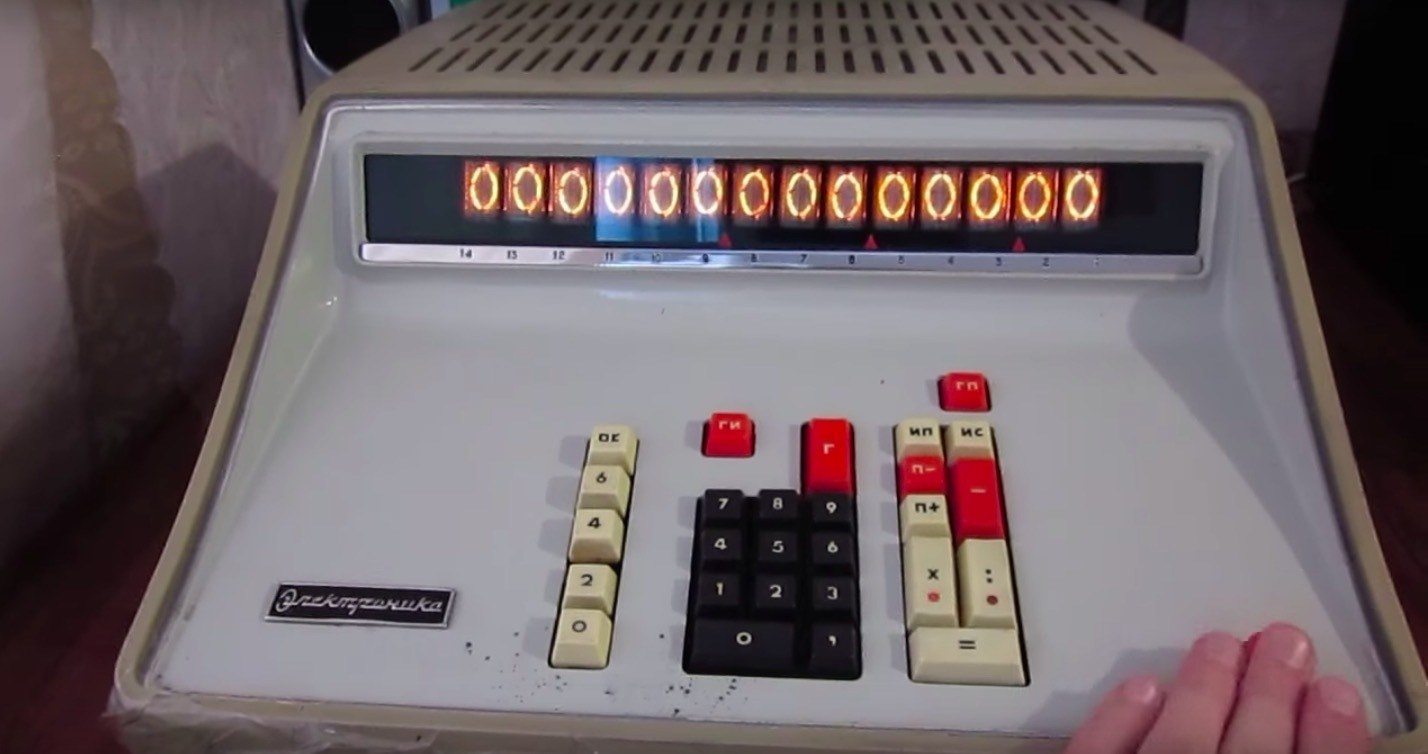
A Soviet calculator was not a product of a company. It was the output of a plan, assigned to a ministry, designed at an institute, built at one or more state factories, priced by a state committee, and sold through state shops. Understanding the machines means understanding a little of that system: who made what, how the names were formed, what the prices meant, and how much of the design came from abroad.
2.1 Two ministries
The Soviet calculator came from two separate branches of industry, and they were rivals.
- The office-machine industry, under the Ministry of Instrument-Making, Automation Equipment and Control Systems (Minpribor), made the desk electronic keyboard computing machines, the ЭКВМ. Its plant at Kursk, the Kursk accounting-machine works (Schetmash), built the Vega from 1964 and then the long Iskra line, alongside Felix mechanical arithmometers and, later, Iskra desktop computers.
- The Ministry of the Electronics Industry (Minelektronprom, or MEP), under Minister Alexander Shokin, made the chips, the tubes and the Elektronika consumer products, including the pocket calculators. Its institutes and factories were concentrated at Zelenograd, near Moscow, and in Kiev, Leningrad and Minsk.
The historian of Zelenograd, Boris Malashevich, describes MEP assigning the MK-85 pocket computer to its Zelenograd institute in 1984 at Shokin’s direction; a Western collector notes that the 27 engineers who designed the B3-04 were MEP people, and that Iskra belonged to the instrument ministry. No single document has been found that sets out the division, but the pattern is consistent: Iskra machines on the desk, Elektronika machines in the pocket, from different ministries.
2.2 The factories
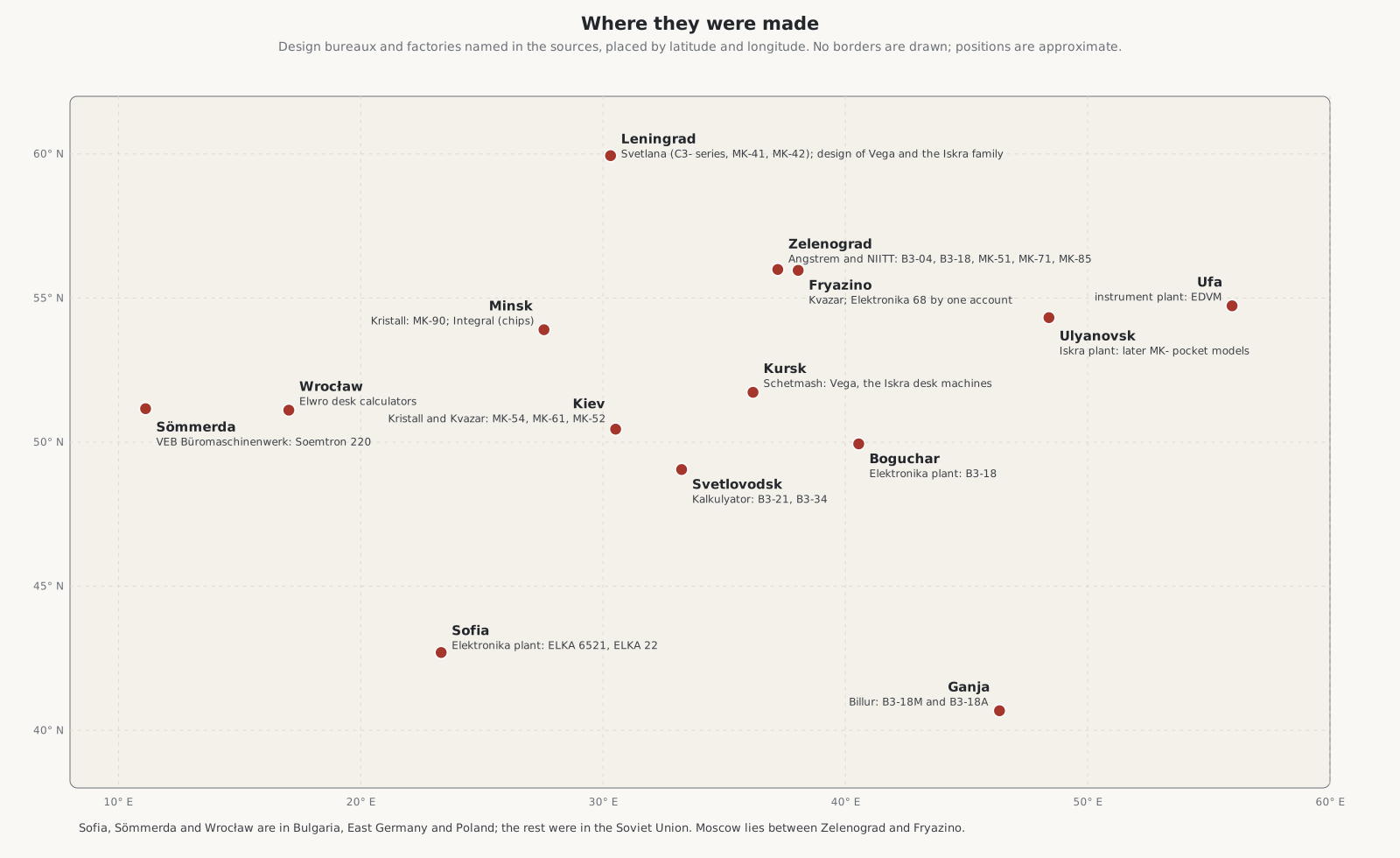
Table 1 — The factories
| Organisation | Where | Calculators |
|---|---|---|
| Leningrad branch of the Central Economic-Mathematical Institute | Leningrad | design of the Vega (1962) and the EDVM |
| Kursk Schetmash (accounting-machine works) | Kursk | Vega (from 1964); the Iskra 11, 12, 22 and Iskra 1xx desk machines |
| State Union Design and Technology Bureau “Schetmash” | Leningrad | design of the Iskra 111 family |
| Instrument plant | Ufa | the EDVM military scientific |
| NII Tsiklon | Moscow region | Elektronika DD and Elektronika 68 (1968) |
| Elektronpribor | Fryazino | Elektronika 68 / B3-01, by one account |
| Angstrem (founded 1963 as NII-336) | Zelenograd | B3-04, B3-18, MK-51, MK-71, MK-85 |
| NIITT (Research Institute of Precision Technology) | Zelenograd | design of the MK-85 |
| Elektronika plant | Boguchar | B3-18 |
| Billur | Ganja (Kirovabad), Azerbaijan | B3-18M and B3-18A |
| Kalkulyator plant | Svetlovodsk, Ukraine | B3-21 (1977–81), B3-34 (1980–86) |
| Kristall and Kvazar | Kiev | MK-54 (from 1982), MK-61, MK-52 |
| Svetlana | Leningrad | the С3- desk series, MK-41, MK-42 |
| Kristall | Minsk | the MK-90 pocket computer |
| Integral | Minsk | chips and Elektronika watches |
Sources disagree on several of these. The MK-61 and MK-52 are credited to Kiev “Kristall” by Russian Wikipedia and to Kiev “Kvazar” by others; the MK-52 manual was printed by Kvazar; and a collector who has examined many MK-61s has found the logos of Kvazar, Kvantor and Kontinent embossed on their cases, with Kristall and Kosmos reported, and concluded that up to five Ukrainian plants built them. The Iskra brand, from Kursk, is unrelated to the Iskra plant at Ulyanovsk, which made some later pocket models.
2.3 How the names work
- Б3- (B3-): the Б stands for бытовая, “household”, the category of consumer goods, and the 3 for the class: calculators. Other classes were clocks and watches. The 3 is a numeral, though period print and many photographs show it as the Cyrillic letter З, which looks the same: “БЗ-34”.
- МК- (MK-): микрокалькулятор, microcalculator. From about 1982–83 many B3 models were renamed: the B3-26 became the MK-26, the B3-35 the MK-35, the B3-18M the MK-18M, and the B3-34’s cheaper successor appeared as the MK-54.
- С3- (S3-): С for Svetlana, the Leningrad electronics combine, whose desk machines began with the С3-07 of 1974. The С3- and “S3-” series are the same thing in two alphabets.
- МКШ (MKSh): school microcalculator. МС (MS 1103, MS 1104): later desk programmables.
- Elektronika 24-71: a name with a date in it. The 71 is the year, 1971, and the 24 the 24th Congress of the Communist Party, held in the spring of 1971, for which the machine was readied.
2.4 What they cost
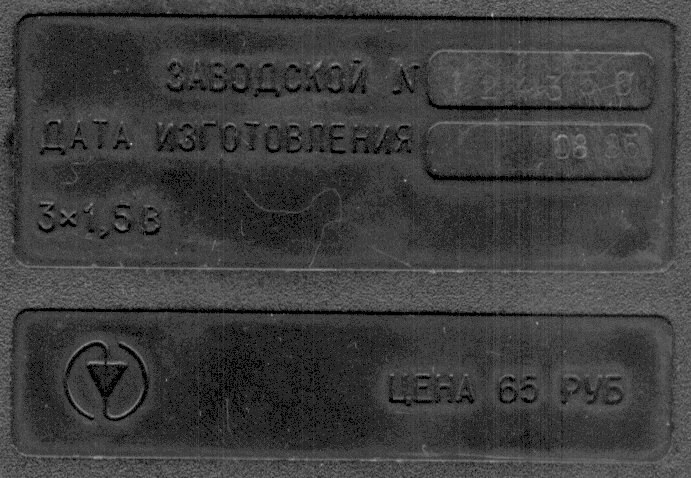
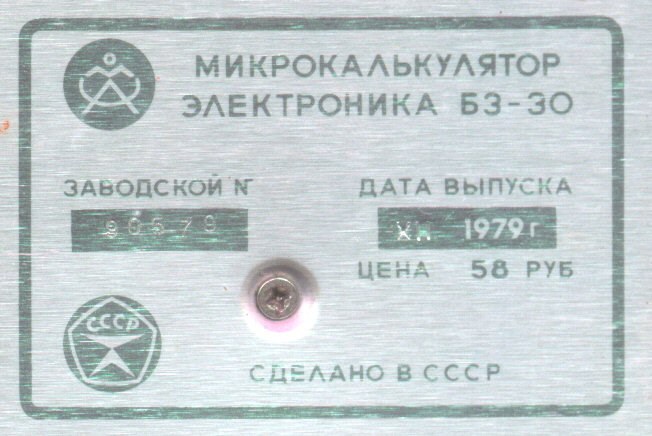
Prices were fixed by the State Price Committee, printed in the manual, and often moulded into the case or stamped on its label. They fell steeply as production grew:
Table 2 — Prices were fixed by the State Price Committee, printed in the manual, and often moulded into the case or stamped on its label. They fell steeply as production grew
| Machine | Launch price | Later |
|---|---|---|
| Iskra 12 desk (1971–72) | 992 roubles | — |
| Iskra 1122 desk, CRT display | 4,100 roubles | — |
| B3-04, first pocket (1974) | 220 roubles | — |
| B3-18 scientific (1976) | 220 roubles | B3-18M: 200 (1978), 45 (1982) |
| B3-19M, first RPN (1977–80) | 240 roubles | 65 (1981–82) |
| B3-21 programmable (1977–79) | 350 roubles | 190, then 80 (1981–82) |
| B3-34 programmable (1980–81) | 120 roubles | 85 |
| B3-26 four-function (1980) | 45 roubles | — |
| MK-54 | 65 roubles | — |
| MK-61 | 85 roubles (70 in 1985 by one source) | — |
| MK-52 | 115 roubles | ROM modules about 16 roubles each |
| MK-51 scientific | 64 roubles | — |
| MK-85 BASIC pocket computer (1986) | 145 roubles (115 by another source) | — |
| MK-90 BASIC pocket computer (1988–89) | 3,500 roubles | 1,500 (1990–91) |
| B3-23A, the cheapest | 18 roubles | — |
To give these a scale: the average Soviet wage was about 150 roubles a month in 1979, and a newly qualified engineer earned about 120. A B3-21 at 350 roubles was more than two months’ average pay; an Iskra 1122, at 4,100 roubles, cost more than the cheapest car, at 3,600. By the mid-1980s an MK-54 at 65 roubles was about two weeks’ pay. The MK-51’s manual, as an example, prints its price as 64 roubles without the cell, under price list no. 139-1977/97 and a State Price Committee decree of 2 June 1986.
2.5 How many were made
Production figures are scarce. The Kon-Tiki community, working from the serial numbers of photographed machines, estimates that more than 220,000 B3-21s had been made by July 1981; that the B3-34 had passed 7,000 by then and reached about 356,000 by December 1986; and, more loosely, that perhaps a million MK-52s were made. Malashevich gives more than 150,000 MK-85s of all versions, built from 1986 to 2000. About 7,000 MK-87 electronic notebooks were made, and given to delegates of a Party congress. The Elektronika 68 is said to have been made at 7,000 to 10,000 a year. In East Germany, 155,142 Soemtron 220s were built between 1966 and 1977.
2.6 Copying: what is fact and what is rumour
Soviet calculators are often said to be copies, and some were. The evidence is uneven, and it is worth grading:
Table 3 — Soviet calculators are often said to be copies, and some were. The evidence is uneven, and it is worth grading
| Soviet machine | Said to copy | Evidence |
|---|---|---|
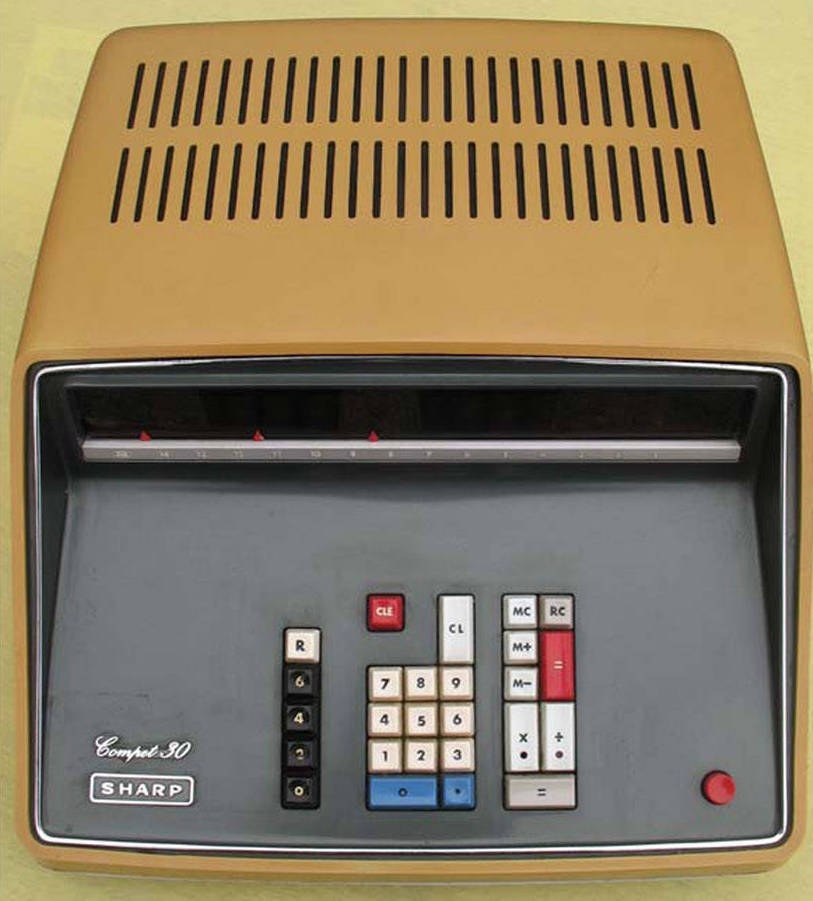
| Elektronika DD and Elektronika 68 / B3-01 (1968) | Sharp Compet CS-30A or CS-30B | Good. Three independent sources agree; Calcuseum compares the parts counts, about 600 KT315 transistors and 1,500 diodes against Sharp’s 650 and 1,600 |
| Elektronika 24-71 (1971) | Sharp QT-8D (as a design basis) | Good. Frolov: “the Sharp QT-8D was taken as the basis”, with “the chips an entirely domestic development” |
| Elektronika-70 (1970) | Hewlett-Packard 9100A | Weak: two popular articles |
| B3-04 (1974) | Sharp EL-805 (outside) | Good for the appearance, from five or more sources; whether the circuit was copied is not shown, and its chips were Soviet |
| B3-18 and B3-18A (1975–76) | Rockwell 202SR; Rockwell 61R | Medium: consistent, but all secondary |
| B3-14, B3-30, B3-38 | Corvus; Sharp; Casio FX-48 | Weak: one source each |
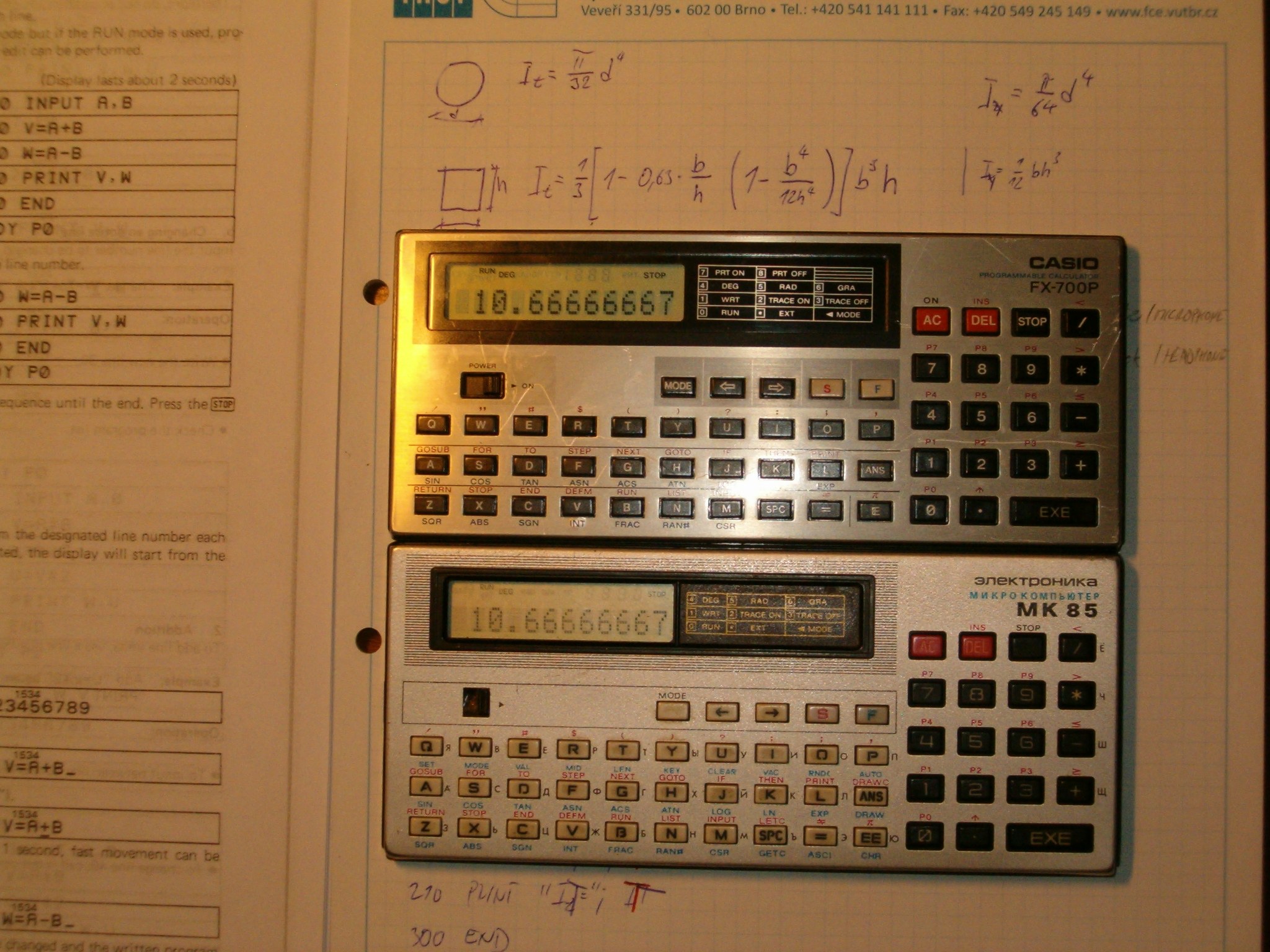
| MK-85 (1986) | Casio FX-700P (outside only) | Strong. Malashevich: begun in 1984 as a task to reproduce the FX-700P; Shokin demanded full external resemblance; inside, a 16-bit Soviet processor with the PDP-11 instruction set, not Casio’s 4-bit chip |
| С3-15 (1975) | — | described as the first Soviet scientific calculator not copied from a foreign design |
| B3-34 and MK-61 family | — | no foreign original claimed; Western and Russian enthusiasts later reverse-engineered its chips |
The pattern is that copying was strongest at the start, when the industry was catching up, and in the outward design, which was sometimes ordered from above. Minister Shokin’s habit of directing his institutes to match Western products is documented for the KT315 plastic transistor as well. No evidence has been found of chip-level copies of Texas Instruments or Hitachi calculator chips; the programmable calculator chips, at least, were original.
2.7 The documents in the box
Soviet consumer goods came with paperwork, and calculators came with a lot of it: an operating manual, often with a full circuit diagram folded inside; a passport recording the serial number and the inspection stamp of the factory’s quality-control department, the ОТК; a warranty card; and two tear-off repair vouchers. The manuals told the buyer to check, at the shop, that the machine worked, that the seals were intact, and that the warranty card bore the seller’s stamp and the date of sale. The MK-61’s manual even states its precious-metal content: 0.06455 g of gold and 0.04274 g of silver. That is why some scrap dealers still list these calculators, and why some surviving boards have been stripped.
Comments (0)