Scientific Calculators · Volume 9
Exams and Collecting
The scientific calculator outlived the slide rule, the pocket computer and, so far, the smartphone’s attempt to replace it, and a large part of the reason is the exam room. Every board that sets mathematics and science exams bans phones and anything that can communicate or do algebra symbolically, and nearly all of them allow a scientific calculator. That keeps the fx-82 and the TI-30 in production by the million. For collectors the interest is the other end of the story: the LED machines of the 1970s, which are now cheap enough to collect and old enough to need care.
9.1 What the exams allow
Table 1 — What the exams allow
| Exam | Scientific calculators | Notes |
|---|---|---|
| NCEES FE and PE (US engineering licences) | only listed families: Casio fx-115 and fx-991 models, HP 33s and 35s, and any TI-30X or TI-36X model | the model name must contain one of those numbers; unchanged for 2026 |
| SAT (digital) | allowed throughout the maths section | CAS, QWERTY keyboards, wireless and phones banned; a Desmos calculator is built into the test software |
| ACT | allowed | CAS models banned by name, from the TI-89 to the HP Prime |
| AP | allowed, up to two calculators | from 2027 AP Statistics will require a graphing calculator |
| UK GCSE and A-level (JCQ) | standard equipment unless a paper says otherwise | banned: symbolic algebra, symbolic calculus, communication, stored text or formulae, lids printed with formulae |
| IB Diploma | allowed | CAS, add-on apps and stored notes banned; some papers need a graphing calculator |
So my TI-36X Pro is allowed in American engineering licensing exams, and my fx-82ES is not: a Casio there must be an fx-115 or fx-991, the fx-82ES’s larger siblings. Both are allowed for the SAT, ACT and AP.
National Public Radio’s The Indicator put the graphing calculator’s survival down to exactly this: phones are banned in the exam, and a Texas Instruments executive told it, “We could easily add features to our calculators like a touchscreen, Wi-Fi or a camera, but we don’t.” The same logic applies even more strongly to scientific calculators, which every board allows. The digital SAT and AP now include a built-in Desmos calculator, which may slowly change the picture.
9.2 What they cost new
A TI-36X Pro costs about $20 new, less than its 2011 list price of $25. The fx-82ES is out of production; its current equivalent, the fx-82ES PLUS second edition, is about £19.50 in Britain.
9.3 Collecting the classics
The collectable scientific calculators are the landmarks of the 1970s:
Table 2 — The collectable scientific calculators are the landmarks of the 1970s
| Calculator | Launch | Today |
|---|---|---|
| HP-35 “red dot” (1972) | $395 | one sold for $1,500 in 2015; a $1,600 asking price in 2020 was called too high for a poor one |
| TI SR-50 (1974) | $169.95 | about $100 or less for a working one |
| Sinclair Scientific (1974) | £49.95, $139.95; kit £9.95 by 1975 | about £25–150, mostly asking prices |
| TI-30 (1976) | $24.95 | no reliable figures found for the first LED version |
Collectors value first versions, working machines with their original battery packs, and complete sets with box, case and manual. A few things to know:
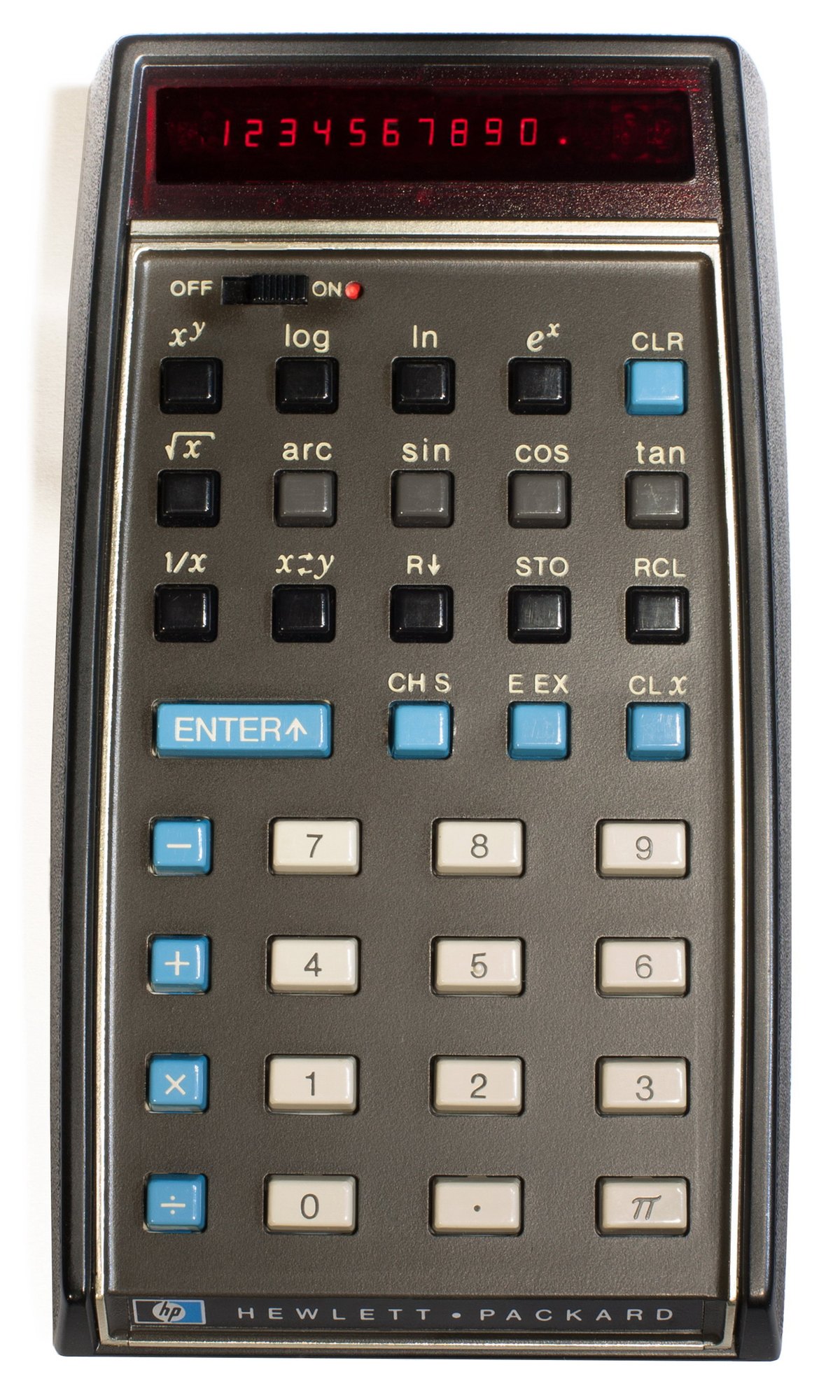
- The HP-35 red dot is the first version, recognised by a red dot by the power switch and serial numbers beginning 1143A, though collectors warn that serial ranges overlap and that at least one fake red dot is known: check the size and position of the dot’s hole against a genuine one. The original rechargeable packs are long dead, and owners rebuild them with new cells.
- The Sinclair Scientific was sold as a kit as well as assembled, and kits form a market of their own.
9.4 Modern machines
Calculators of the LCD era are mostly worth little, but some have followings: the HP-15C, reissued twice; Casio’s fx-82 line, which has been made under one number since 1982; and the TI-30 line from the 1976 original onwards. The European TI-30X Pro MultiView of September 2010, withdrawn within a month for wrong answers, is a curiosity.
9.5 Emulators
Casio’s own PC emulators of its ES calculators contain the real ROMs, and the fxesdev group has written open emulators for the nX-U8 calculators from them. For the classics, Ken Shirriff’s online simulator of the Sinclair Scientific runs the original 320-instruction program read from the chip.
9.6 The documents in the Library
Everything in the Reference Library for this series:
- My two calculators: Casio’s fx-82ES User’s Guide and its appendix of examples; TI’s TI-36X Pro Guidebook.
- Their families: Casio’s guides to the fx-82MS, fx-115ES and fx-991ES, fx-570ES PLUS and fx-991ES PLUS and fx-991EX ClassWiz; TI’s guides to the TI-30X Pro MultiView, TI-30XS MultiView with its teacher guide and reference card, TI-30X IIS with its teacher guide, and TI-36X Solar.
- The classics: the HP-35 operating manuals of 1972 and 1973 and the HP Journal of June 1972; TI’s manuals for the SR-10, SR-50, SR-51, TI-30 of 1976, TI-30-II, TI-30 SLR and TI-55; the Sinclair Scientific instructions and Electronics Today International of July 1975.
- Patents: Kilby, Merryman and Van Tassel’s US 3,819,921, the hand-held calculator, and Boone and Cochran’s US 4,074,351, the single-chip programmed calculator.
- Exams: the ACT calculator policy.
9.7 Gaps
The launch price of the fx-82ES was not found, nor the chip inside the non-PLUS fx-82ES or the TI-36X Pro, nor a published teardown of the fx-82ES. Sold prices for the 1970s classics are few, and those given are mostly asking prices. Casio’s guides to the fx-82ES PLUS and the ClassWiz CW could not be downloaded for the Library.
Comments (0)