Dial Adders · Volume 9
Collecting: Buying, Styluses, Parts and Sources
Lightnings are among the easiest antique calculating machines to find. Bob Otnes wrote in 2002 that they were “to be found in almost every flea market in the United States”, and by Otnes’s own estimate the Los Angeles factory alone may have made over two million. That makes them an ideal first mechanical calculator: cheap, sturdy, usable, and a direct descendant of Pascal’s machine. It also means that the interest lies in the details: which model, how complete, whether it works, and whether it still has its stylus, which it usually does not.
9.1 Where they turn up
- eBay is the main market, in the United States and, for exported machines, in Britain and Germany.
- Flea markets, antique malls and estate sales, in the United States especially. Lightnings were sold by mail order across the country for forty years.
- ShopGoodwill and similar charity auction sites, where they appear among office equipment, often without a stand or stylus.
- Specialist dealers in scientific instruments and calculating machines, for boxed and complete examples, at higher prices.
- Worthpoint aggregates past eBay and auction sales and is the best place to see what Lightnings actually sold for, as opposed to asking prices. It needs a subscription.
9.2 What they cost
Original retail prices are well documented. Current market prices are not. The figures below are the evidence that could be found. Asking prices are not sale prices, and none of these has been checked against a run of sold listings.
Table 1 — What they cost
| Item | Price | Status | Source |
|---|---|---|---|
| The Calculator, Grand Rapids | $12.50 | original retail, 1920 | Popular Science |
| Lightning Calculator, Grand Rapids | $10 / $12.50 / $15 | original retail, c. 1926 (bare / cased / on base) | Rechnerlexikon |
| Los Angeles Lightning, with or without lever | $12.95 | original retail, 1946–48 | advertisements |
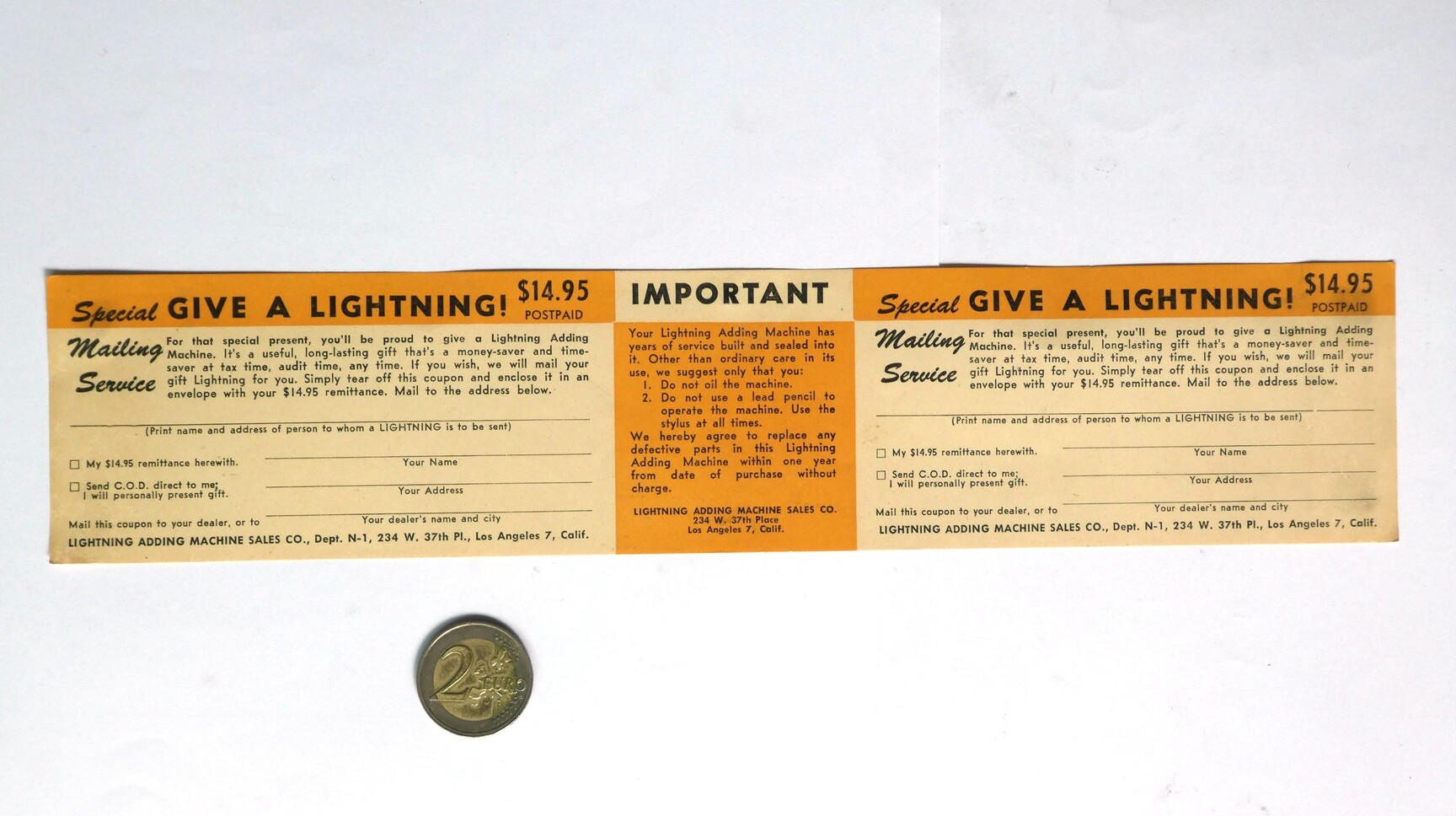
| Subtracting Lightning | $14.95 | original retail, c. 1951–59 | advertisements, order slip |
| Bare machine, no stand or stylus | $9 | paid on eBay, 2019 | blog report |
| Lightning in stand, with stylus and instructions | €36 | reported sold, eBay.de, August 2025 | search listing, not opened |
| Various, with box, stylus or instructions | about $20–$120 | asking prices | eBay listings, not opened |
| Unused, boxed, with instructions, stylus and stand | £160 | dealer’s asking price, January 2024 | Fletcher Wallis, via fleaglass.com |
On that evidence, a working Los Angeles Lightning in its stand with a stylus is a machine of tens of dollars, a bare machine one of a few dollars, and a boxed, complete, unused one worth a dealer’s three-figure price. Grand Rapids Lightnings on their wooden bases, Pangborns and Smallwoods are scarcer. Otnes: “Pangborns and Smallwoods are scarce, and very few B&S examples are known.” Check current sold prices before buying or selling.
9.2.1 What adds value
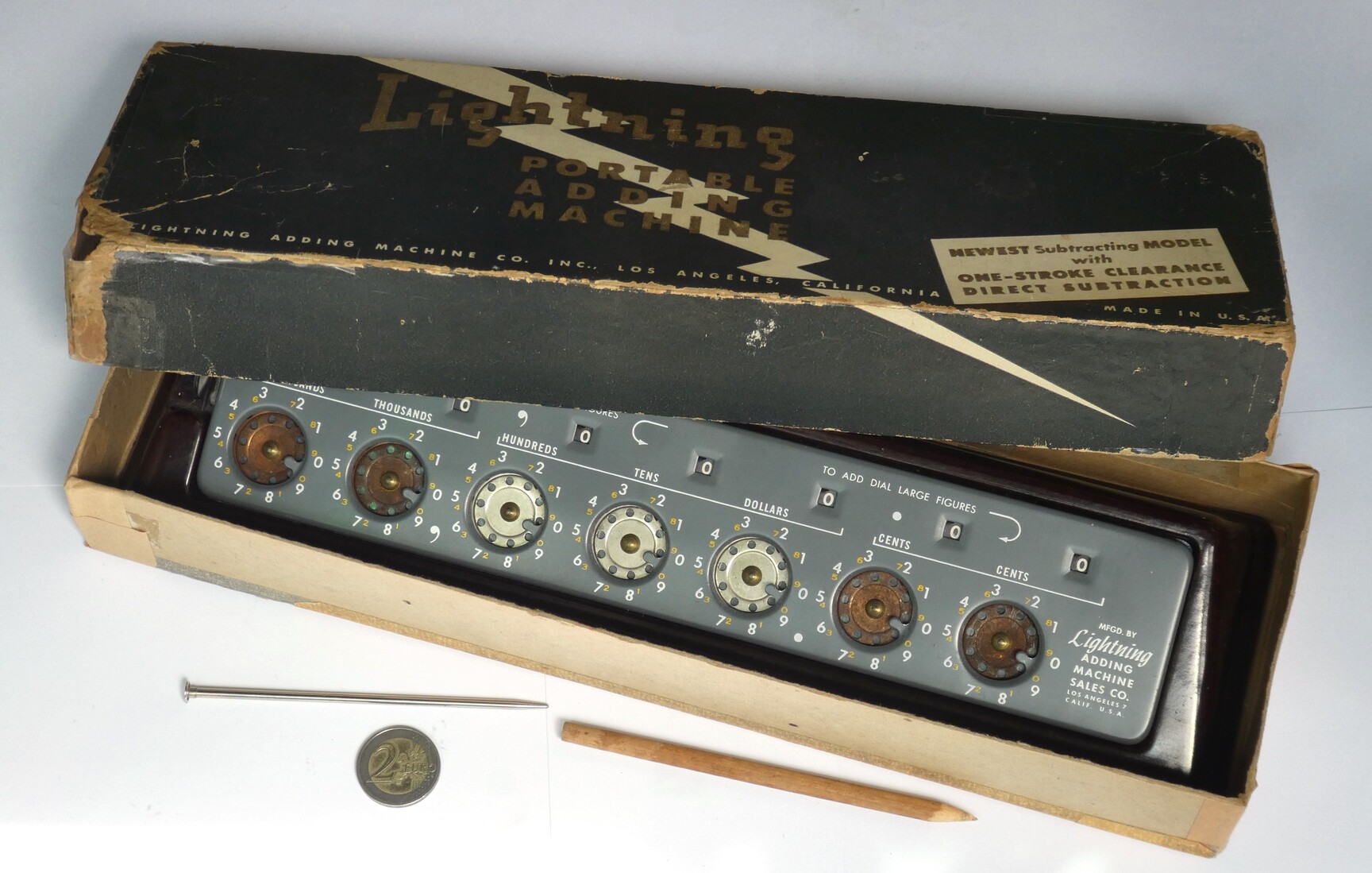
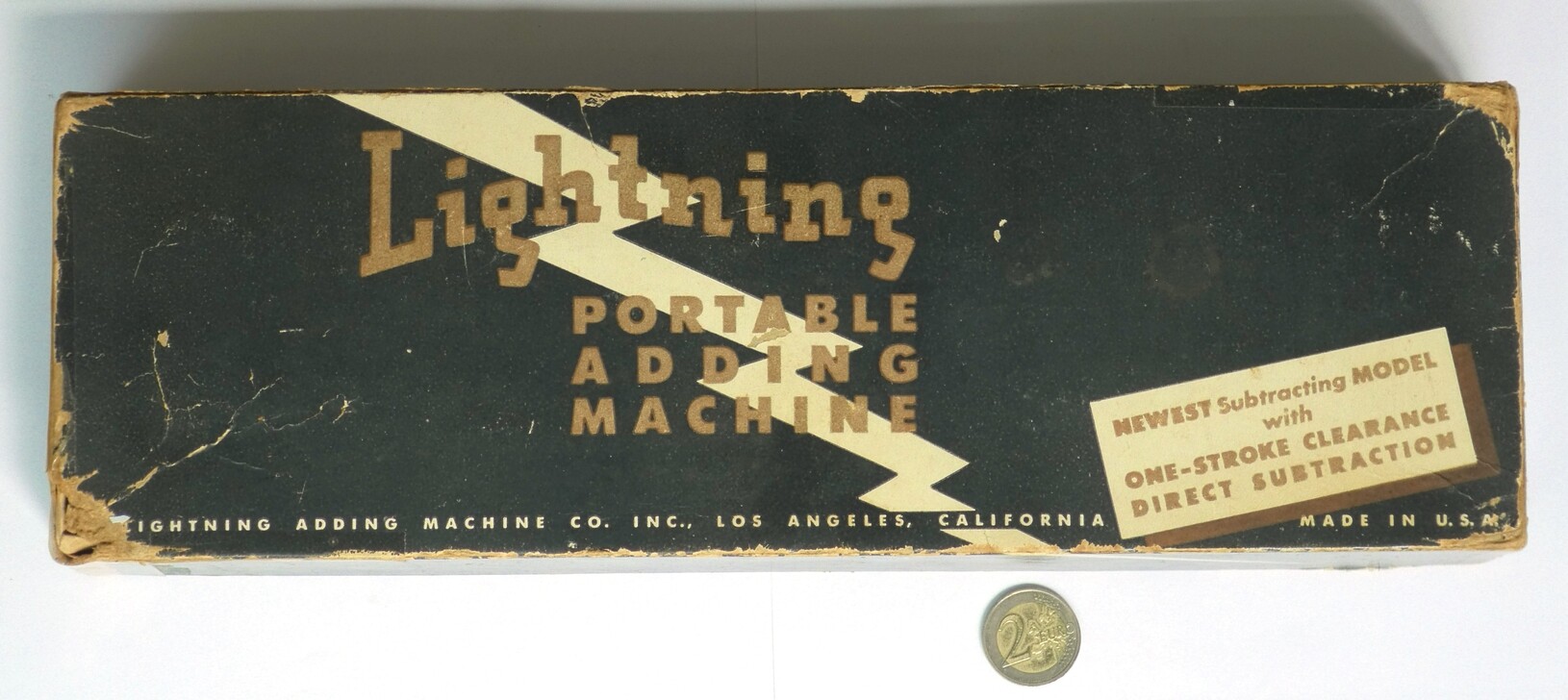
- Completeness: original stylus, stand, box, instruction leaflet, inspection card, guarantee and order slip. Scherphuis’s collection includes all of these.
- Working order: a full carry across all seven places, a clean clear, and, on grey machines, a clean borrow.
- Rarity of model: Bonham & Schram machines are the rarest, then Pangborns and Smallwoods, then the Grand Rapids machines; Los Angeles Lightnings are the commonest. Among Los Angeles machines, early ones with triangles and unusual colours (red, dark red, tan; Otnes “even heard of plaid ones”) stand out.
- Non-decimal versions: the Grand Rapids “L” (feet and inches) and “S” (pounds, shillings and pence) models are a niche of their own.
- Condition of the paint, the printed figures and the Bakelite.
9.3 Before buying: a checklist
- Every dial, every figure. Each turns clockwise to its stop and leaves a whole digit in the window.
- Full carry. Set 99,999.99 and add 1 on the cents dial. Every window should roll to zero. This is the single most revealing test.
- Borrow (grey machines). Subtract 1 from zero with the small figures. The windows should show 99,999.99.
- Clear. On lever machines, one full pull returns every window to 0 from a full register. On early machines, each dial clears from its triangle.
- Whole digits. A window that shows two half-digits points to a weak pawl.
- Stylus. Present? Original? (See below.)
- Stand. It matches the body (early stands have no cut-out for the lever tab). Check for cracks, chips and repairs.
- Back plate. Rust, a felt pad, and any date stamp or dealer’s label. The Smithsonian’s machine has a dealer’s label under its stand.
- Paperwork and box. These add a great deal.
The repair volume explains what each failed test is likely to mean.
9.4 The stylus
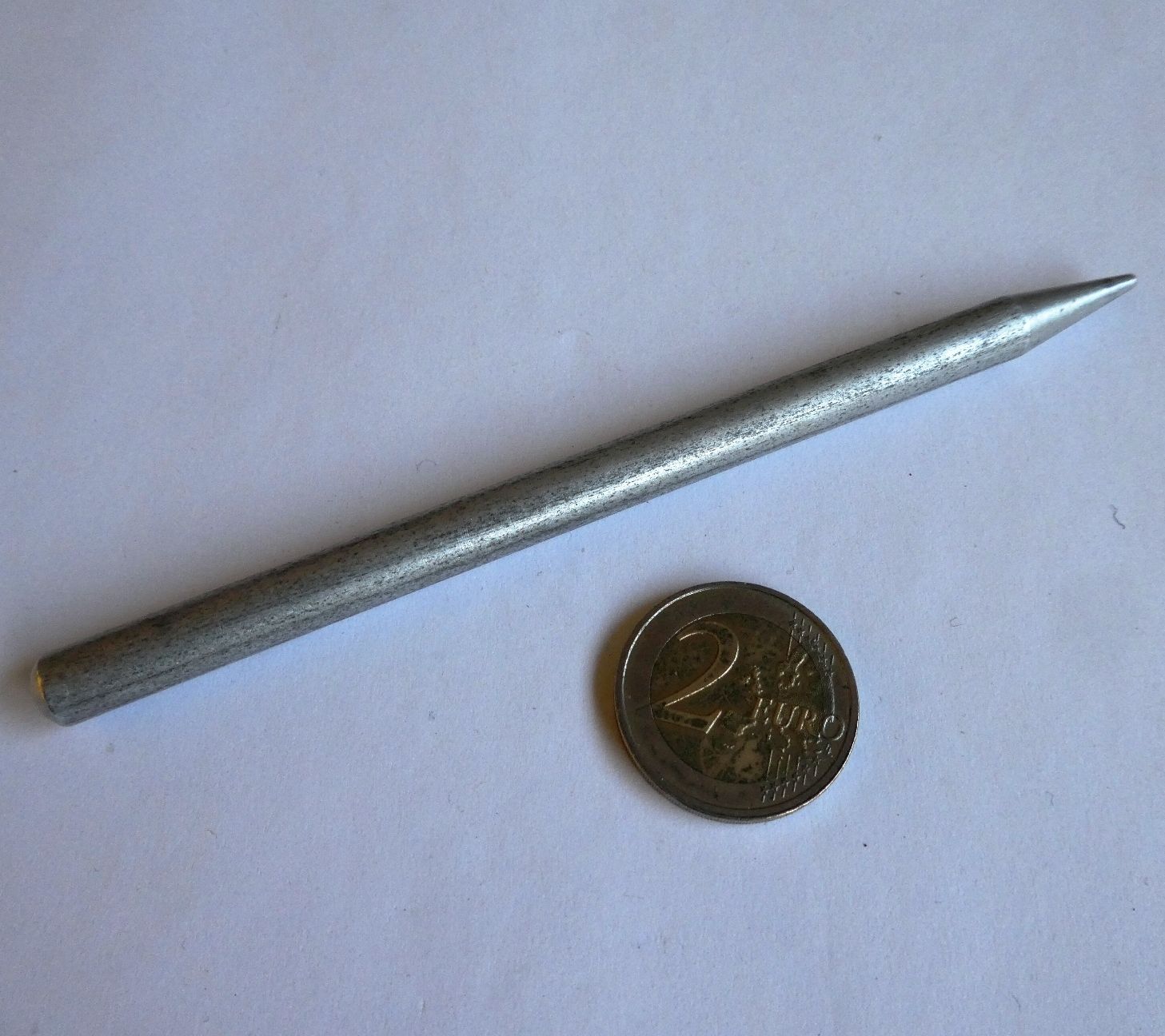
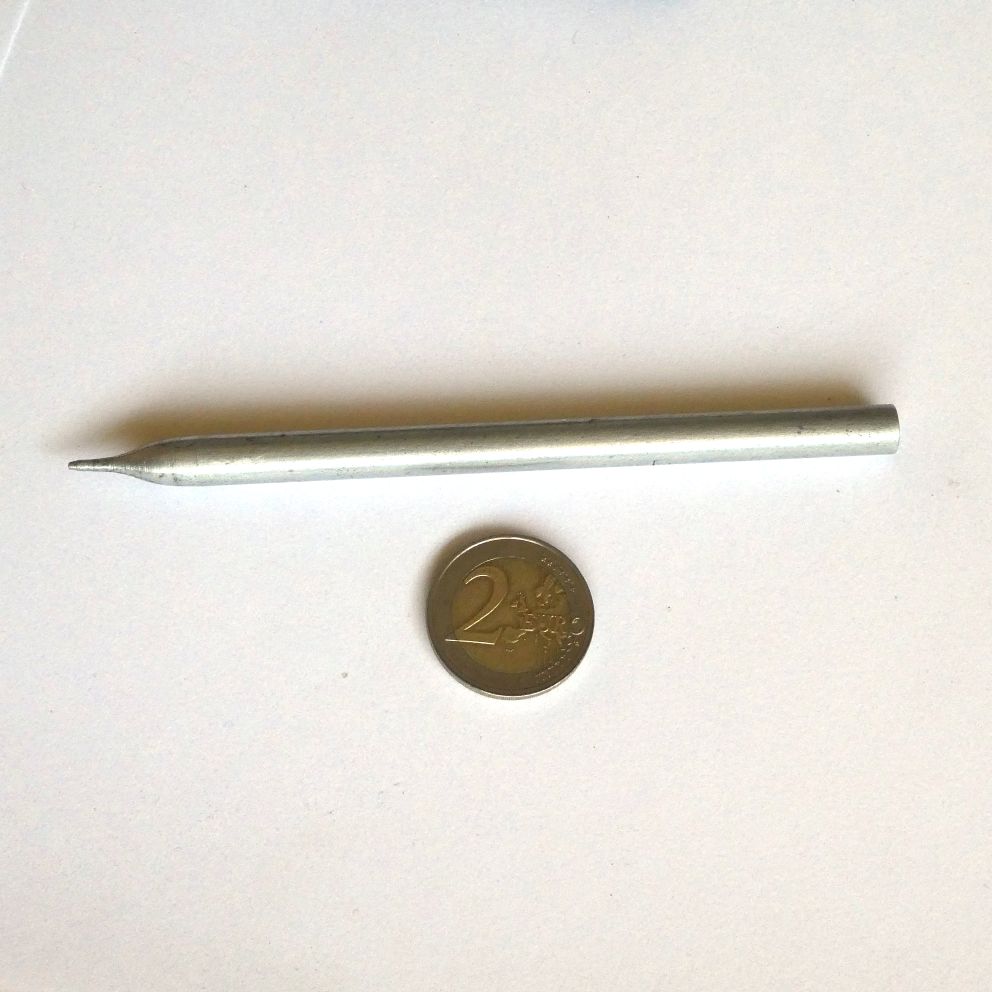
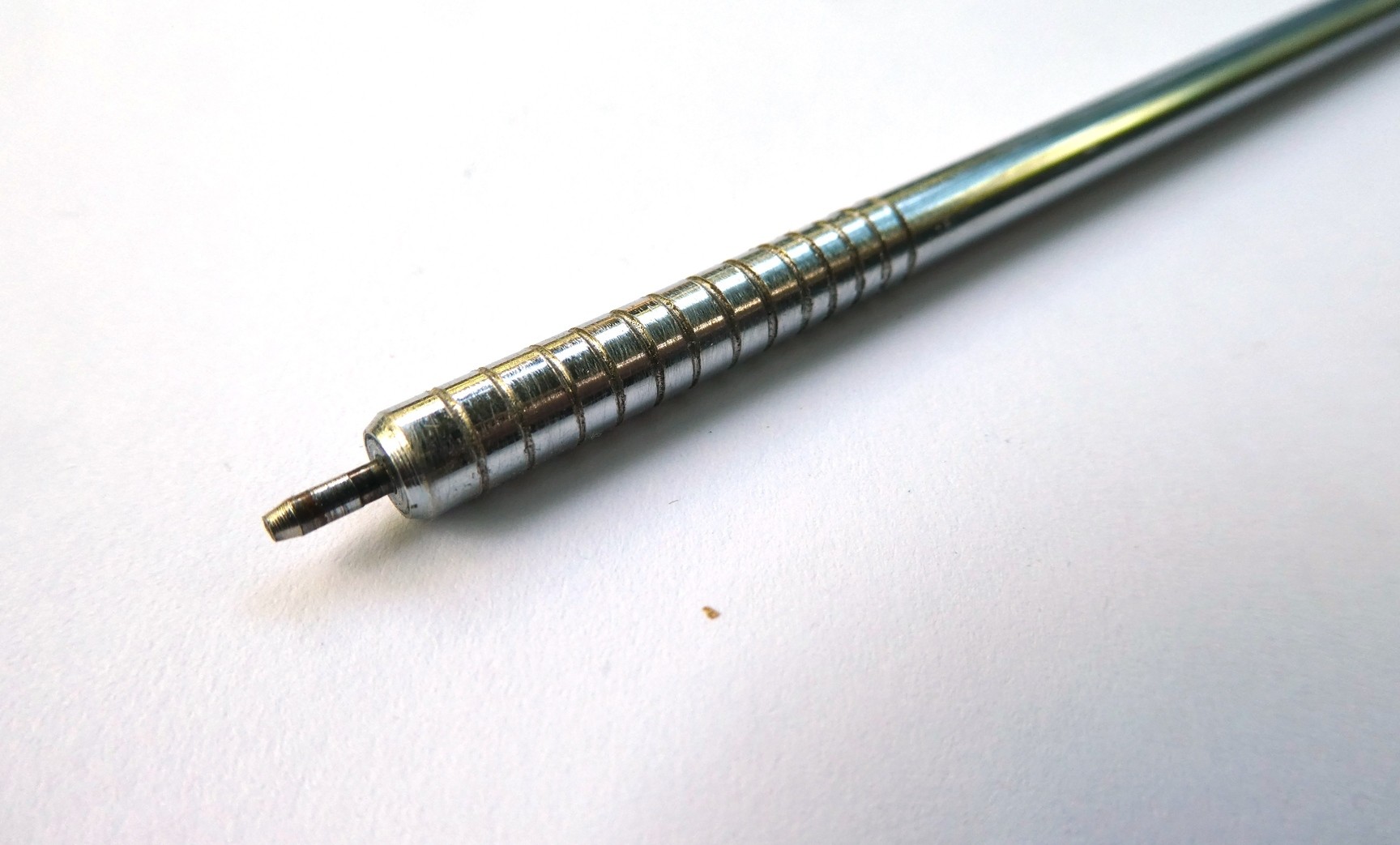
The originals. Los Angeles Lightnings came with an aluminium stylus, pencil-shaped and pointed, stored on a ridge along the front of the Bakelite stand. It was not chained or tied to the machine, which is why so many are lost. Scherphuis’s photographs show two patterns, a stouter one on the 1946 machine and a slimmer one with a finer point on the later machine. The Grand Rapids machines had a steel stylus kept in a hole in the wooden stand. The factory sold spares. The inspection card packed with Los Angeles machines reads “Always use the metal stylus. Additional stylus for 25c postpaid.”
Missing is normal. The Smithsonian’s Lightning, the Whipple Museum’s, the 1950 example in the Berlin collection and even Scherphuis’s boxed machine have all lost their original styluses. A Lightning offered with an aluminium stylus resting on its stand ridge is the exception.
Substitutes. What a Lightning needs is a rigid, smooth metal rod with a blunt conical point that seats fully in a dial hole and will not climb out under the side load of a carry. The leaflets forbid a pencil: too soft, too blunt, and it leaves graphite in the mechanism. Collectors have used:
- a steel knitting needle of the right gauge, which is what the Berlin collection uses with its machine;
- a short length of aluminium or brass rod turned or filed to a cone, which is the closest match to the original;
- another adder’s stylus, which may or may not fit.
Making one. Measure the diameter of a dial hole on your machine with a drill bit or a caliper. No published dimension has been found, and the two Los Angeles patterns differ. Choose rod slightly smaller than the hole, so the stylus seats to the bottom with a little play. Turn or file the last 10–15 mm to a cone, round the very tip so it cannot scratch the dial, and polish it. Aluminium is kind to the dials. Steel is more durable, but deburr it carefully.
Buying one. No dedicated reproduction Lightning stylus was found for sale, and no 3D-printable Lightning stylus or stand design was found on Printables or Thingiverse. Originals turn up with machines and occasionally on their own. A stand-less or broken donor machine sometimes comes with one. A printed stylus would be easy to design, but a printed point would wear quickly; metal is better.
9.5 Parts
There is no parts supplier. Parts come from donor machines, which are cheap. Buy a non-working or stand-less machine of the same model. The early, lever and subtracting machines differ inside, and the early and lever stands are not interchangeable. The pawls are small sheet-spring clips, and a broken one would have to be made from spring-steel shim. No other source has been found.
Sources
Principal references
- Robert K. (Bob) Otnes, “The Lightning Calculator — Bonham, Hook and Pangborn”, Journal of the Oughtred Society 11:1 (Spring 2002), pp. 53–58. The standard history, built from city directories. https://www.boelter.rechnerlexikon.de/_Calculator/V11.1P53.pdf
- Bob Otnes, “Small Adders Part 2” (taxonomy of small adders, 2003). https://rechnerlexikon.de/artikel/Small_Adders_Part_2
- Jaap Scherphuis, “The Calculator and Lightning Adding Machine”: photographs, both instruction leaflets, order slip, guarantee, inspection card and about 35 period advertisements. https://www.jaapsch.net/mechcalc/lightning.htm
- Jaap Scherphuis’s pages on the Addometer, Calcumeter, Webb Adder, Kes-Add, Ken+Add and Dial-A-Matic. https://www.jaapsch.net/mechcalc/
- Rechnerlexikon, “Lightning Calculator”: variant sequence, model designations, the 1948 advertisements. https://www.rechnerlexikon.de/artikel/Lightning_Calculator
- The Office Museum, “Adders”: prices and makers of early adders. https://officemuseum.com/calculating_machines_adders.htm
- Industrial Alchemy, “Lightning Portable Adding Machine”. https://industrialalchemy.org/articleview.php?item=457
- John Wolff’s Web Museum, small rotary adding machines. https://www.johnwolff.au/calculators/adders/adders.htm
Patents
- W. R. Bonham, US 845,747 (1907) and US 908,731 (1909). https://patents.google.com/patent/US845747A/en · https://patents.google.com/patent/US908731A/en
- R. W. Hook, US 1,574,249 (1926), the Lightning. https://patents.google.com/patent/US1574249A/en
- C. H. Webb, US 75,322 (1868) and US 414,959 (1889).
- J. J. Walsh, US 689,255 (1901) and US 897,688 (1908), the Calcumeter.
- W. T. Ray, US 1,410,507 (1922).
- A. E. Vethe, US 1,764,915 (1930) and US 1,829,379 (1931), the Addometer.
- E. G. Kesling, US 2,450,668 (1948), the Kes-Add.
- O. Lehre, US 2,797,047 (1957), the Dial-A-Matic.
Museum examples
- Smithsonian National Museum of American History, Lightning Adding Machine 1989.0325.02 (green, clearing lever, brown stand). https://americanhistory.si.edu/collections/search/object/nmah_690296
- Whipple Museum of the History of Science, Cambridge, object 4404 (grey, Sales Co., Los Angeles 7). https://collections.whipplemuseum.cam.ac.uk/objects/13189
- Computer History Museum, Mountain View. https://www.computerhistory.org/collections/catalog/102636429
- University of Waterloo Computer Museum (several Lightnings). https://computermuseum.uwaterloo.ca/
- Science Museum Group, London (Addometer, c. 1925).
Videos
None of these is a repair teardown.
- Jaap Scherphuis, “The Lightning Adding Machine”. https://www.youtube.com/watch?v=IeLaGvIyhv8
- Jaap Scherphuis, “Lightning Adding Machine comparison” (1946 and 1950 machines). https://www.youtube.com/watch?v=hA8XPNHmdEk
- Jaap Scherphuis, “The Calculator adding machine”. https://www.youtube.com/watch?v=MscJcrpzHno
- Jaap Scherphuis, “Addometer adding machine”. https://www.youtube.com/watch?v=OaUmdqVk4HE
- Chris Staecker, “Lightning Adding Machine Review / HowTo”. https://www.youtube.com/watch?v=ou9u5ZZLWPU
- Our Own Devices, “Lightning Adding Machine: Simple Mechanism, Complex Origins”. https://www.youtube.com/watch?v=lsP0mt3HuA0
- Joe Van Cleave, “Dead Tech Review — The Lightning Adding Machine”. https://www.youtube.com/watch?v=LeOEiwDR_xk
Comments (0)