Dial Adders · Volume 1
Two Lightnings on My Shelf
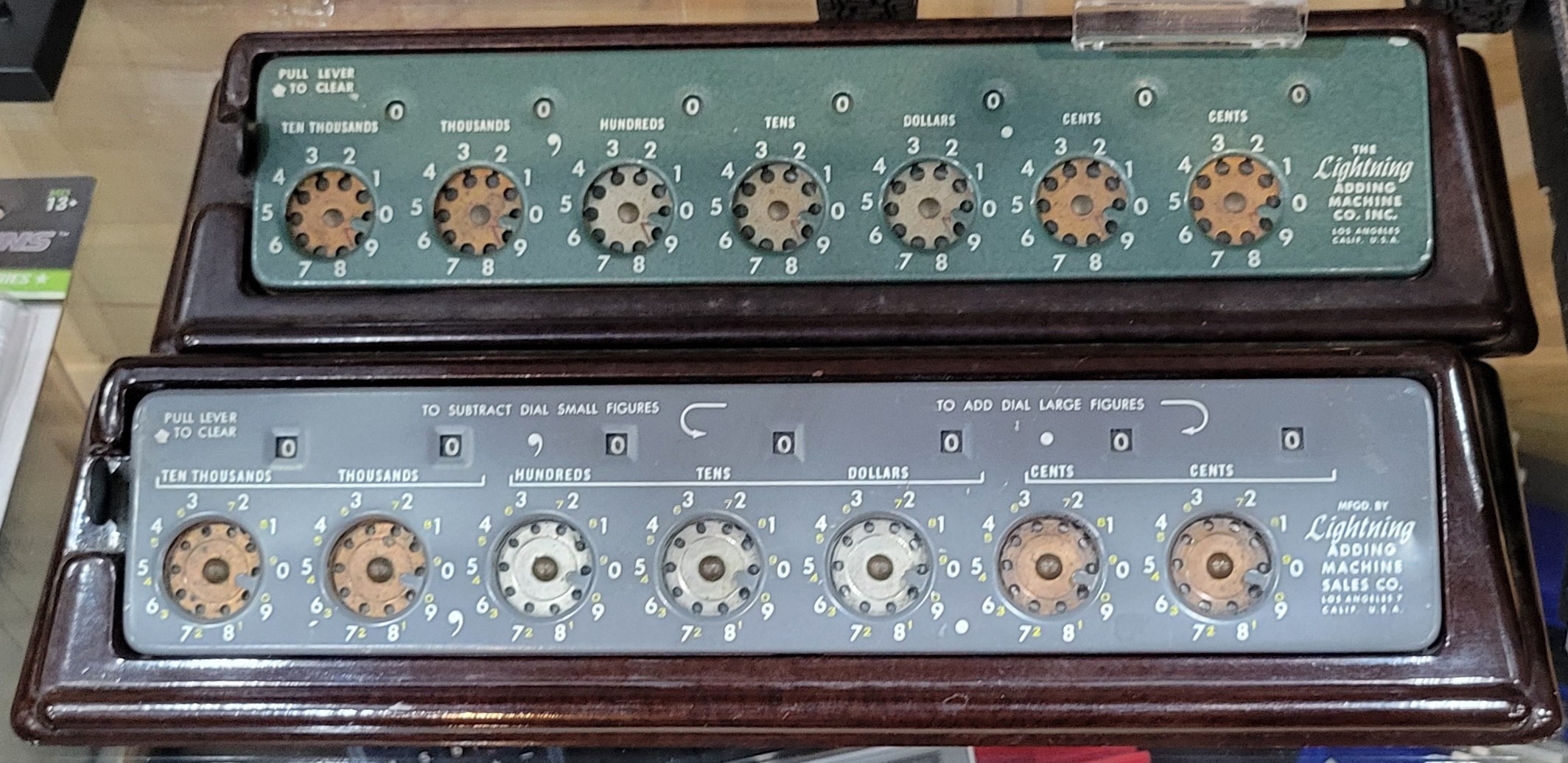
Two Lightning Adding Machines sit side by side on my shelf, each lying in its brown Bakelite stand. They look like the same object in two colours, and at a glance they are: a steel plate a foot long with seven stylus dials in a row, a row of little windows above the dials showing the running total, and the words PULL LEVER TO CLEAR at the left-hand end. Look closer and they are different machines, made in different years by what was, legally, a different company. The green one only adds. The grey one adds and subtracts, and its dials carry a second ring of small yellow figures to do it. One faceplate names the Lightning Adding Machine Co. Inc.; the other says “Mfgd. by Lightning Adding Machine Sales Co., Los Angeles 7”. That small “7” is a postal zone, and it is enough on its own to date the grey machine to a window of twenty years; with the company’s advertisements it narrows to between late 1953 and about 1955.
1.1 What a dial adder is
A Lightning is a stylus-operated rotary dial adder: an adding machine with no keys, no crank and no motor, in which every digit is entered by putting a pointed stylus into a hole in a toothed dial and dragging the dial round until the stylus fetches up against a fixed stop. Each dial serves one decimal place. The amount the dial turns is the digit entered, and an automatic tens carry passes the overflow from each dial to the one on its left. The running total is read in a row of windows.
The design is very old. Didier Roth patented a row of stylus dials with a carry in 1843, and the principle goes back further, to the wheels of Pascal’s machine of 1642. What the Lightning family did was to make it cheap. A Burroughs key adding machine cost hundreds of dollars in the 1910s; the Lightning’s ancestor, The Calculator of Grand Rapids, sold for $12.50 in 1920, and the Los Angeles Lightning for $12.95 in 1948. The historian Bob Otnes, writing in the Journal of the Oughtred Society in 2002, called the family “the ultimate democratization” of Pascal’s design, “permitting almost anyone of modest means” to own an adder.
Collectors sort non-printing pocket and desk adders into families by how the stylus drives them. The Lightning belongs to what Otnes’s taxonomy calls dials in a row with geared carry. Its relatives in other families — the slide adders (the Addiator and its many copies), the chain adders (the Golden Gem) and the band adders — work on different principles and are treated separately. The full four-function calculating machines, with cranks, carriages and stepped drums or pinwheels, are another class again.
1.2 How the machine reads
Every Lightning faceplate is laid out the way an amount is written on paper. On my two machines, from left to right:
Table 1 — Every Lightning faceplate is laid out the way an amount is written on paper. On my two machines, from left to right
| Dial | Label on the faceplate | Place |
|---|---|---|
| 1 | TEN THOUSANDS | 10,000s of dollars |
| 2 | THOUSANDS | 1,000s |
| 3 | HUNDREDS | 100s |
| 4 | TENS | 10s |
| 5 | DOLLARS | units |
| 6 | CENTS | dimes |
| 7 | CENTS | cents |
A printed comma between the thousands and hundreds dials and a printed point between the dollars and cents dials divide the row, so the machine reads up to $99,999.99. The dials are colour-coded on the grey machine and on the green one alike: the two cents dials and the two thousands dials are copper-coloured, the three middle dials nickel. The colour breaks the row of seven into the same groups the eye uses when reading a written amount.
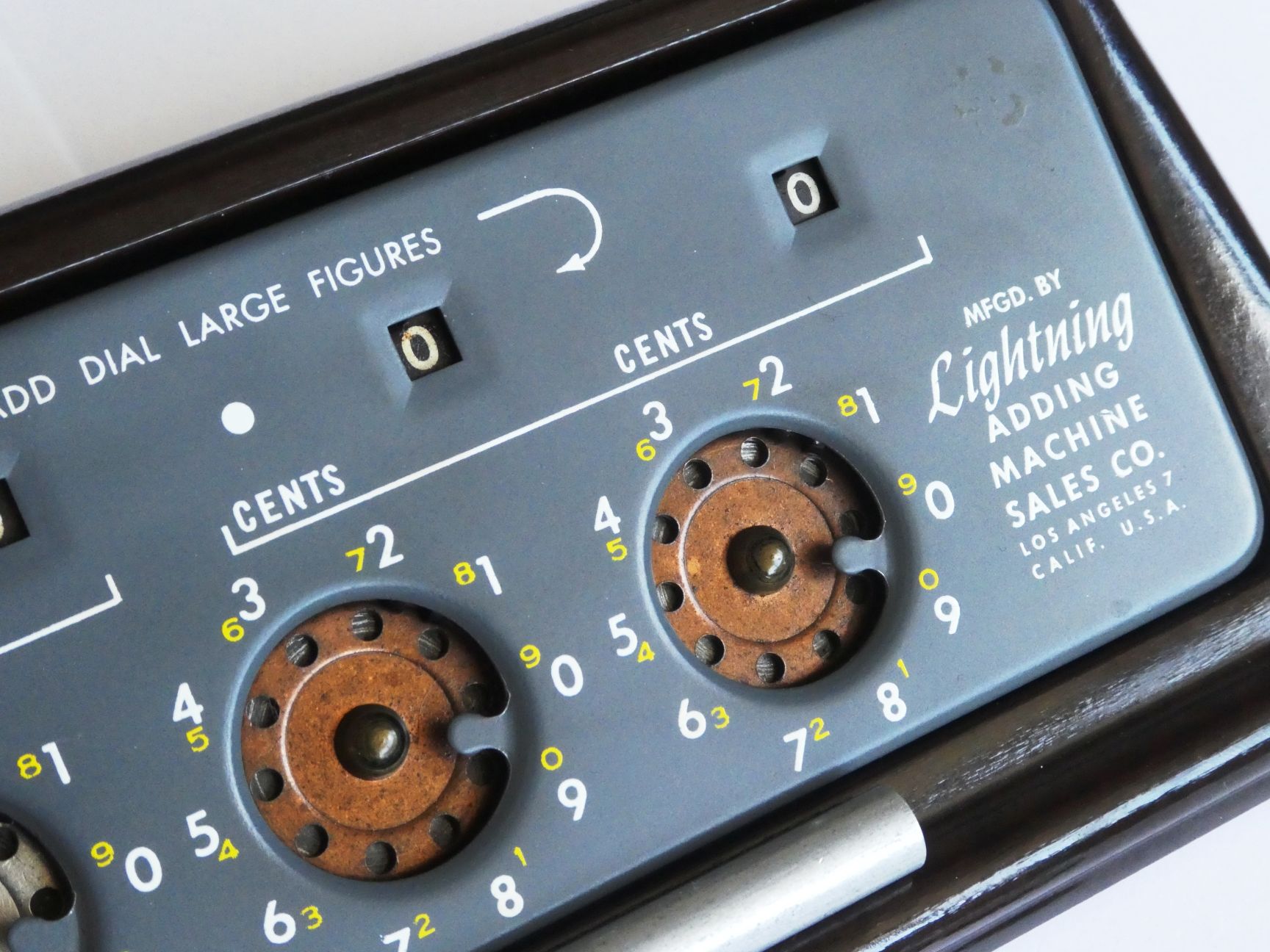
Around each dial are the figures 1 to 9 and 0, running anticlockwise. To add 6, the stylus goes into the hole beside the printed 6 and the dial is turned clockwise until the stylus hits the stop. The stop is a small hook at about four o’clock on each aperture. On the grey machine a small yellow figure stands beside each large white one, the large figure’s nine’s complement, and the faceplate says what they are for: TO ADD DIAL LARGE FIGURES, with a clockwise arrow, and TO SUBTRACT DIAL SMALL FIGURES, with an anticlockwise one.
1.3 The two machines, side by side
Table 2 — The two machines, side by side
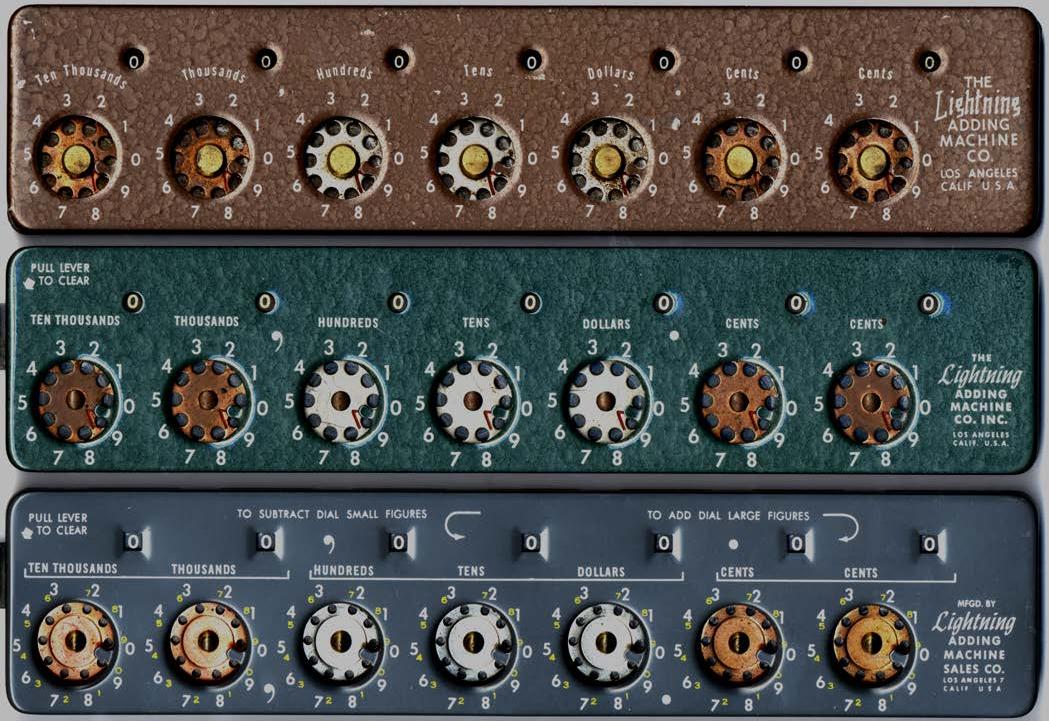
| Green machine | Grey machine | |
|---|---|---|
| Maker’s name | THE Lightning ADDING MACHINE CO. INC., LOS ANGELES CALIF. U.S.A. | MFGD. BY Lightning ADDING MACHINE SALES CO., LOS ANGELES 7, CALIF. U.S.A. |
| Figures | one ring, white | large white figures plus small yellow complement figures |
| Subtracts | not marked for it | directly, by anticlockwise turns on the small figures |
| Clearing | PULL LEVER TO CLEAR | PULL LEVER TO CLEAR |
| Result windows | round, in the green face | square, framed |
| Probable date | mid-1948 to the early 1950s | late 1953 to about 1955 |
The dating is worked through in the volume on identifying and dating a Lightning. The short version: Los Angeles Lightnings made before mid-1948 had no clearing lever at all. The lever arrived between March and July 1948, and the price stayed at $12.95. Direct subtraction, a grey finish and a $14.95 price came in the early 1950s. The “Sales Co.” name is in a Newsweek advertisement of December 1953 at 234 West 37th Place, Los Angeles 7. By 1956 the company had moved to Slauson Avenue, in zone 43.
1.4 What this series covers
The volumes run from the outside of the machine to the inside and back out again.
- Before the Lightning traces the dial adder from Roth’s 1843 patent and Charles Henry Webb’s 1868 adder through the Calcumeter to Walter Bonham’s 1905 Chicago machine and The Calculator of Grand Rapids, from which the Lightning descends directly.
- The Lightning company follows the design from Russell Wallace Hook’s 1921 patent and the Grand Rapids factory to its post-war revival in Los Angeles, the change of owners in 1953 and the end of production around 1959.
- Identifying and dating a Lightning sets out every known variant, what changed when, and how to date a machine from its faceplate, its stand and its windows.
- Theory of operation takes the machine apart on paper: every part in the exploded view, how a stylus stroke becomes a digit in a window, how the carry ripples, what Hook’s weighted pawl is for, how the clearing lever zeros seven wheels with one pull, and why one hole can serve for both adding and subtracting.
- Operating a Lightning is drawn from the two factory instruction leaflets: adding, clearing, both methods of subtraction, multiplication, division, ledger balancing and the errors the factory warned against.
- The relatives covers the dial adders the Lightning competed with and was copied by: the Addometer, the Ray, the Smallwood, the Kes-Add, the Ken+Add and the Sterling Dial-A-Matic.
- Care, repair and restoration covers what can and cannot be done to a machine whose top plate is held on by folded tabs and whose axles are rivets.
- Collecting covers where Lightnings turn up, what they sell for, what to check before buying, and the perennial problem of the missing stylus.
1.5 A note on the sources
The backbone of the history is Otnes’s 2002 article “The Lightning Calculator — Bonham, Hook and Pangborn”, which was built from the Grand Rapids and Los Angeles city directories, and Jaap Scherphuis’s online Lightning collection, which reproduces the instruction leaflets, the order slip and about thirty-five period advertisements. Rechnerlexikon, the German collectors’ encyclopedia, supplies the variant sequence and the 1948 advertising evidence. The patents — Bonham’s of 1907 and 1909, Hook’s of 1926 and those of the relatives — are reproduced from the United States Patent Office originals.
Where these sources disagree, the disagreement is stated. The largest one, whether the Los Angeles machine gained its clearing lever and its subtraction in a single redesign in 1948 or in two separate steps, is settled by the company’s own trade notices: two steps, about four years apart. My green machine, with the lever and no subtraction figures, is an example of the machine between the two.
Comments (0)