Dial Adders · Volume 4
Identifying and Dating a Lightning
A Lightning carries no serial number, and catalogue dates for them are unreliable. Museum records give “c. 1900”, “first produced 1908”, even “sold for $12.95 in 1938 by the Lightning Adding Machine Sales Co.”, and every one of those is wrong. The machine itself is a better witness. Its finish, its stand, its maker’s name, its clearing arrangement, its subtraction figures, the shape of its windows, a postal zone and sometimes a date stamp on the back plate can between them place most examples within a few years. This volume collects those clues.
4.1 The family at a glance
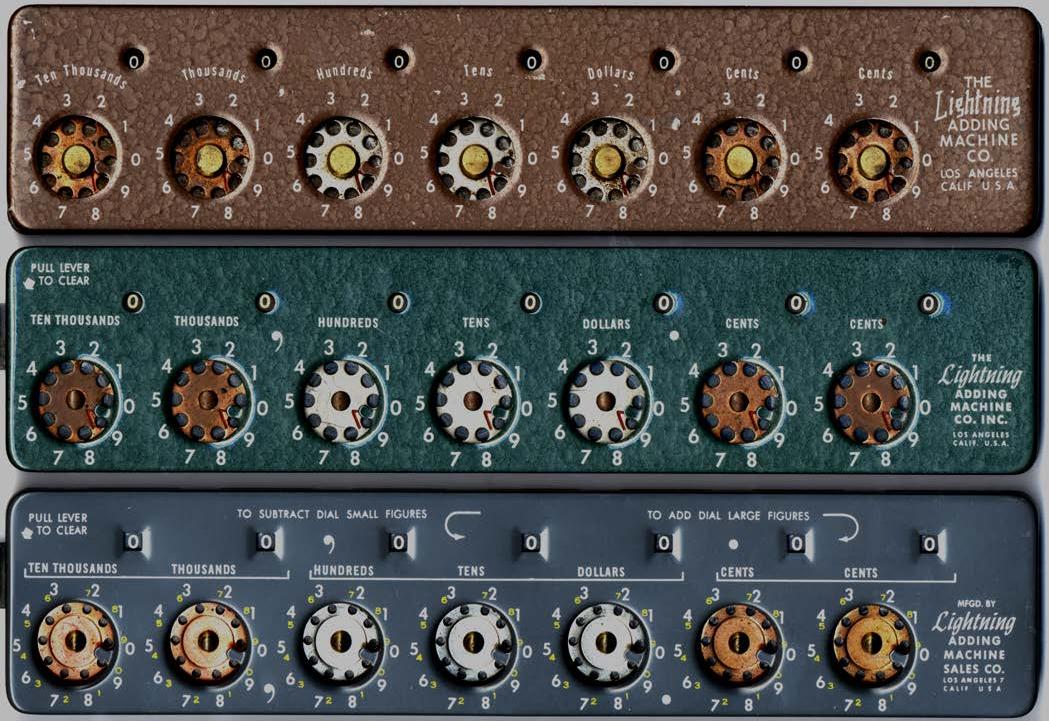
Table 1 — The family at a glance
| Machine | Place | Years | Finish and stand | Result read | Clearing | Subtraction |
|---|---|---|---|---|---|---|
| Bonham & Schram “Improved Calculator” | Chicago | c. 1905 | plain brass | on the dials (not aligned) | per dial | two numeral sets, not simultaneous |
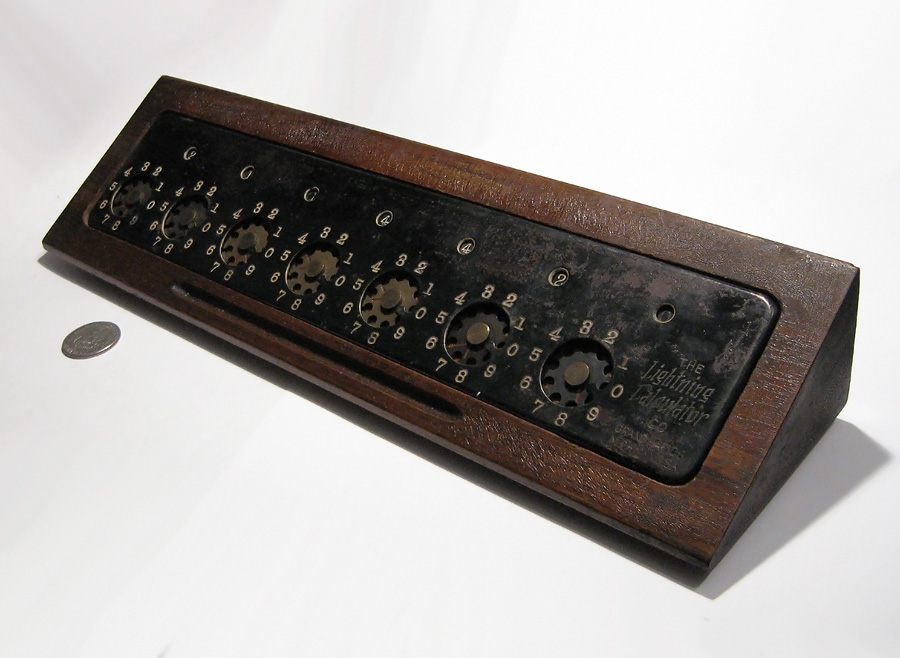
| The Calculator | Grand Rapids | 1915–21 | black enamel; wooden wedge stand with stylus hole | on the dials | per dial | not marked; carry clockwise only |
| Pangborn | Grand Rapids | 1921–23 | as The Calculator, Pangborn decal over “THE CALCULATOR CORP.” | on the dials | per dial | as The Calculator |
| Lightning Calculator | Grand Rapids | 1921–c. 1942 | black enamel, stamped paint-filled lettering; models -1 bare, -2 cased, -3 sloped wooden base | separate row of windows | per dial, red reset marks | not marked |
| Smallwood | Oakland, Calif. | 1920s | close copy, decal lettering | windows | per dial | not marked |
| Lightning Adding Machine, first LA model | Los Angeles | 1945/46–spring 1948 | painted steel, colours (mostly green; also tan, red, brown); Bakelite stand, black on the earliest | windows | per dial, red “triangles” | by the triangle method (complements) |
| LA, clearing model | Los Angeles | mid-1948–early 1950s | thicker body; stand with cut-out for the tab; still $12.95 | windows | PULL LEVER TO CLEAR | not marked on the faceplate |
| LA, subtracting model | Los Angeles | c. 1951–53 to 1959 | ”non-glare gray finish”, square framed windows; $14.95 | windows | lever | small yellow figures, carry both ways |
Sources: Otnes 2002; Rechnerlexikon; Scherphuis; the company’s own trade notices and advertisements of 1948–53. Scherphuis places the lever and subtraction in one 1948 redesign, but the 1948 advertisements show the lever on an add-only machine at the old price, and subtraction was announced separately, at $14.95, from an address the company used in 1950–53.
4.2 The clues, one at a time
4.2.1 Wood or Bakelite
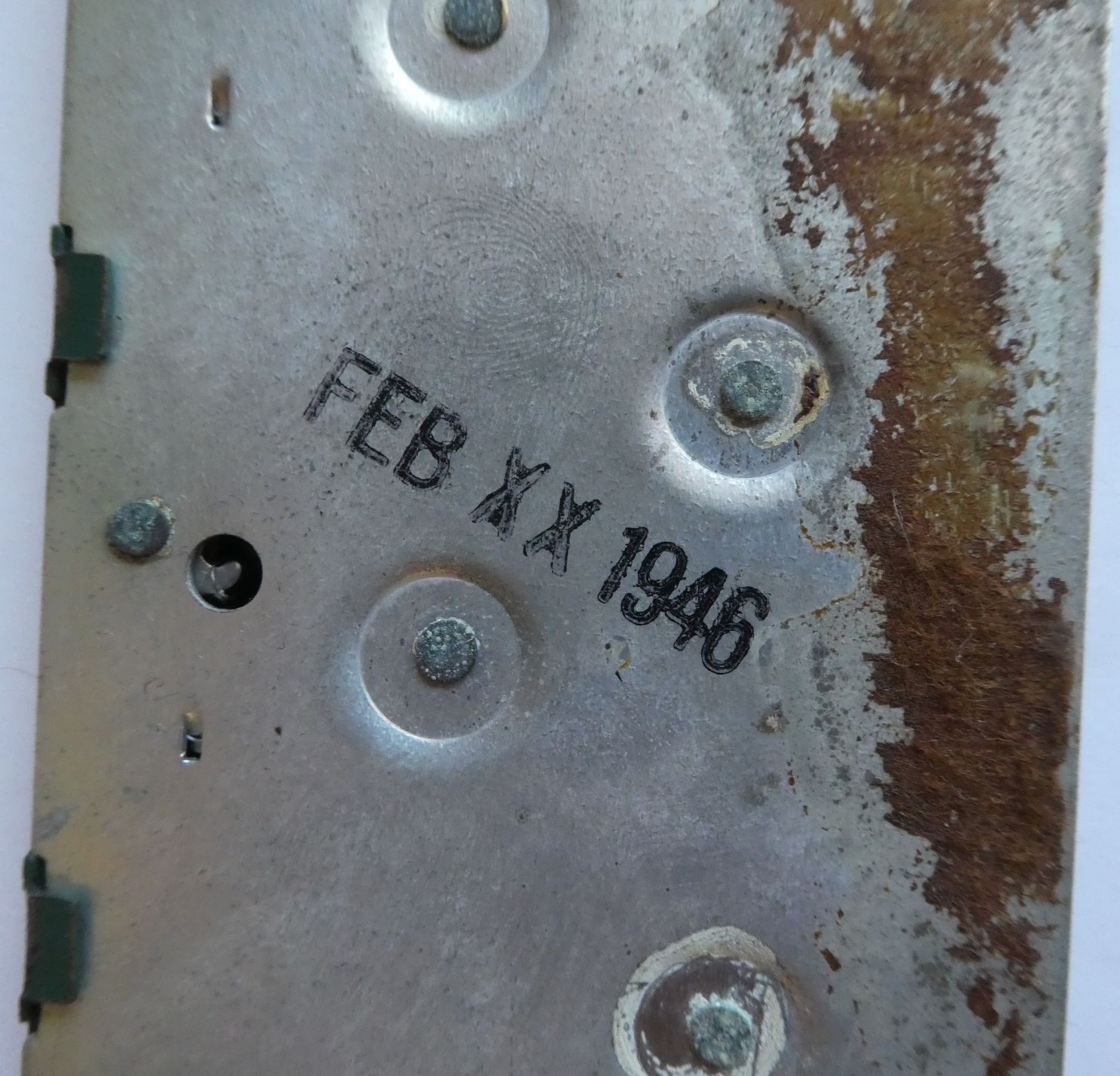
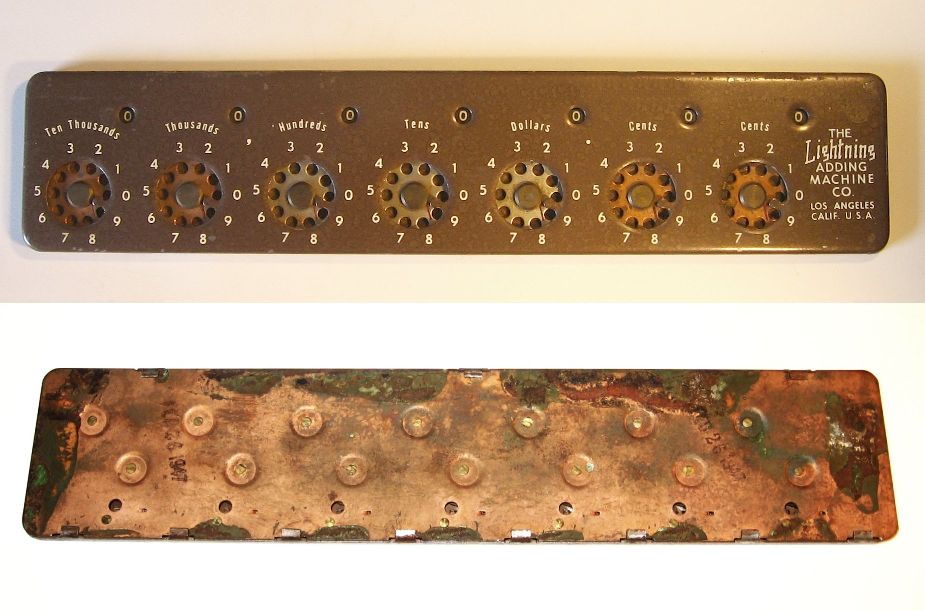
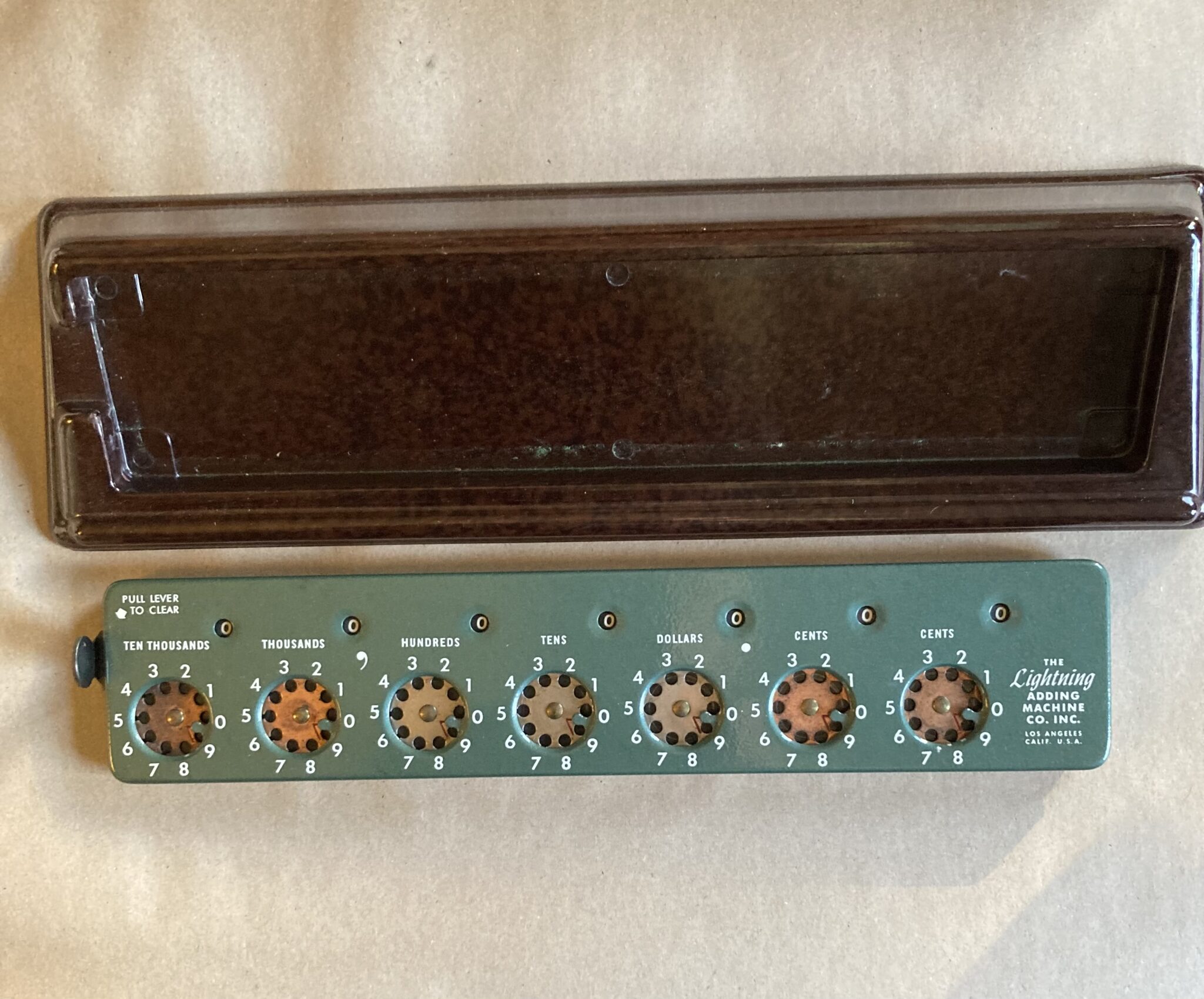
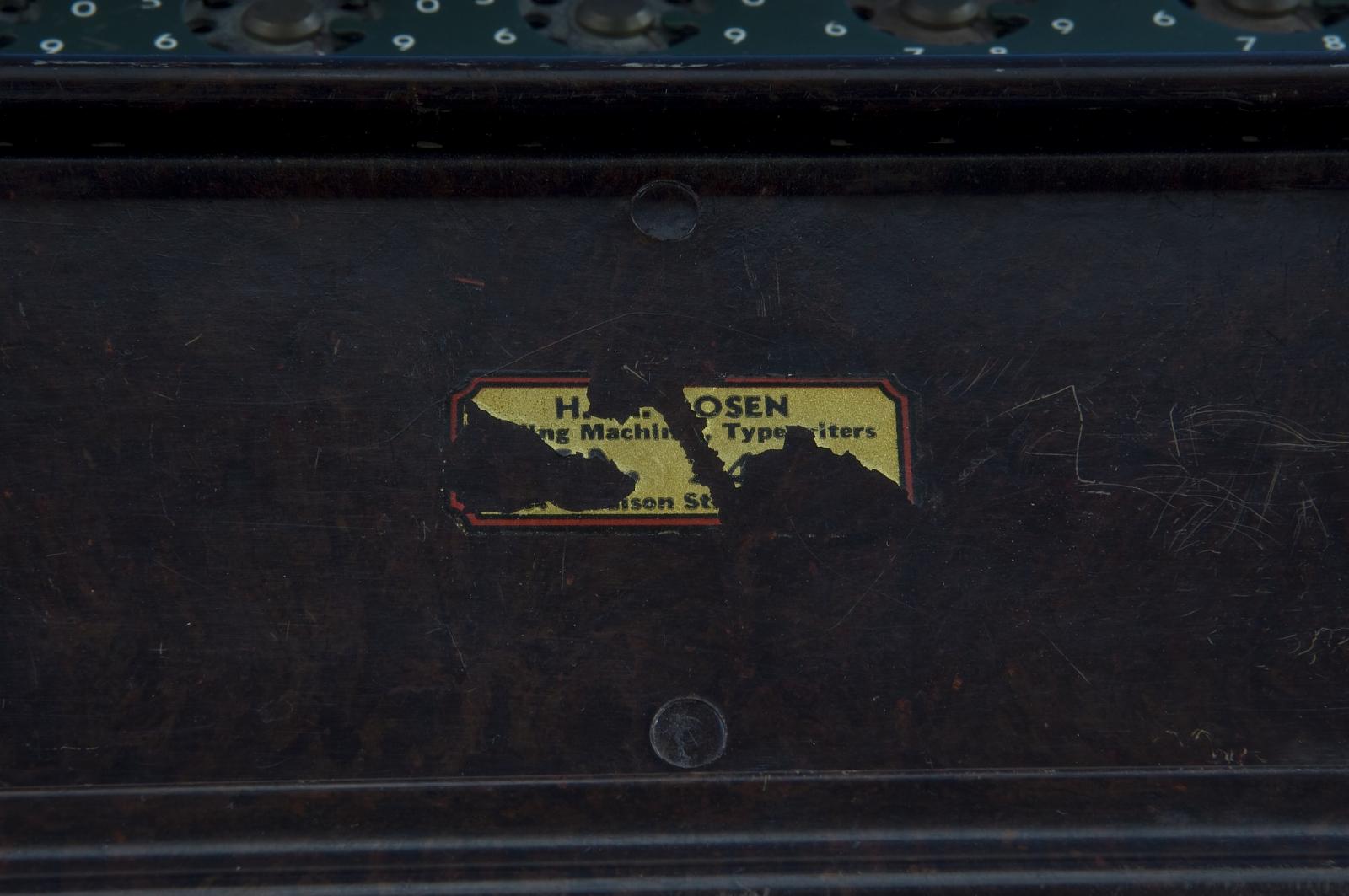
A wooden base means Grand Rapids, before the war. A Bakelite stand means Los Angeles, after it. The earliest Los Angeles stands, of 1946, are black, and most later ones are brown. The underside of the stand carries an intertwined “GIM” moulder’s mark, which the Smithsonian also records on its example. The Bakelite is the stand only. The machine that lifts out of it is painted steel, whatever its colour, and on the back it is a bare steel plate with rivet bosses, a felt pad and, on some machines, a factory date stamp. Scherphuis’s early Los Angeles machine is stamped FEB 1946. A machine that has lost its stand can still be placed by the rest of the clues.
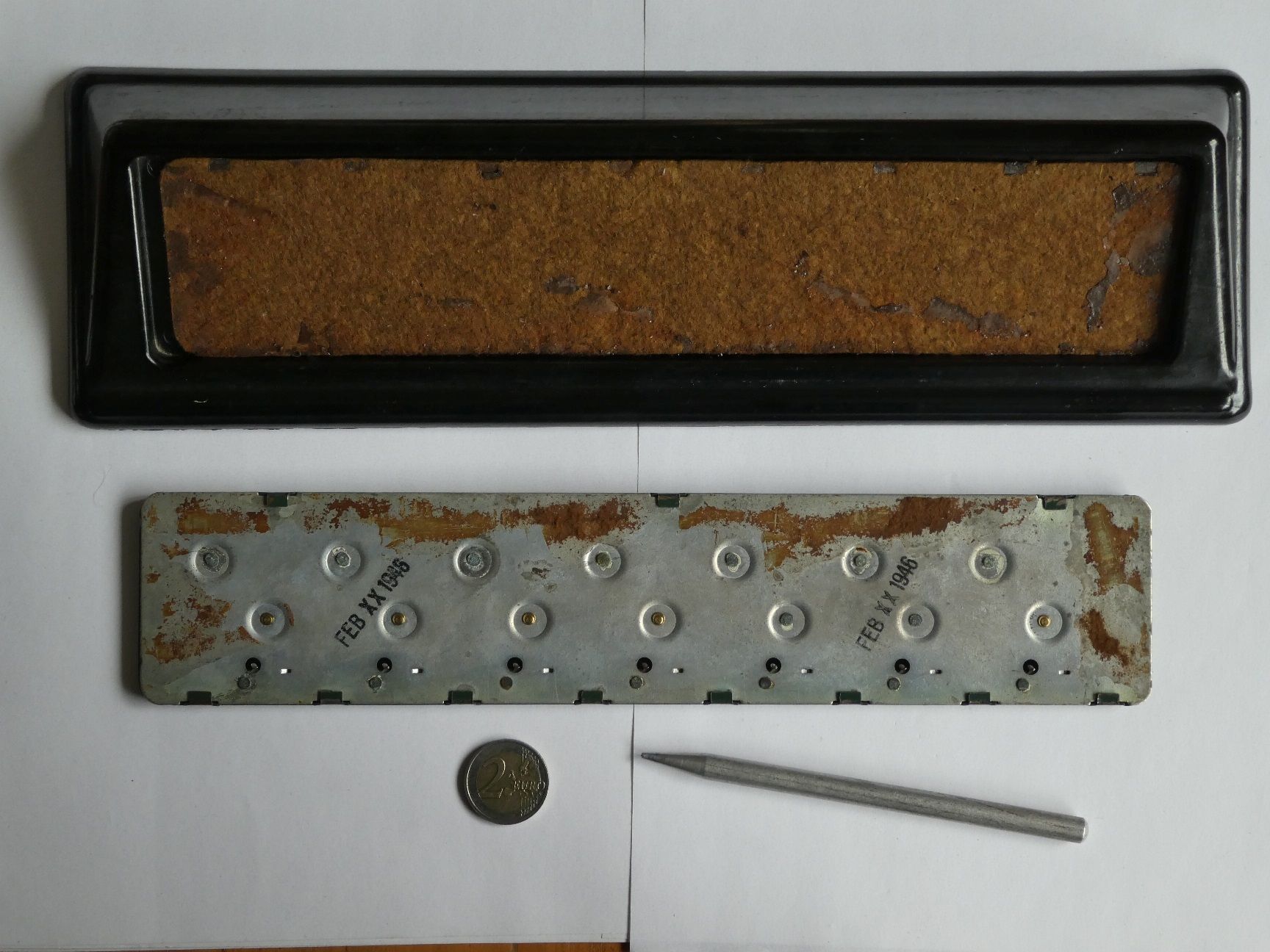
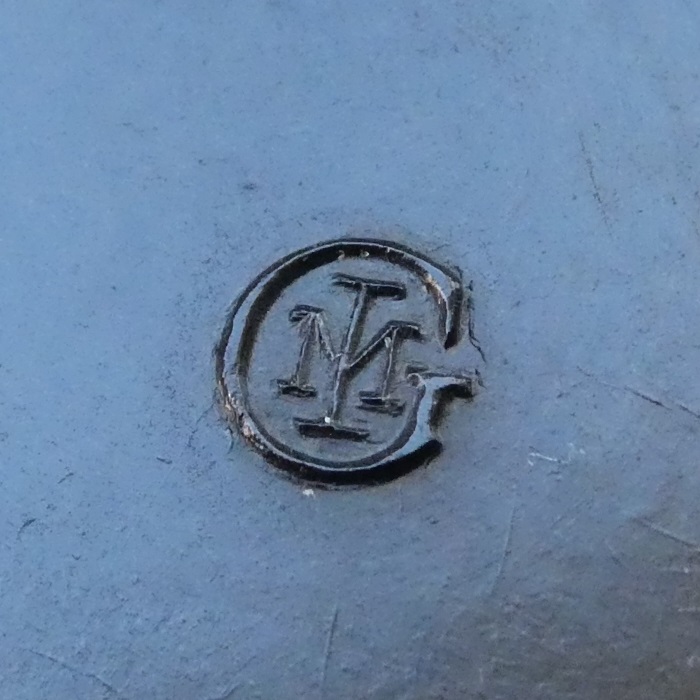
Stands are not interchangeable between the early and the lever models. The lever model’s body is thicker, and its stand has a cut-out at the left for the tab.
4.2.2 “Calculator” or “Adding Machine”
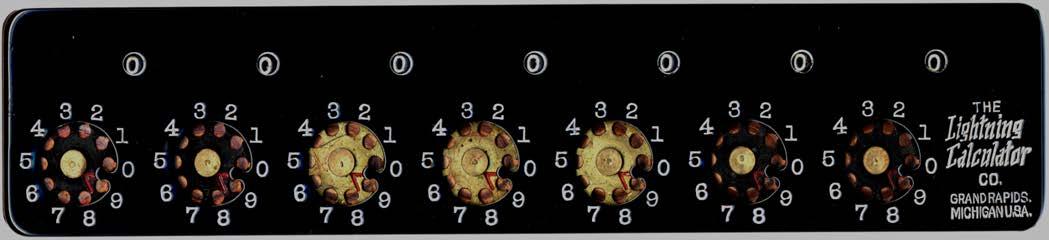
Grand Rapids machines are Lightning Calculators. Los Angeles machines are Lightning Adding Machines. Otnes notes that the “Lightning” script on the earliest Los Angeles machines matches the Grand Rapids lettering and later changed style.
4.2.3 The maker’s name on the faceplate
Table 2 — The maker's name on the faceplate
| Wording | Period |
|---|---|
| Lightning Calculator, Grand Rapids (stamped; exact wording varies) | 1921–c. 1942 |
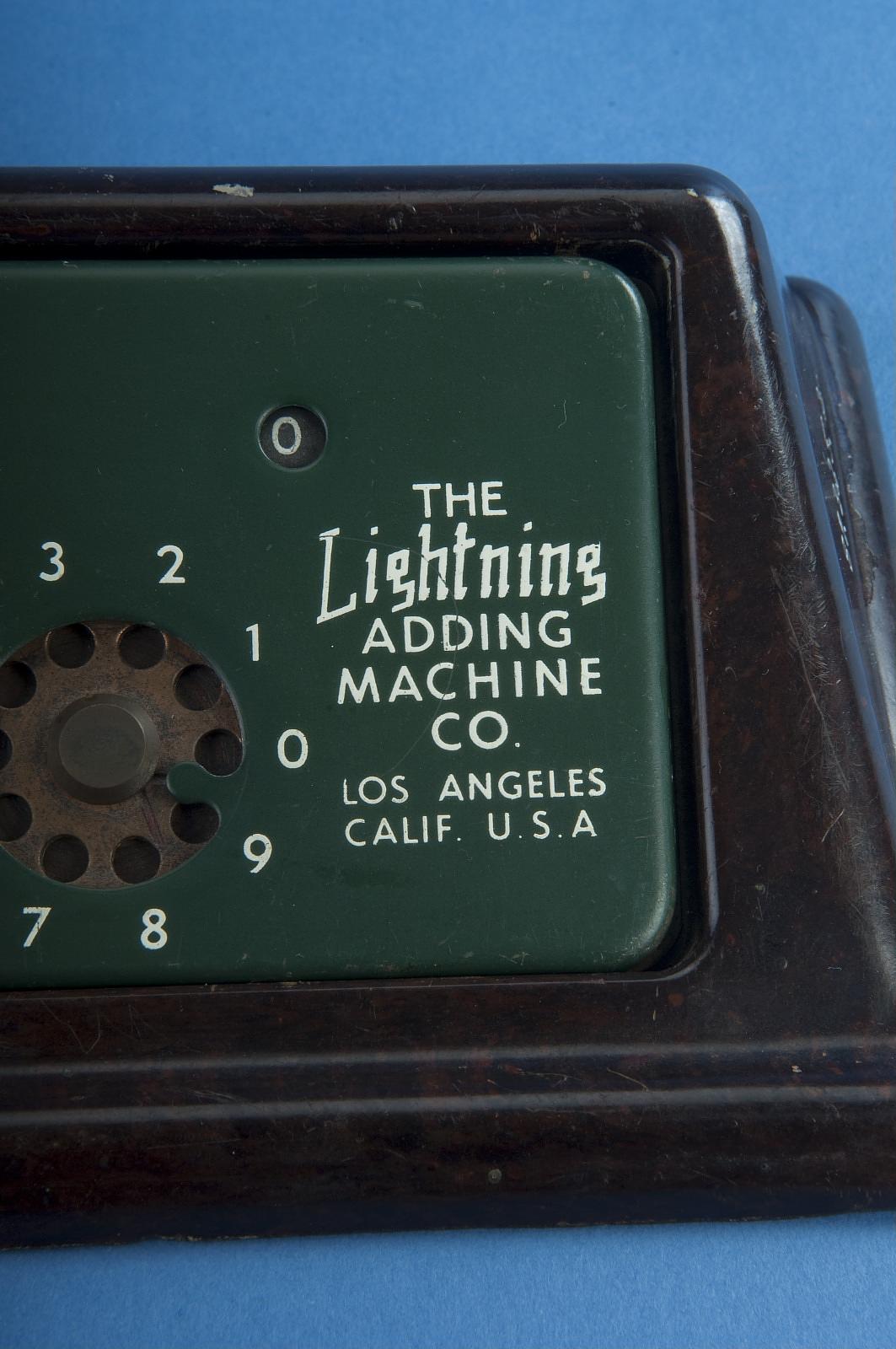
| THE Lightning ADDING MACHINE CO. [INC.], LOS ANGELES CALIF. U.S.A. | 1945/46 to about 1953 |
| MFGD. BY Lightning ADDING MACHINE SALES CO., LOS ANGELES 7, CALIF. U.S.A. | late 1953 to about 1955 |
| … SALES CO. with a zone other than 7, or the Slauson Avenue address (Los Angeles 43) | 1956–59 |
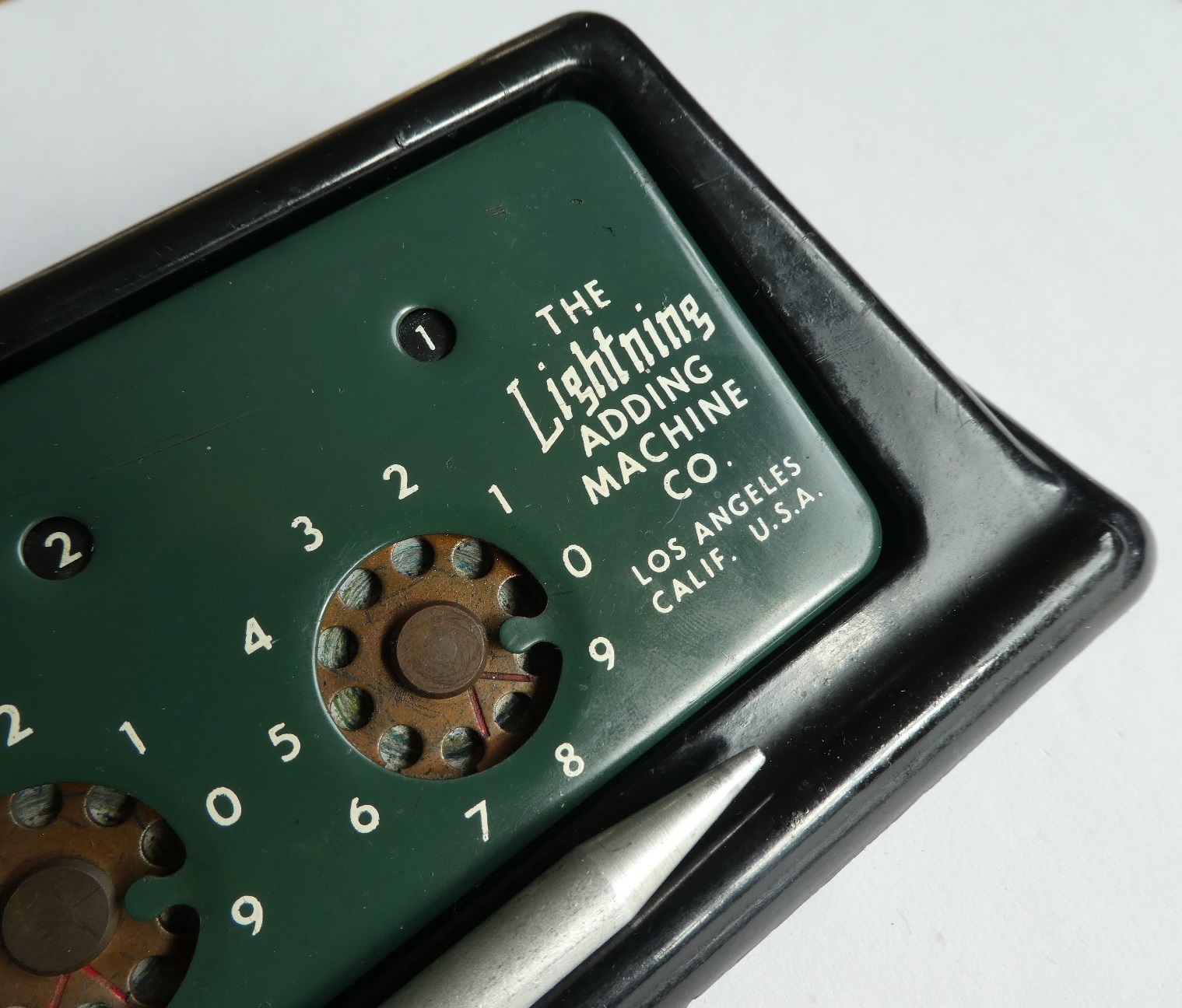
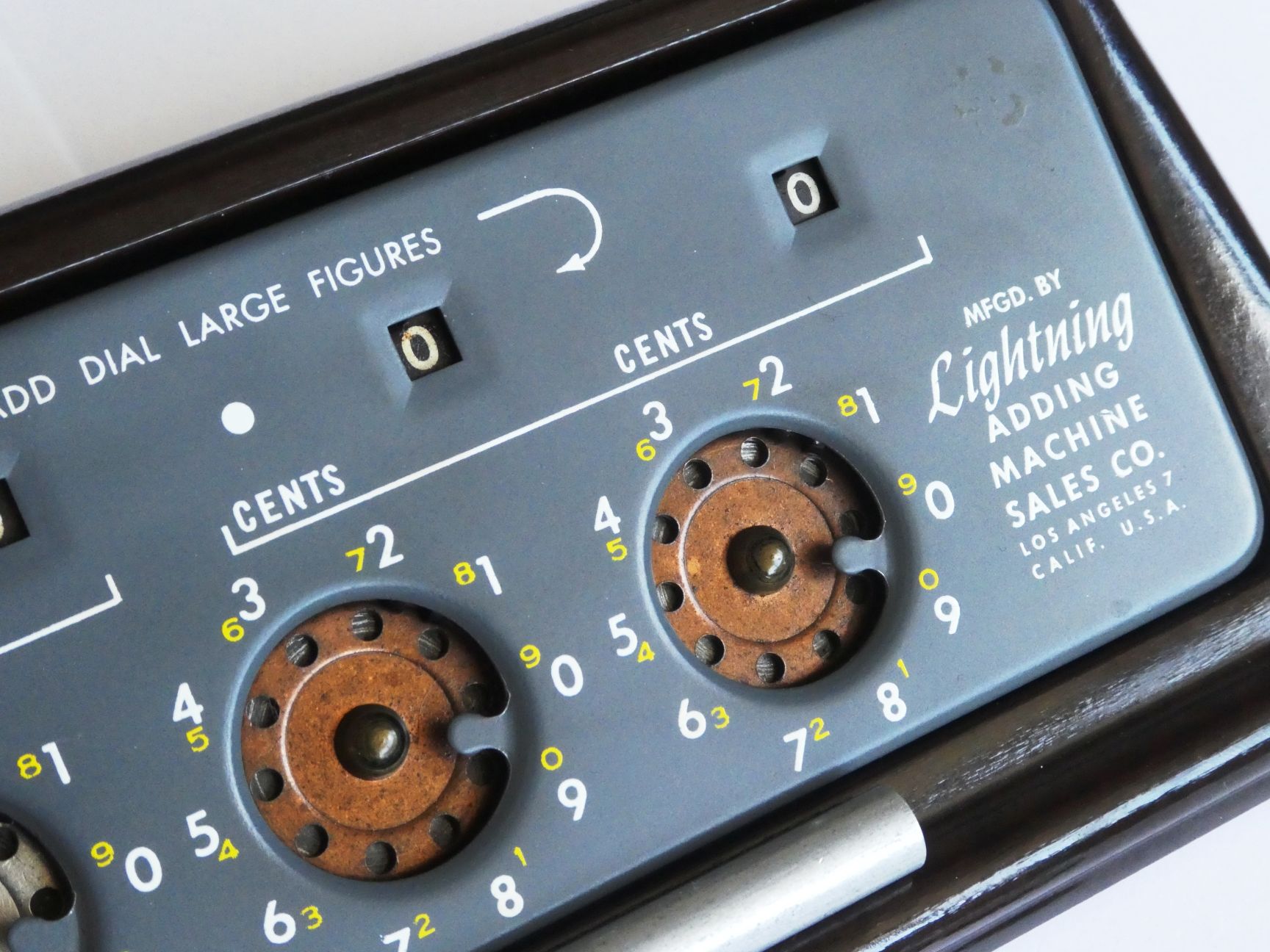
The “Sales Co.” at 234 West 37th Place, Los Angeles 7, was advertising in Newsweek on 14 December 1953, the month the trade press reported the company’s sale to Max Dworsky and Martin Walsbren, and is in the 1955 city directory there. The 1956–59 address, 2306 West Slauson Avenue, is printed “Los Angeles 43” on the late leaflet. A faceplate reading “Los Angeles 7” with the Sales Co. name therefore most probably dates from between late 1953 and about 1955. The caveat is that faceplates may have been printed in bulk and used up after a move, and the directories quoted are not complete year by year.
4.2.4 The postal zone
US postal zone numbers, the “7” in “Los Angeles 7”, were introduced in 124 cities in 1943 and replaced by ZIP codes from 1 July 1963. The zone became the last two digits of the ZIP. Any zone number on a faceplate, box or leaflet therefore dates it to between 1943 and 1963. A faceplate with no zone is not necessarily earlier: many Los Angeles faceplates, my green one among them, print only “Los Angeles Calif.”, even though the company’s early leaflet already gave its address as “543 So. Spring Street, Los Angeles 13”.
4.2.5 Clearing: triangles or a lever
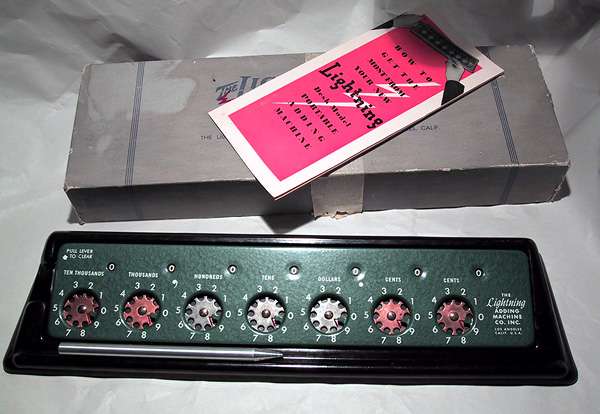
A machine with no lever and a small red triangle or two red lines on each dial is either Grand Rapids or Los Angeles before mid-1948. A machine with the PULL LEVER TO CLEAR tab is mid-1948 or later. The 1948 advertisements in Office Appliances show the change: March without, June–July and December with.
4.2.6 Subtraction figures
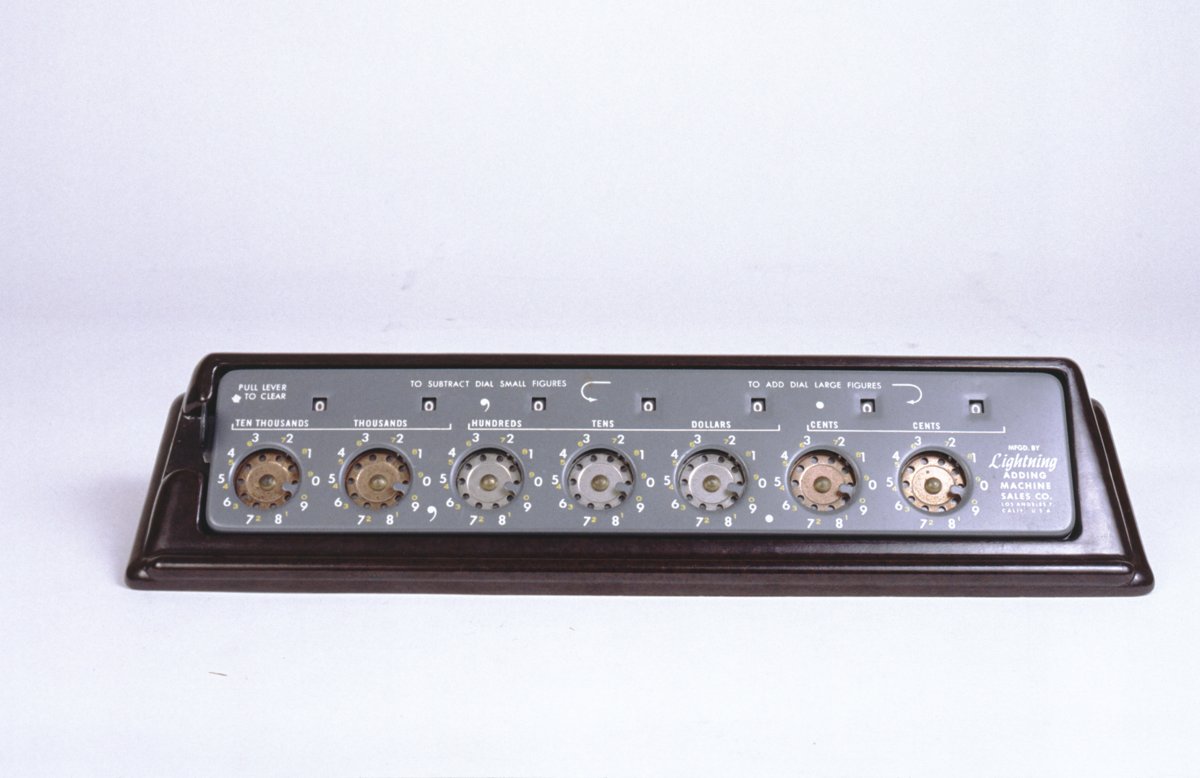
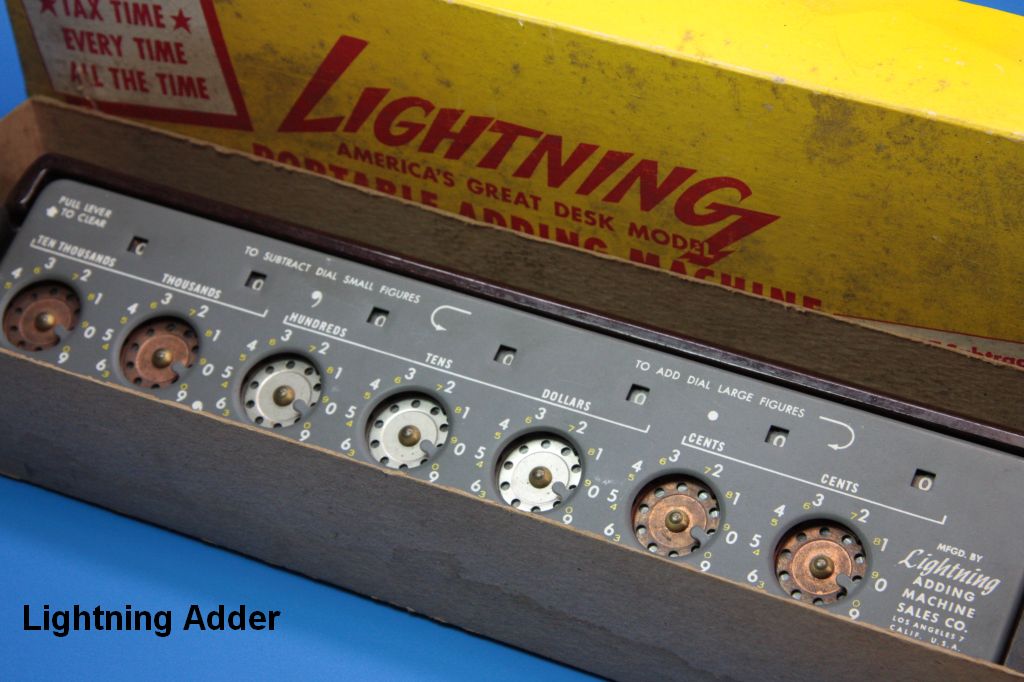
Small yellow figures beside the large white ones, with TO SUBTRACT DIAL SMALL FIGURES and TO ADD DIAL LARGE FIGURES printed with their arrows, mark the final model, announced in about 1951–53 in a “distinctive non-glare gray finish”. Rechnerlexikon says these are always grey. Grey alone is not enough, though, since add-only machines were also made in a blue-grey.
4.2.7 Price
Table 3 — Price
| Price | Evidence |
|---|---|
| $12.50 | The Calculator, Popular Science, July 1920 |
| $10 / $12.50 / $15 | Grand Rapids Lightning, c. 1926 (bare / cased / on base) |
| $12.95 | Los Angeles, Office Appliances January and March 1948, before the lever |
| $12.95 | Los Angeles with the clearing lever, Office Appliances June–July and December 1948 (“yet it still retails for $12.95”) |
| C$19.95 | Eaton’s of Canada catalogue, 1950–51, “couleur: brun foncé” |
| $14.95 | the subtracting model, from its announcement (c. 1951–53) and Newsweek, December 1953; $14.95 postpaid on the order slip |
| $15 | a 1950s subtracting machine, “original price $15” (Museum of Radio & Technology) |
4.3 Dating my two machines
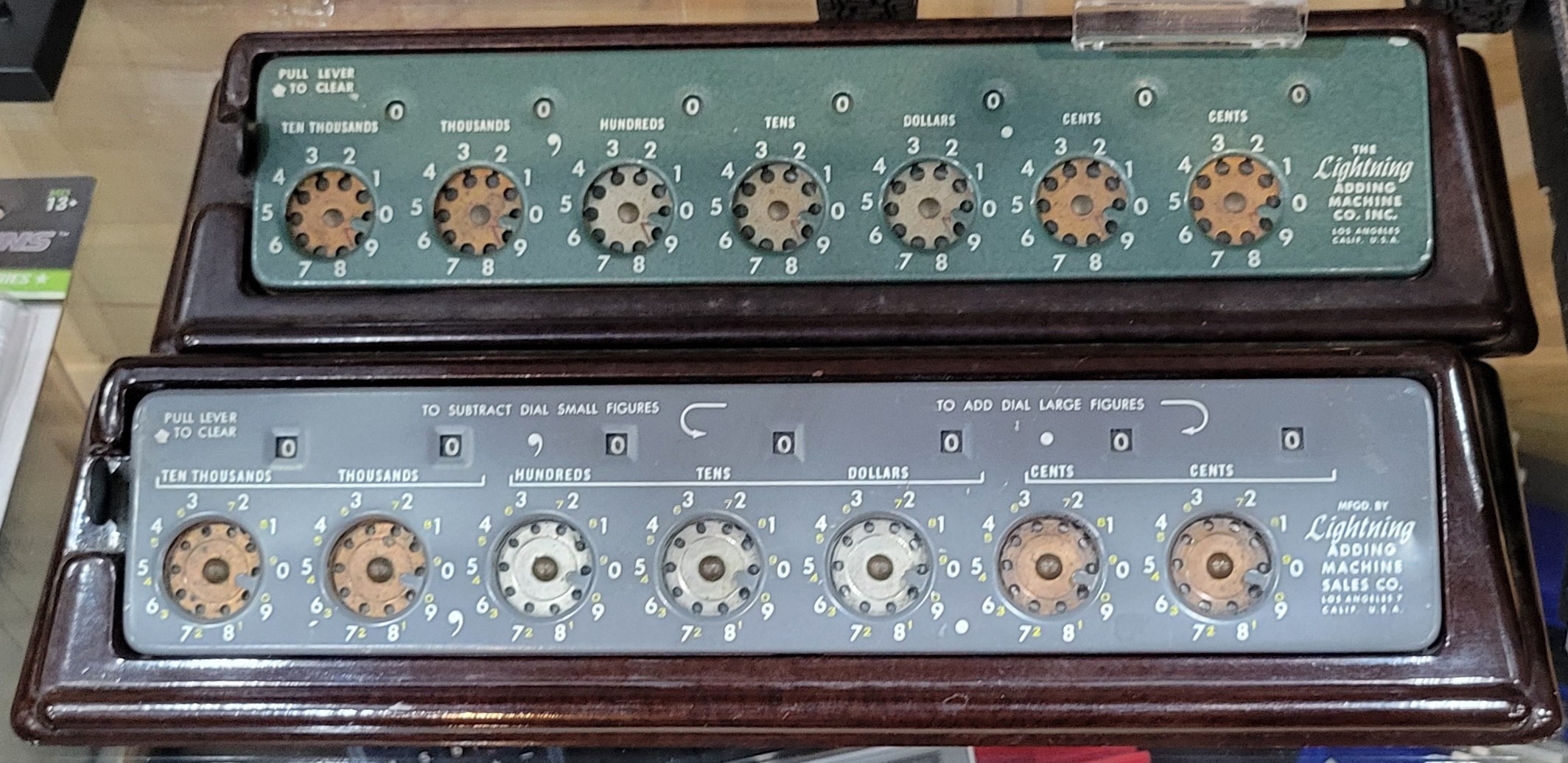
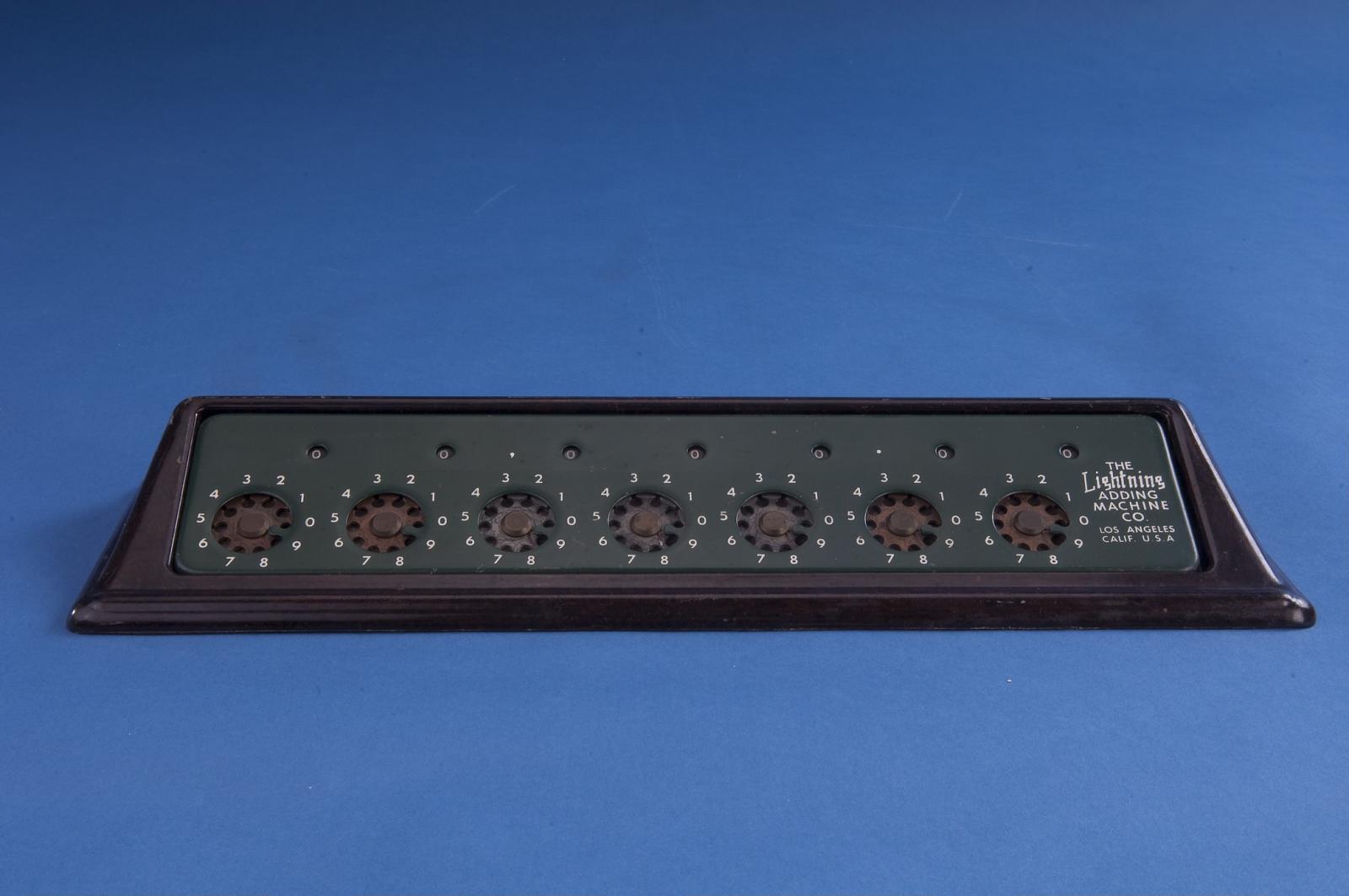
The green machine reads “THE Lightning ADDING MACHINE CO. INC., LOS ANGELES CALIF. U.S.A.”, has the PULL LEVER TO CLEAR tab, a single ring of white figures and no subtraction legend, and sits in a Bakelite stand. The lever puts it after spring 1948. The absence of subtraction figures, and the company name, put it before the grey subtracting machines of the early 1950s. Mid-1948 to the early 1950s. If its back plate carries a date stamp, that will narrow it further.
The grey machine reads “MFGD. BY Lightning ADDING MACHINE SALES CO., LOS ANGELES 7, CALIF. U.S.A.”, has the lever, the yellow subtraction figures, square framed windows and the subtraction legend. The Sales Co. name and zone 7 together put it between the December 1953 Newsweek advertisement and the move to Slauson Avenue: late 1953 to about 1955. The grey subtracting Lightning in the Whipple Museum at Cambridge carries exactly the same wording.
4.4 Dates to distrust
- “c. 1900” and “first produced 1908” for a Lightning. Both probably come from confusion with the unrelated Detroit “Lightning Calculator” (a Webb copy, 1900–02) or with Bonham’s 1905 patent application.
- “1938” for a Lightning Adding Machine Sales Co. machine. The Sales Co. name dates from late 1953, and the zone number from after 1943.
- “1920” for a Lightning Calculator. That predates both the company and Hook’s patent application, though it would suit The Calculator.
- “Early 1960s” as the end of production. The last directory entry found is 1959.
- February 1959 for the “Subtracting-Adding Machine” announcement. Its 1260 West 2nd Street address and “over 30 years of use” point to about 1951–53.
- Any Lightning with other than seven dials. None is recorded. The 4-, 5- and 6-dial machines sometimes described are Sterling Dial-A-Matics. The Grand Rapids “L” and “S” models had seven dials with non-decimal places for feet and inches or pounds, shillings and pence.
Comments (0)