Dial Adders · Volume 2
Before the Lightning: From Roth's Dials to The Calculator
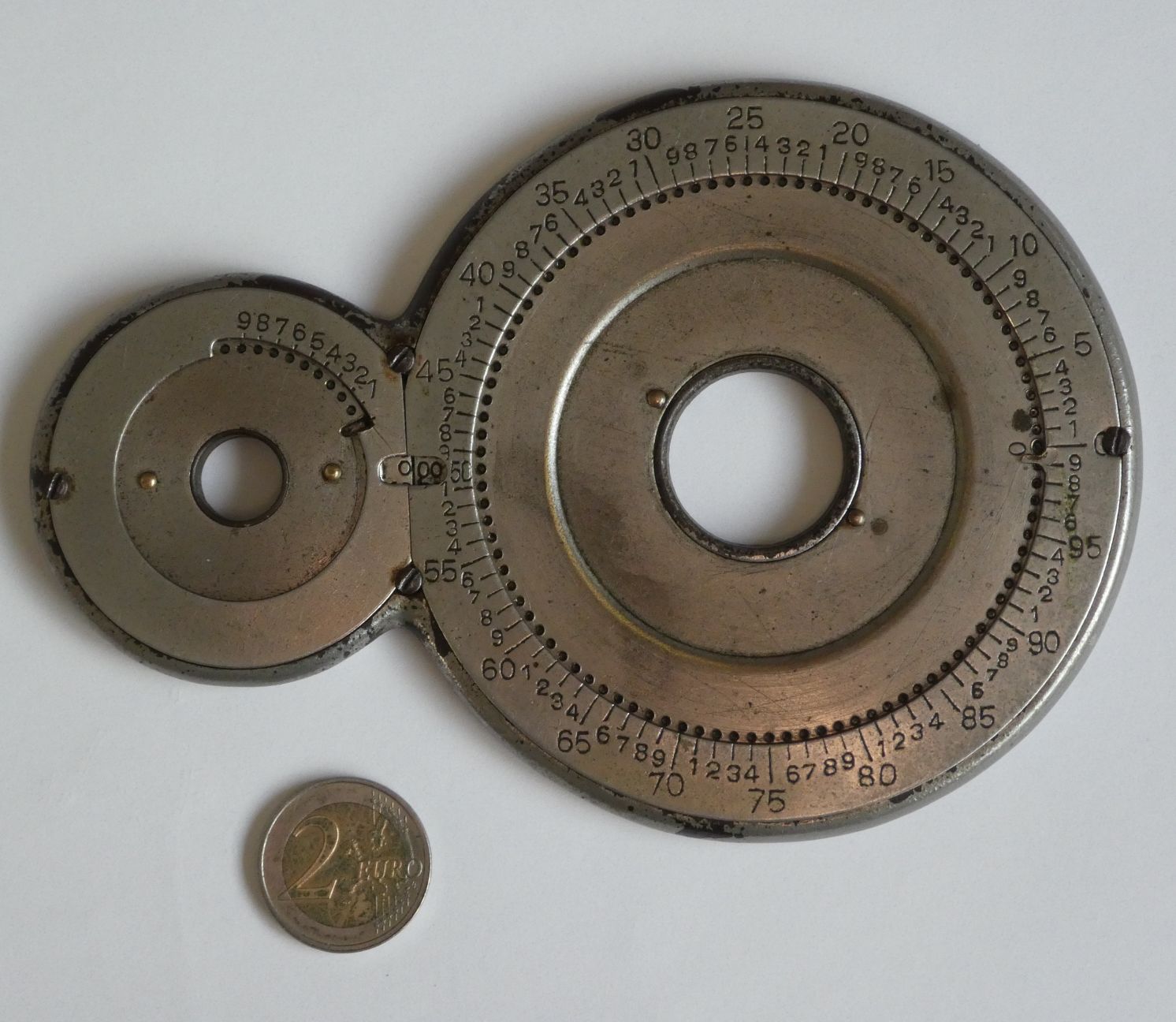
The Lightning did not arrive from nowhere. By the time Russell Wallace Hook filed his patent in 1921, the stylus dial adder had existed for eighty years, had been reinvented at least a dozen times on both sides of the Atlantic, and had already been sold by the hundred thousand. Hook’s machine is the last link in one particular chain, a design that started in Chicago in 1905 and passed through two Grand Rapids companies and a lawsuit before it carried the Lightning name. This volume follows the general history of the dial adder up to that point, and then the particular one.
2.1 The oldest idea in mechanical arithmetic
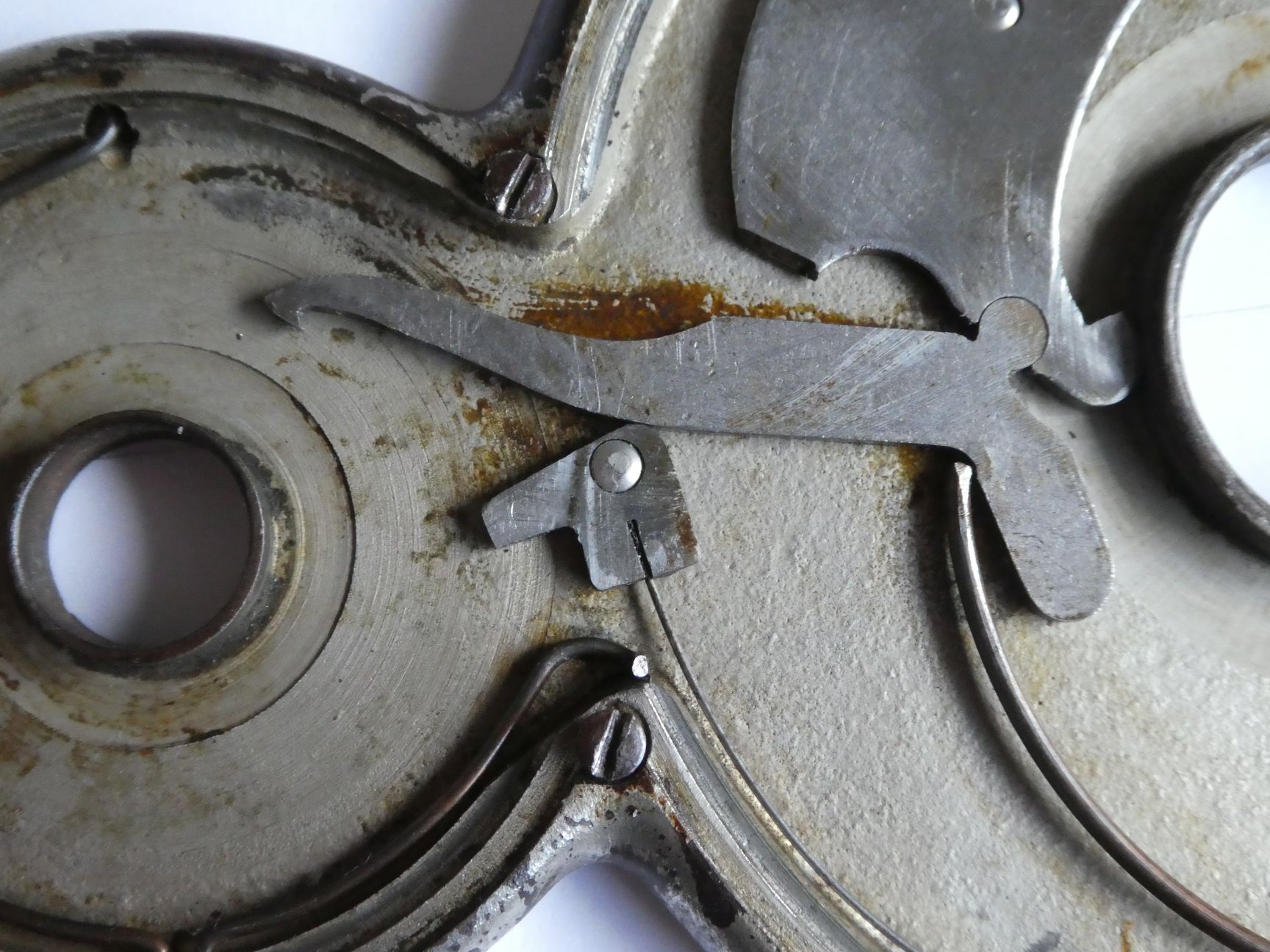
A wheel with ten positions, turned by a pointed tool and coupled to its neighbour so that a full turn advances the next wheel by one, is the oldest working idea in mechanical calculation. Blaise Pascal’s machine of 1642 is built on it: the operator turned each of its wheels with a stylus against a stop, and a carry mechanism passed the tens along. Everything in this series is, in that sense, a simplified Pascaline.
What Pascal’s machine was not was cheap, and for two centuries mechanical adders remained instruments for a few. The stylus row adder as a manufactured, saleable product begins in the 1840s.
Didier Roth, in Paris, built a row of stylus dials with a spring-actuated carry, patented in England by D. J. Wertheimber as British patent 9,616 of 28 July 1843. It is the earliest of the family in Otnes’s taxonomy, and it did not sell well. (Roth’s better-known circular machine of 1841 is a multiplier, a different device.)
2.2 Charles Henry Webb and the two-wheel adder
The first dial adder to sell in quantity in America was not a row of dials at all. Charles Henry Webb (1834–1905) was a New York poet, humorist and editor who patented an adding machine in 1868 (US 75,322, 10 March 1868). His adder had two concentric stylus wheels: a large one numbered 00 to 99 and a small one for the hundreds, with a spring that stored energy as the large wheel turned and released it to advance the small wheel at the carry. It was a column adder, made to run up a ledger column two digits at a time, and it reached 4,999 before it had to be cleared.
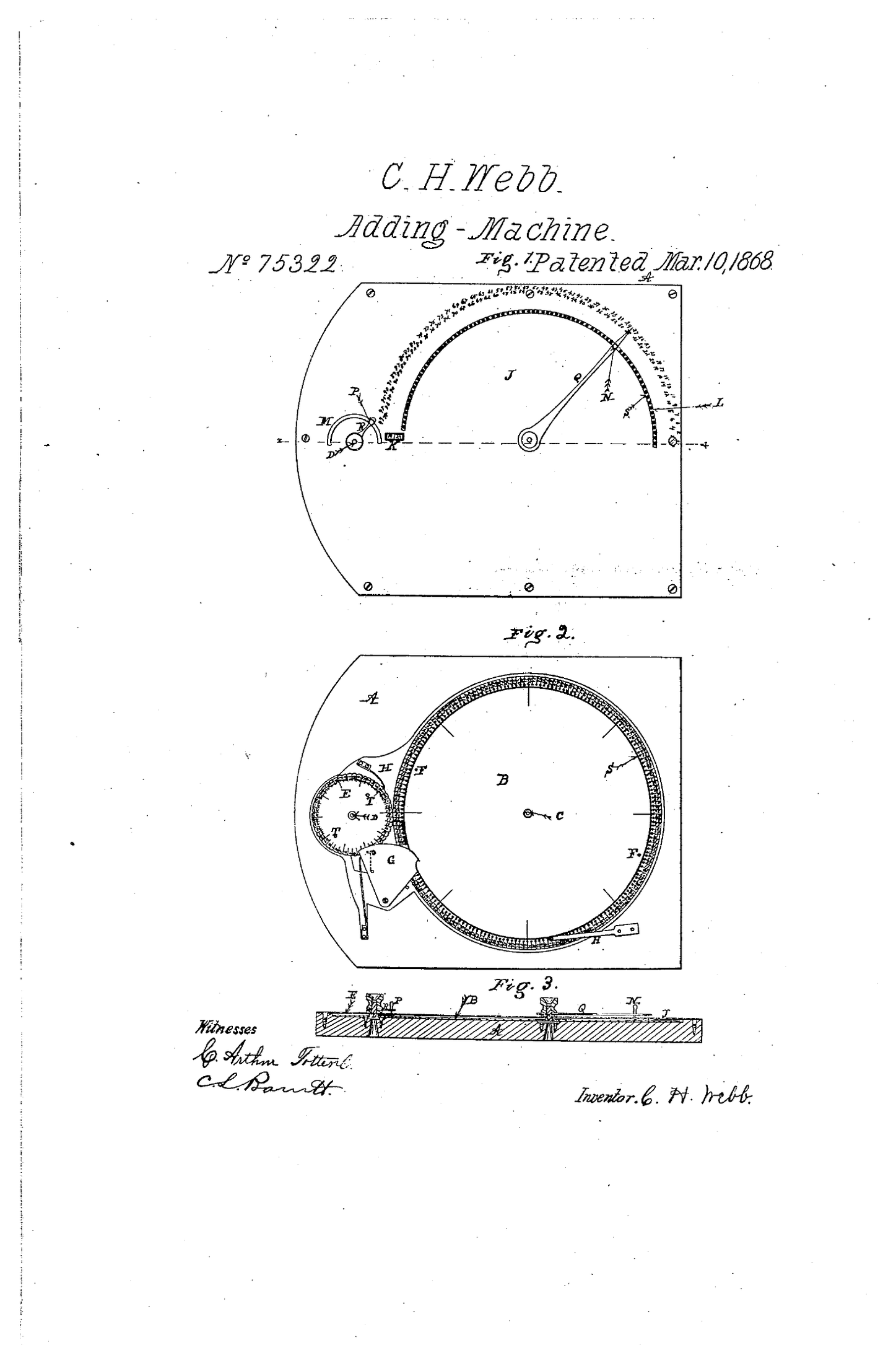
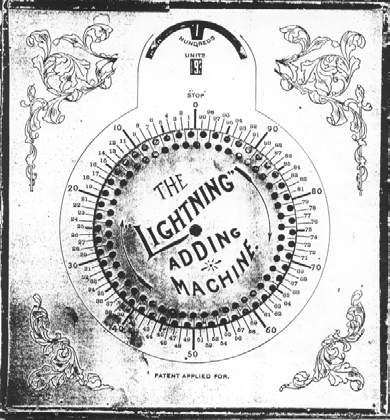
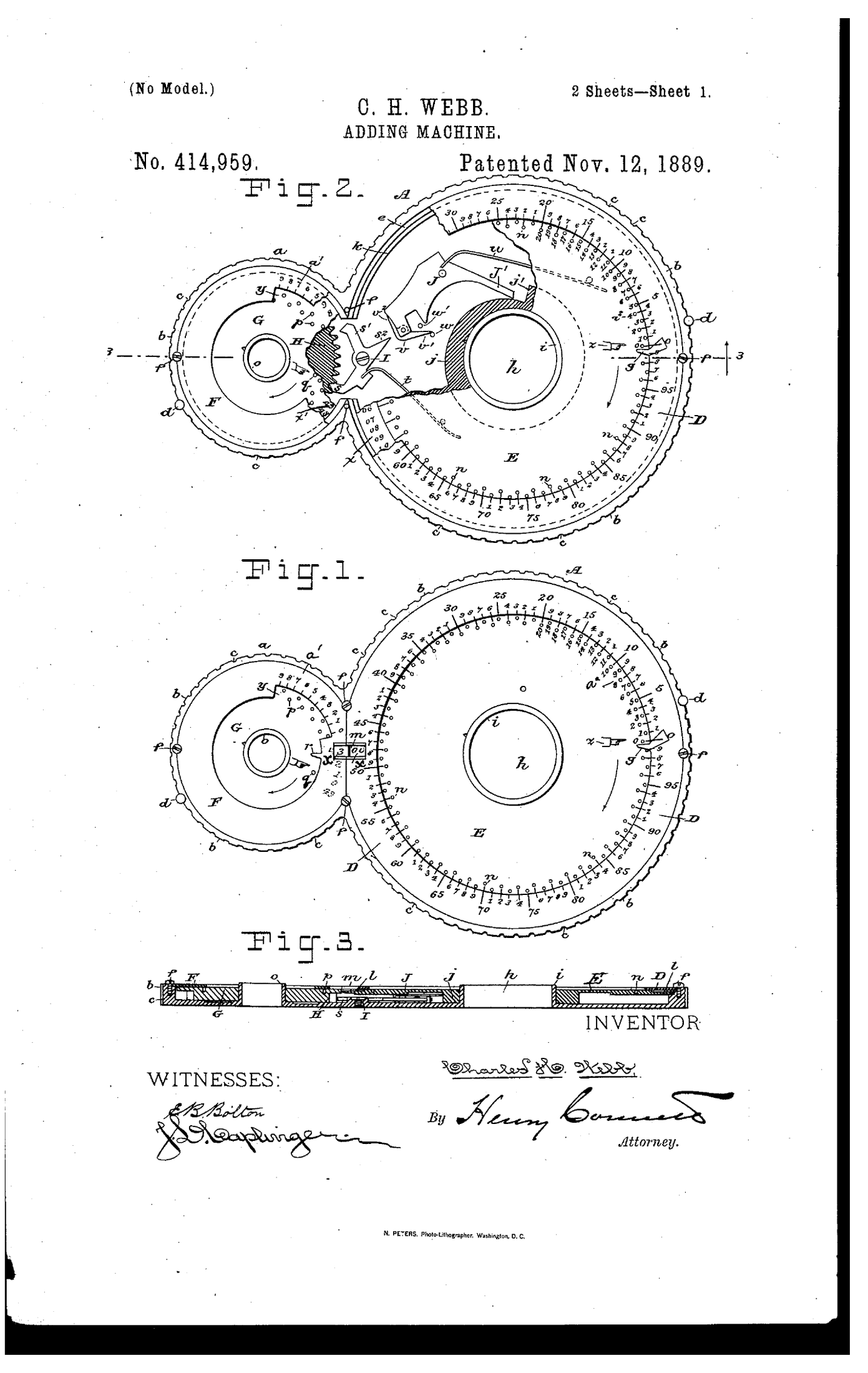
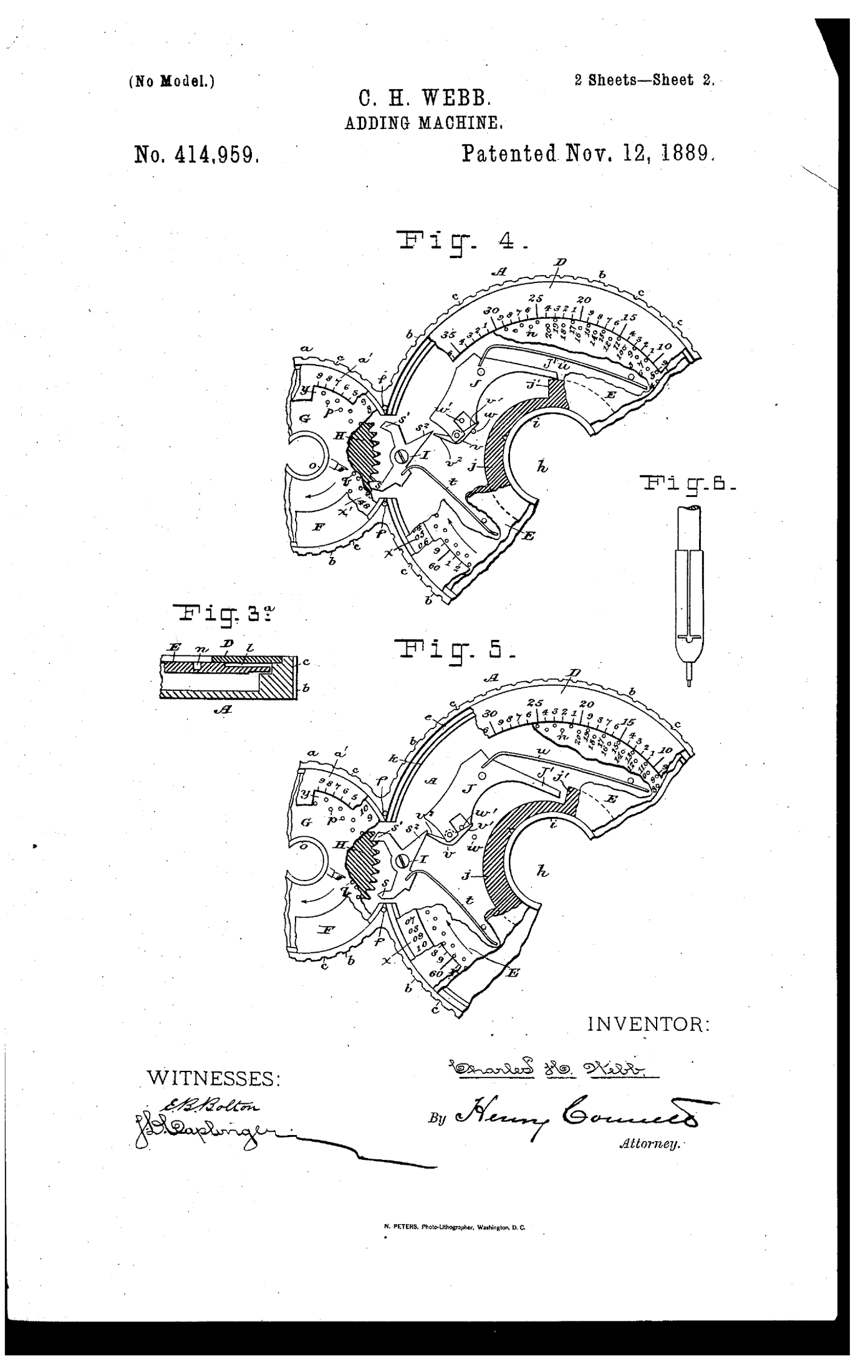
Webb improved the design in 1889 (US 414,959, filed 28 April 1888, granted 12 November 1889), and the Webb Adder sold for $6 to $10 in 1869 and $7 in 1890–92. Its success brought clones: the Victor, the Beach, the Herring, a German version by Nestler and, confusingly for anyone researching the later machine, a “Lightning Calculator” sold by the Book-Keeper Publishing Company of Detroit from about 1900 to 1902 for $3 to $5. That Detroit “Lightning” is a Webb copy and has nothing to do with Hook’s machine; it is the most likely source of the “c. 1900” and “1908” dates attached to Los Angeles Lightnings in some catalogues.
2.3 The Calcumeter: a row of dials as a ruler
The modern form of the dial adder, a straight row of identical dials, each a decimal place, with the total read directly, was made a commercial success by the Calcumeter. James J. Walsh of Elizabeth, New Jersey, patented it in 1901 (US 689,255, filed 16 January 1901, granted 17 December 1901), and it was made by Morse & Walsh from 1903 and by the H. N. Morse Company of Trenton from December 1905.
The Calcumeter was long and flat, like a ruler, and was built with anything from five to twelve dials. It was priced by the dial: $10 for five, $5 for each one more, so $45 for twelve. There were versions for pounds, shillings and pence and for feet and inches. Its carry used no stored energy. A rod on each driving wheel pushed a latch that turned the next wheel, so all the work of a carry came from the operator’s hand, the principle the Lightning would also use. A reset wheel, patented in 1908 (US 897,688), set the dials back to zero. The company claimed “over 25,000 in use” in January 1907 and 100,000 sold by 1913.
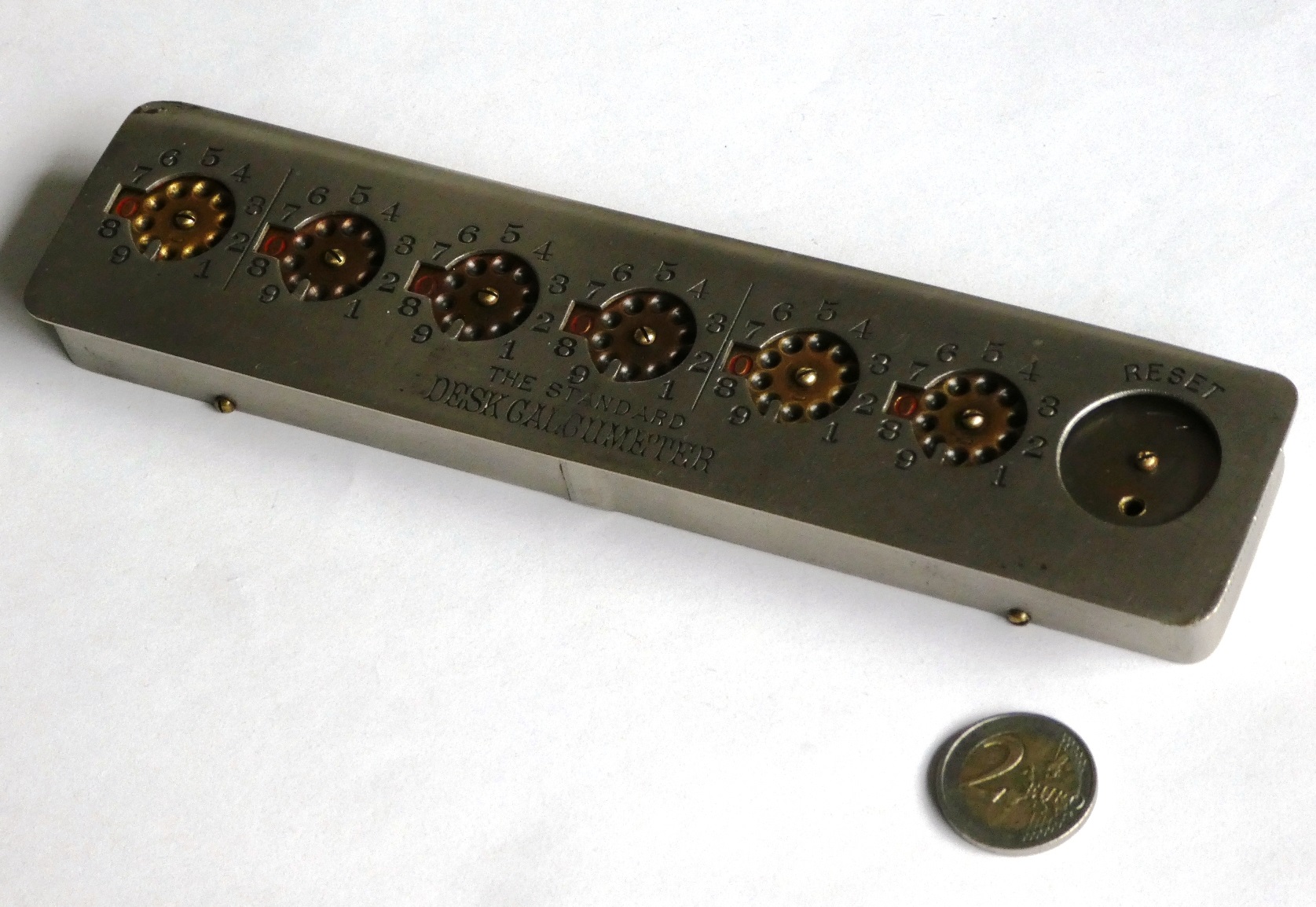
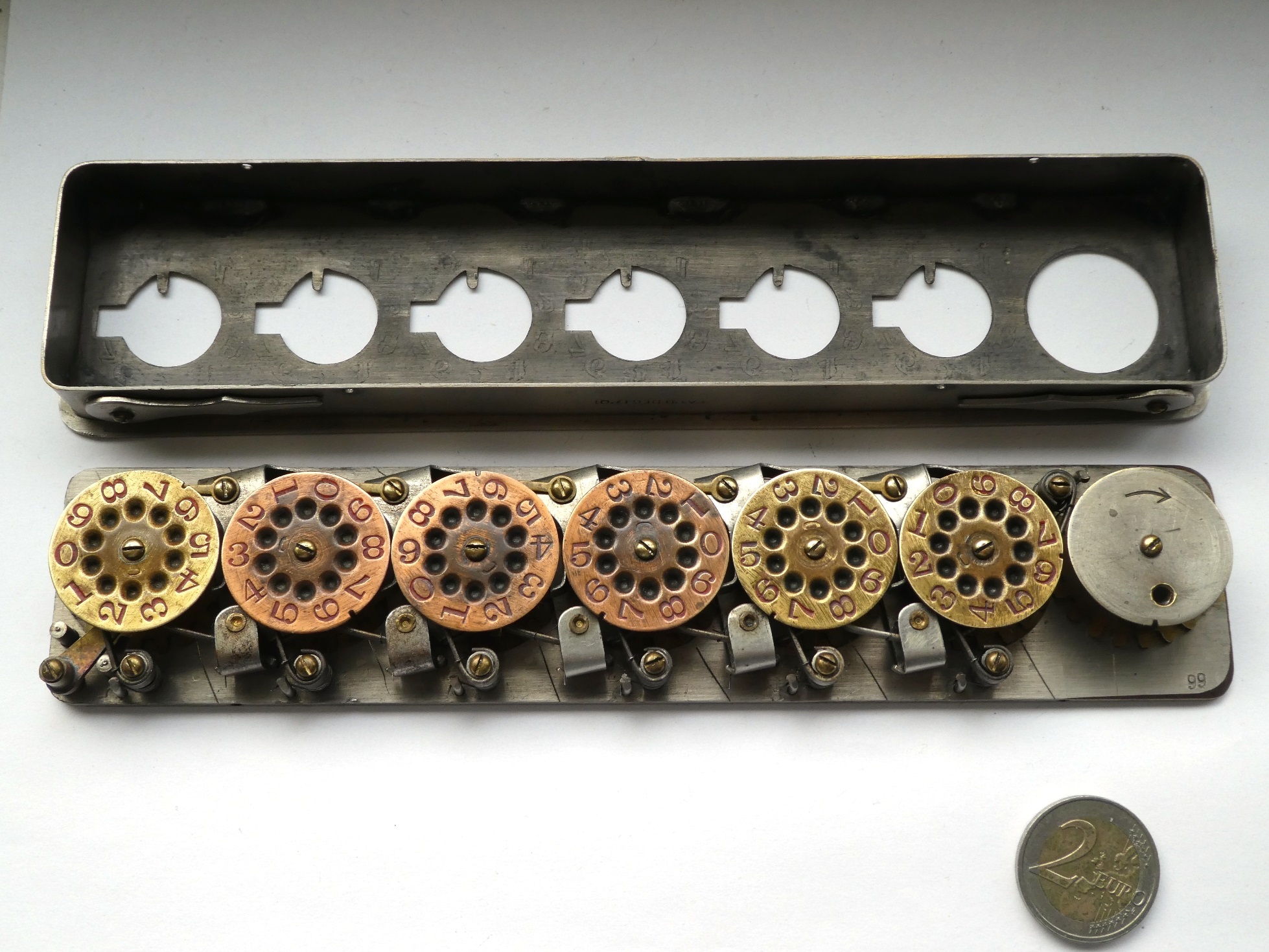
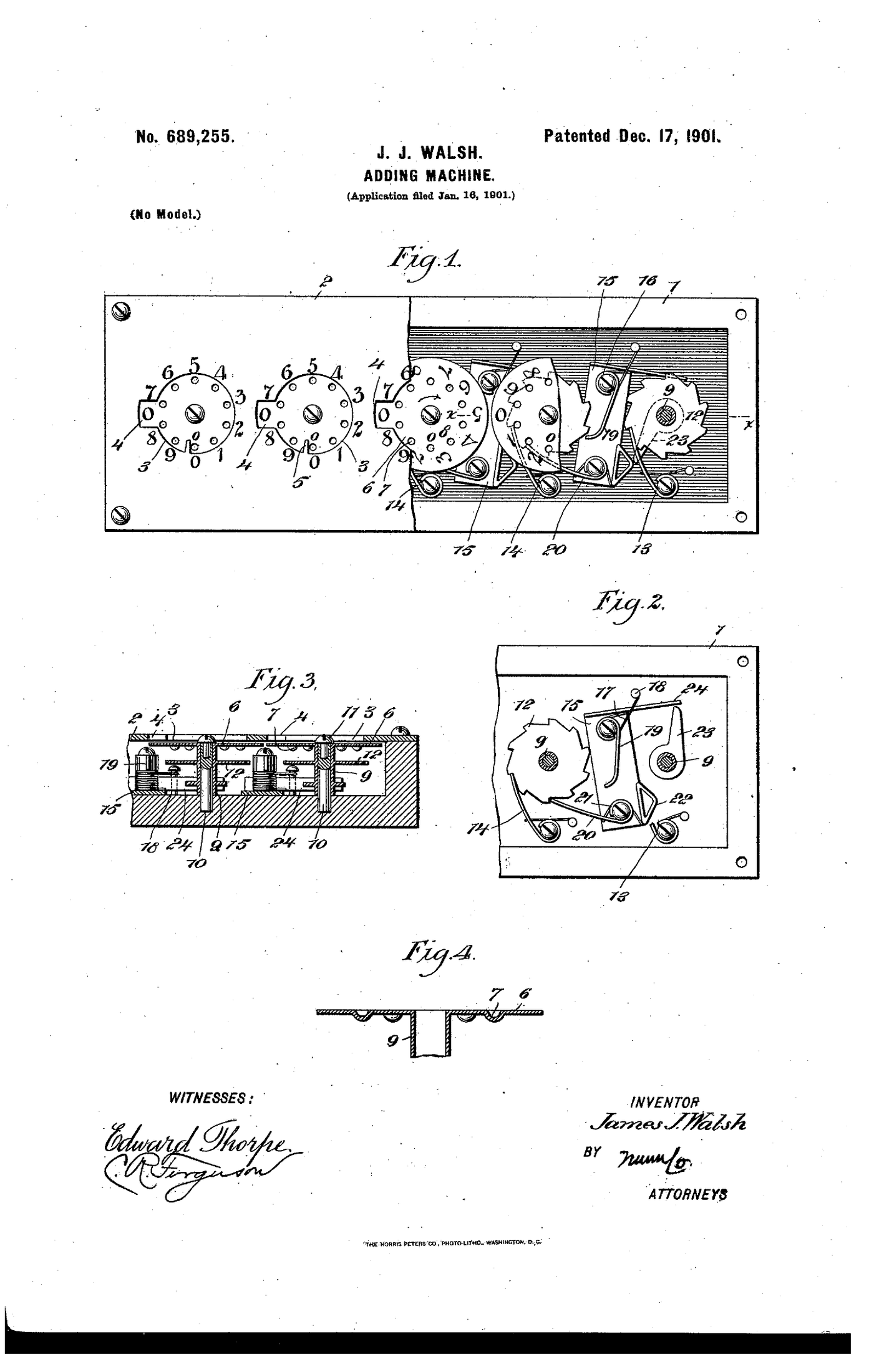
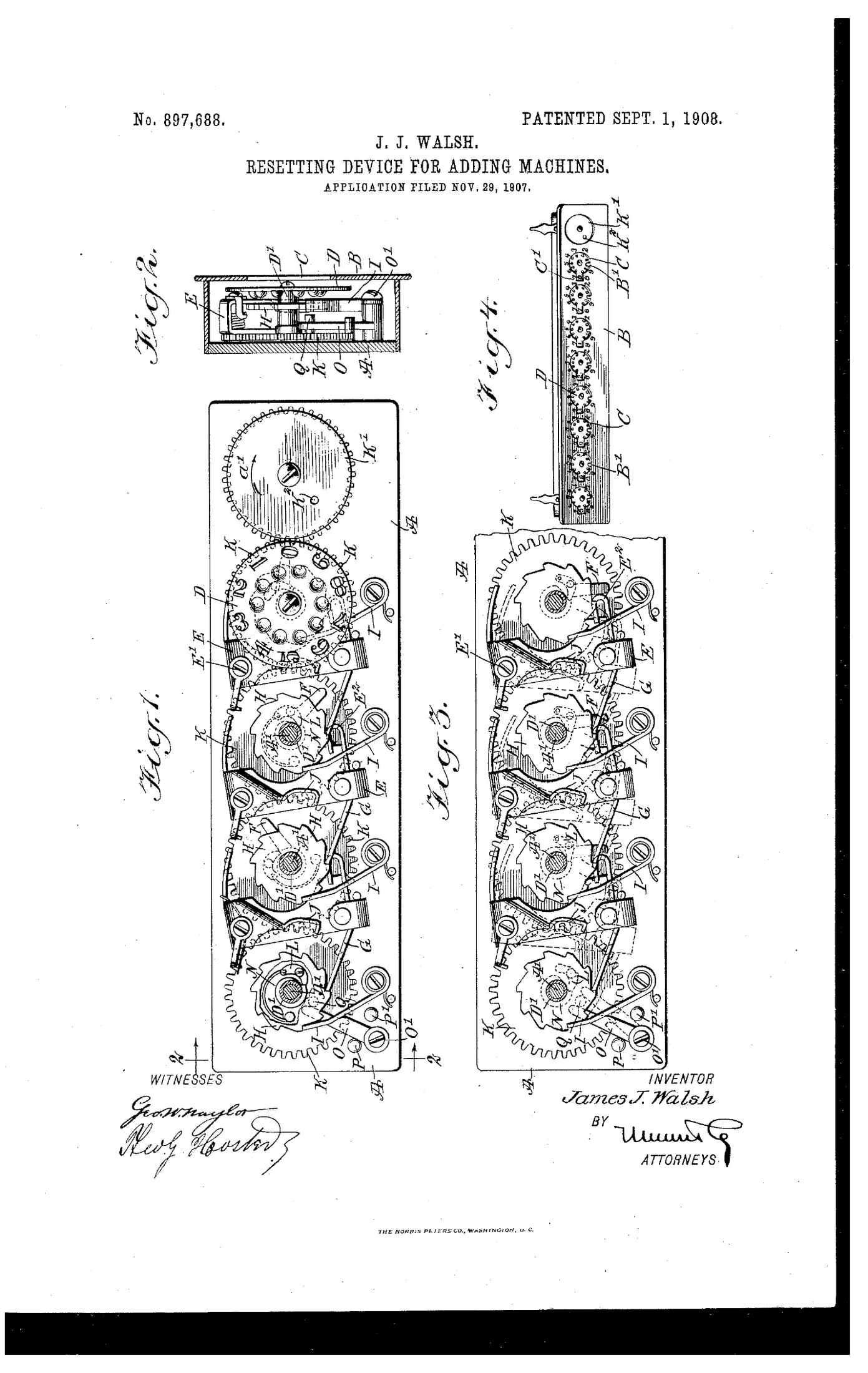
The Calcumeter only added. To subtract, the operator added the ten’s complement. It came with a pencil that had a metal stylus at the other end, and few of those survive.
2.4 Bonham and Schram, Chicago, 1905
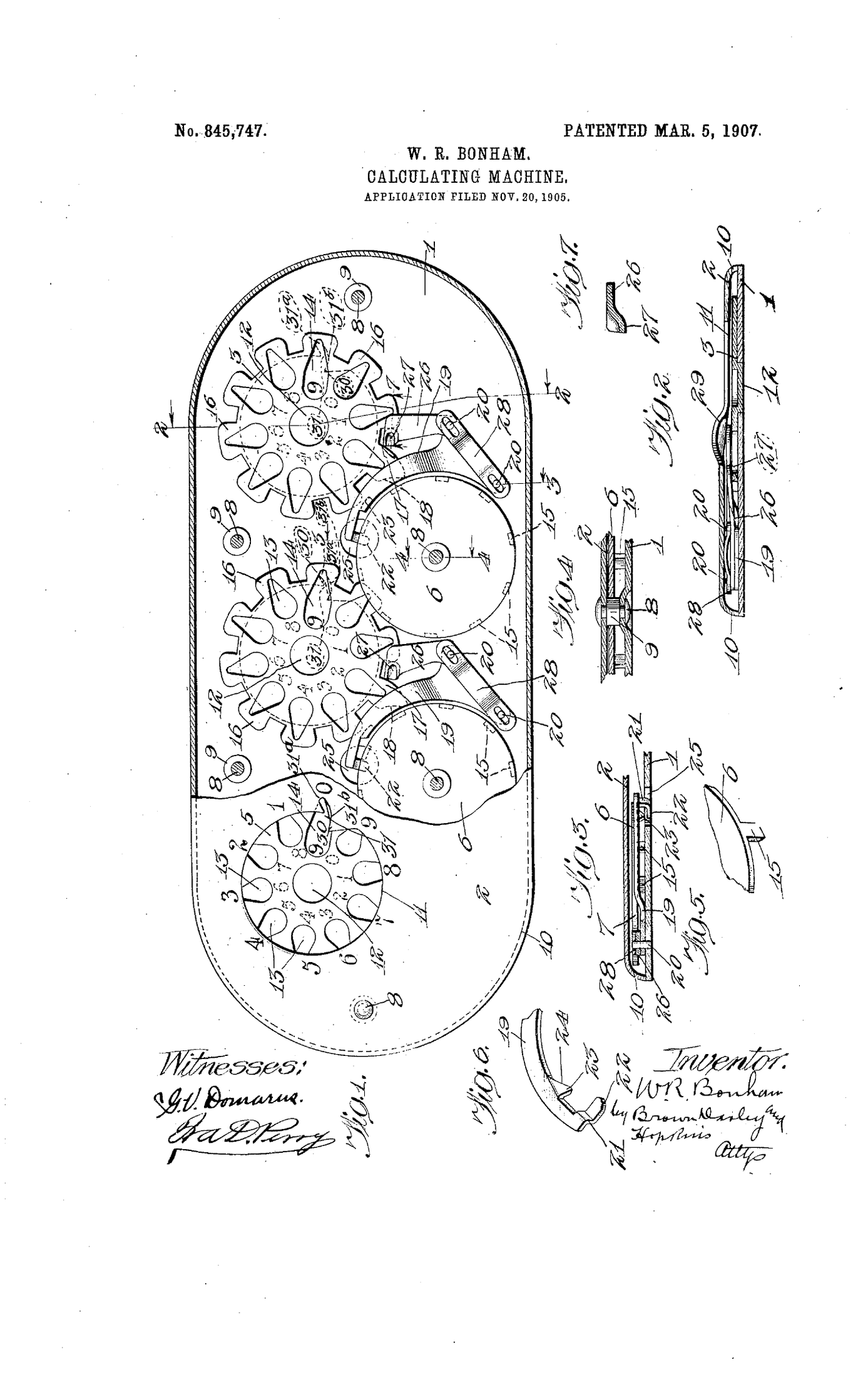
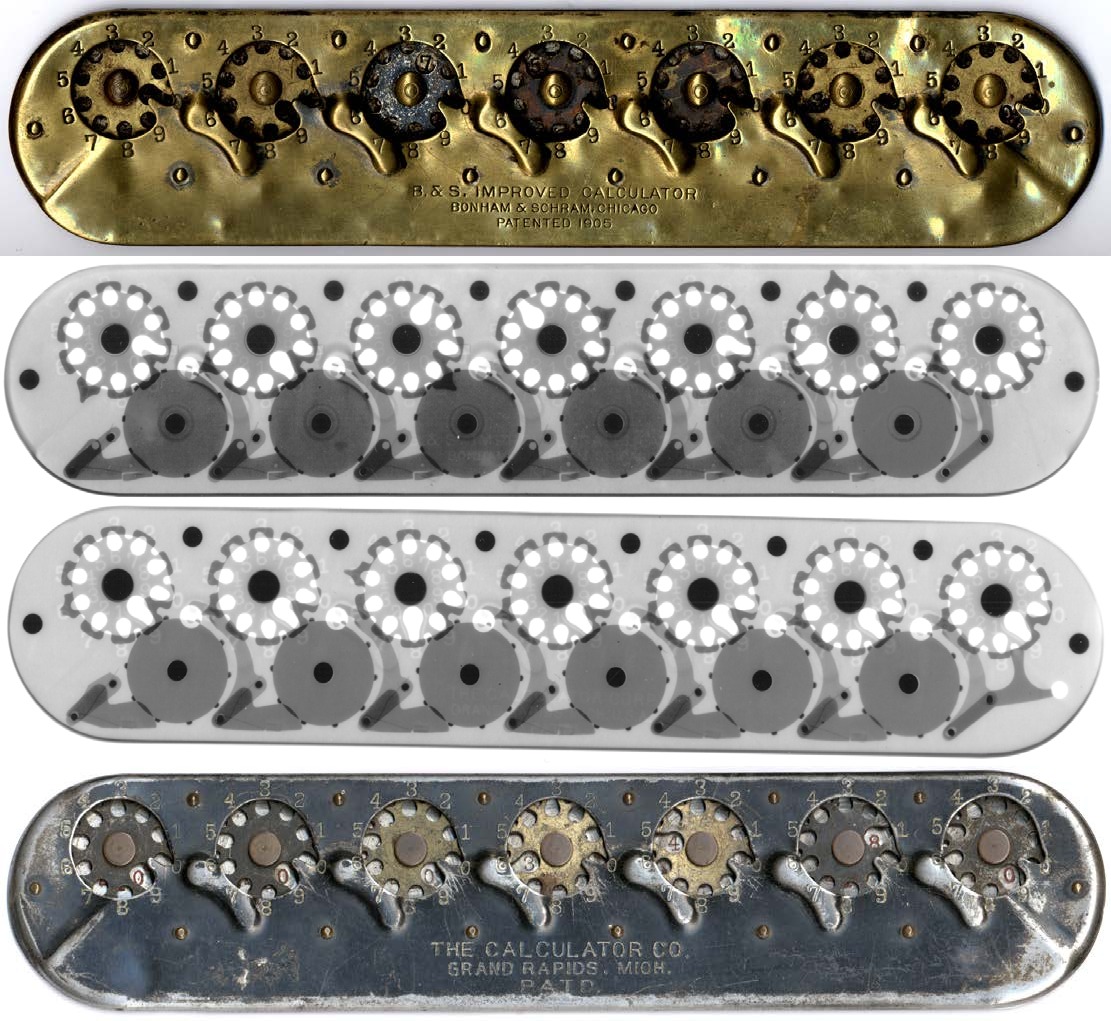
The Lightning’s own line begins with Walter Richard Bonham of Chicago (born 6 February 1871), who filed two patent applications in 1905. By 1917 he was Chicago manager of the Triumph Electric Company. Two-fifths of the first patent was assigned to A. J. Schram of Lake Geneva, Wisconsin, and the machine was sold as the Bonham & Schram “Improved Calculator”. The Lake Geneva News reported “A Promising Invention” on 16 March 1905, and the machine was advertised in Office Appliances in May 1906.
- US 845,747, “Calculating-machine”, filed 20 November 1905, granted 5 March 1907: rotary indicator disks carrying two reversed sets of numerals, one for adding and one for subtracting; carrier disks between them; a spring pawl lock; and a stop on the face plate that the stylus is turned against.
- US 908,731, “Calculating-machine”, filed 6 April 1905, granted 5 January 1909: the carrier-disk carry.
(Otnes’s article prints the second number as “908,371”, which is actually a patent for woven pile fabric, and swaps the two grant dates in its reference list. The Patent Office originals settle both.)
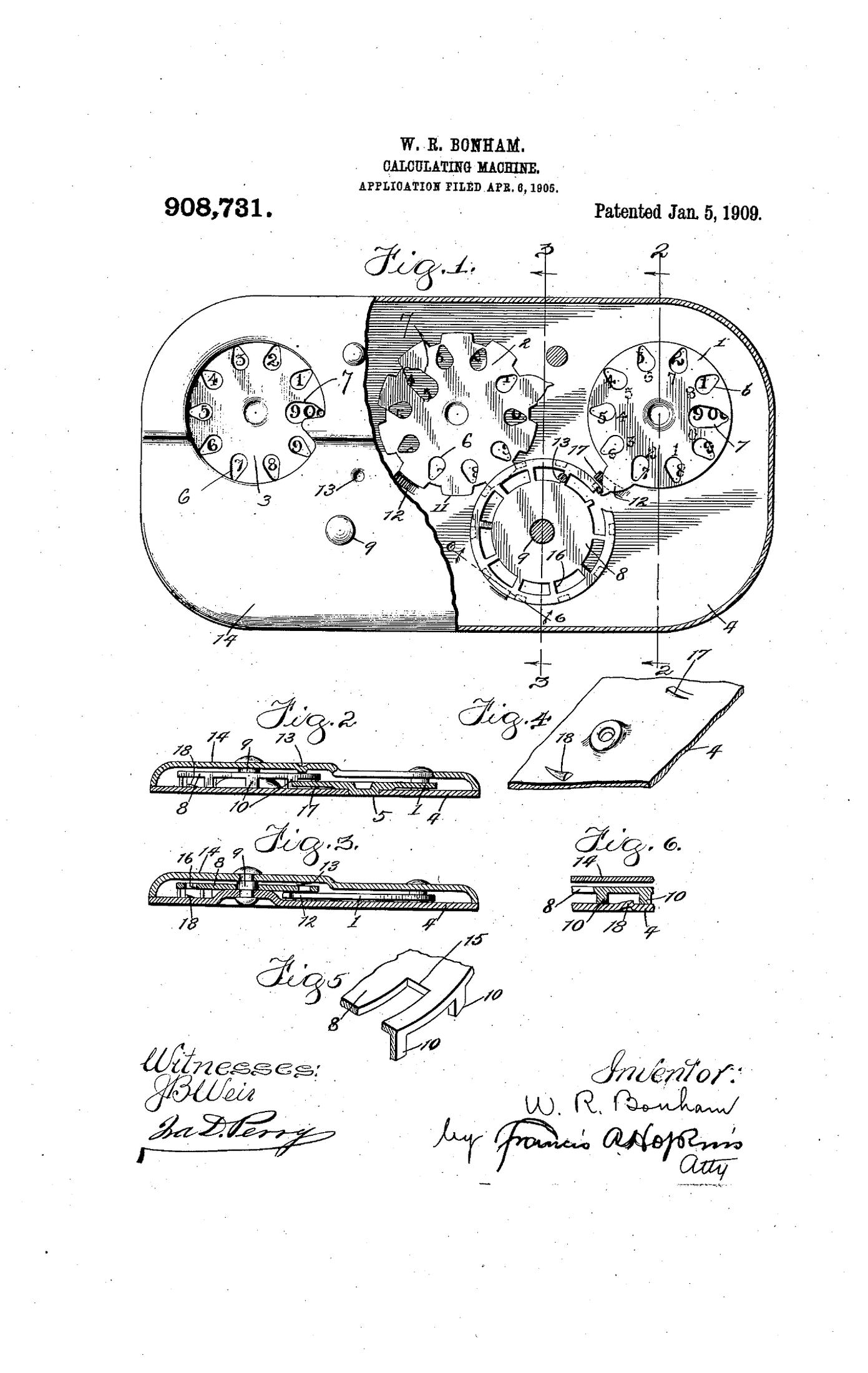
The Bonham & Schram machines Otnes had seen were in plain brass. Their weakness was readability. The result digits were printed on the dials themselves, and because each dial had one elongated hole of its ten, the result position varied from dial to dial, so the answer did not sit in a straight line. Very few examples are known.
2.5 The Calculator, Grand Rapids, 1915–1921
The design next surfaces in Grand Rapids, Michigan, as The Calculator. The city directories trace the company:
Table 1 — The design next surfaces in Grand Rapids, Michigan, as The Calculator. The city directories trace the company
| Years | Name and address | People |
|---|---|---|
| 1915–16 | Calculator Sales Co., 217–218 Fourth National Bank Building | R. Wallace Hook, agency manager |
| 1917 | Calculator Corporation, same building | Hook president; P. O. Hamm secretary-treasurer |
| 1920 | moved to the William Alden Smith Building | |
| 1921 | becomes Lightning Calculator |
Russell Wallace Hook, born in 1891, first appears in 1915 as manager, not owner. Who owned the company is not known. The Calculator was essentially Bonham’s machine, finished in black enamel and mounted on a wooden wedge-shaped stand with a hole to hold the stylus. Its carry worked only clockwise. Ernst Martin, writing in 1925, said that The Calculator, the Pangborn and the Lightning were all made in the same factory. Otnes agrees but adds that the factory “did not belong to any of them”. It appears to have been a Grand Rapids metal-stamping company working to order.
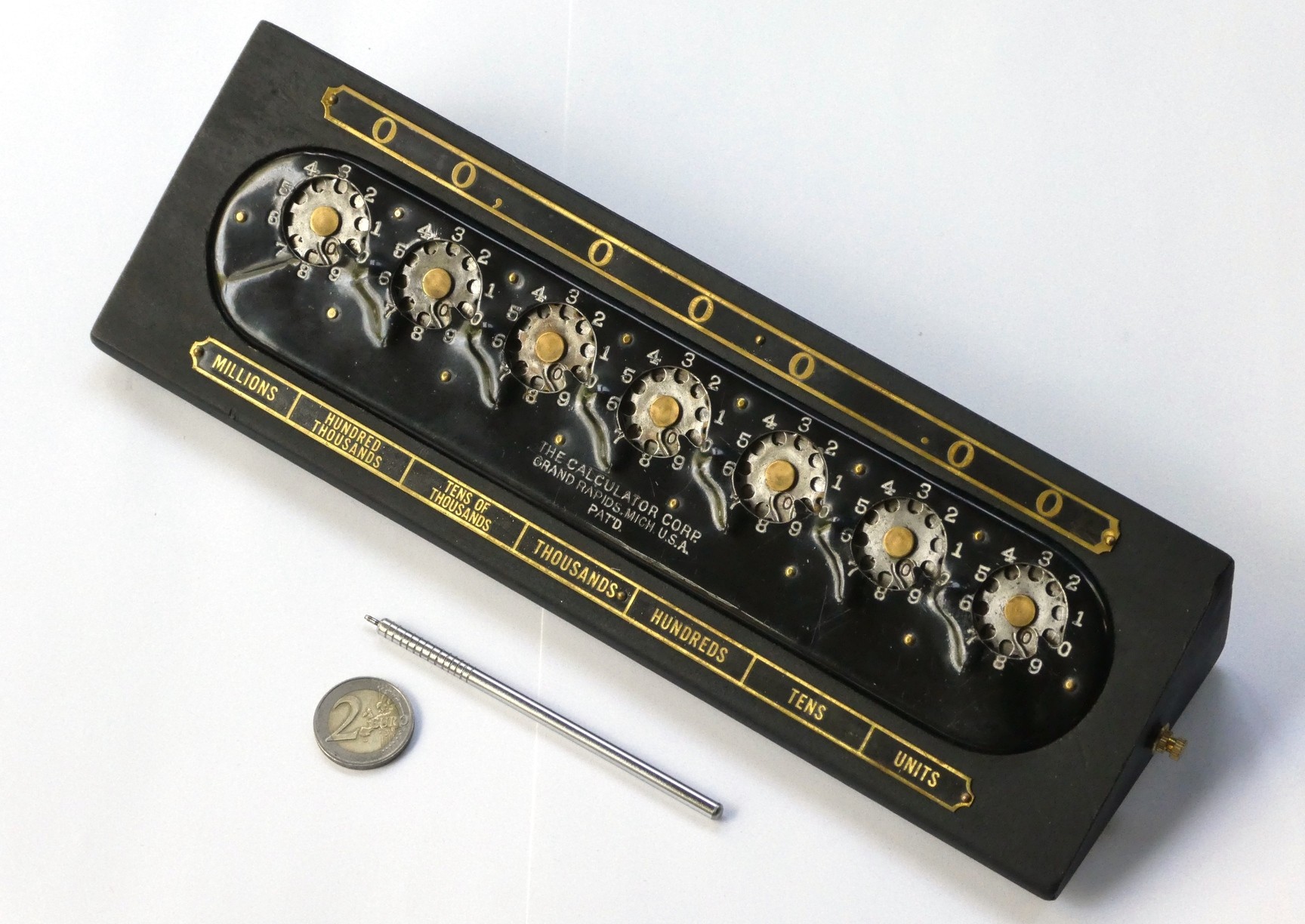
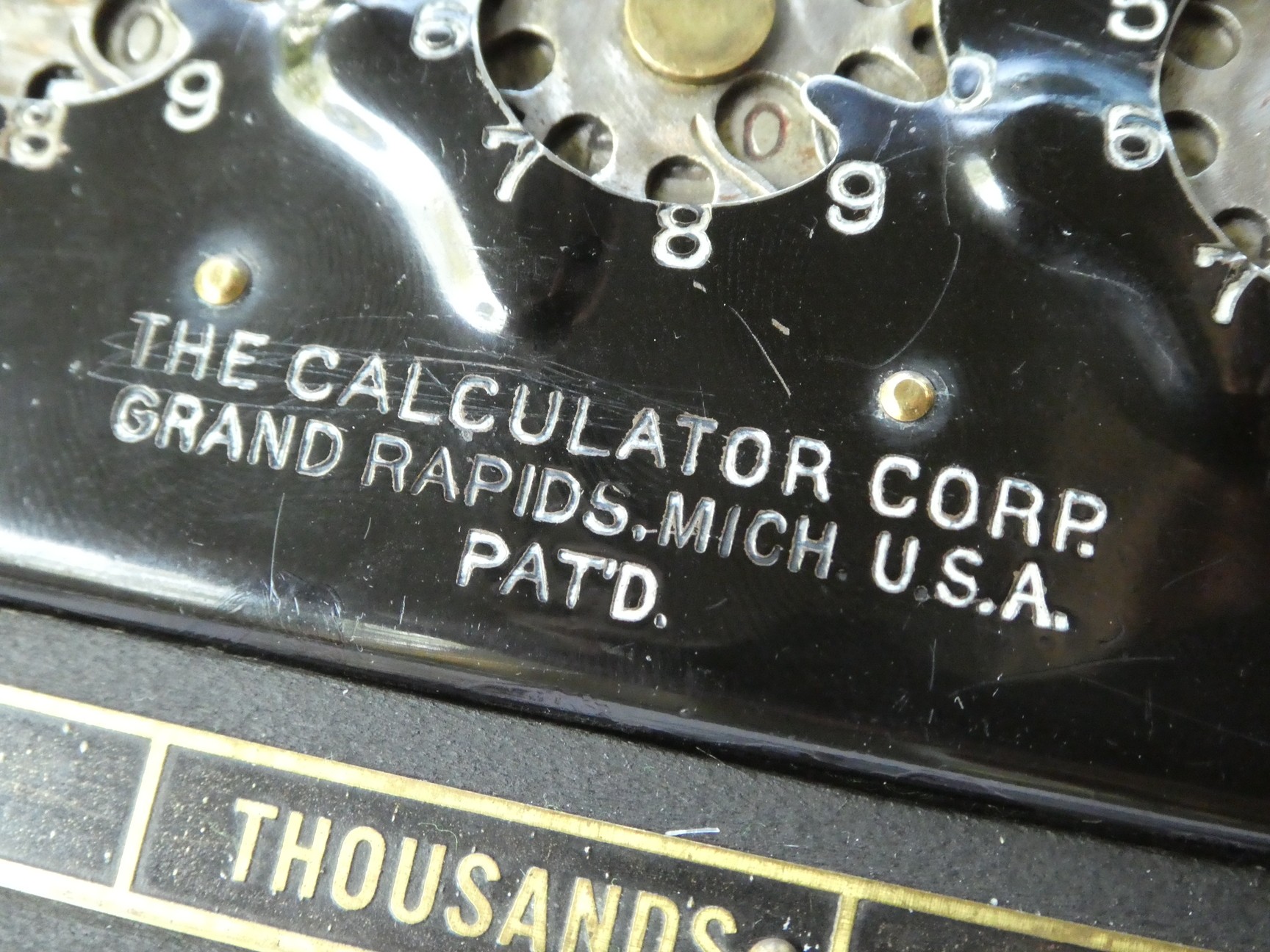
The Calculator was sold the way cheap adders were sold in that era: through magazine advertisements for buyers and for agents. Advertisements ran in the Duluth Herald (13 February 1915), Popular Mechanics (February 1916), Photoplay (January 1917), Popular Science (December 1918, July 1920 and June 1921), the Saturday Evening Post (March and April 1921) and the American Legion Weekly (April 1922), and in newspapers as far away as Perth, New Zealand and Victoria, British Columbia. The July 1920 Popular Science advertisement gives the price as $12.50.
2.6 Pangborn, and a lawsuit
A third Grand Rapids name appears in 1921. The Pangborn Adding Machine Company, at 339 Commerce Avenue SW, Frank C. Pangborn listed in 1922, sold a machine identical to The Calculator but carrying a Pangborn decal, and under the decal “THE CALCULATOR CORP.” can be read. The company is in the directories from 1921 to 1923 and gone by 1924.
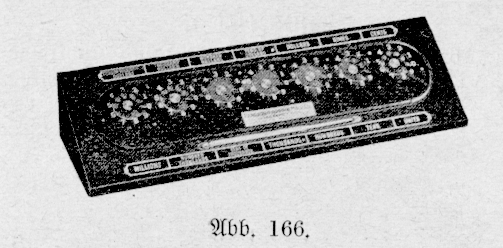
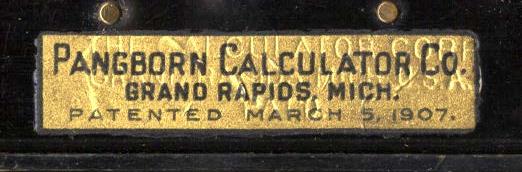
On 8 March 1922 Pangborn sued R. Wallace Hook and The Calculator Corporation in the US District Court for Michigan over the two Bonham patents. Notice of the suit was published in the Official Gazette on 2 May 1922. Its outcome is not known. What is known is that Hook, by then, had a patent application of his own on file, and a new name for his machine.
Comments (0)